
What's inside
As an Amazon Associate I earn from qualifying purchases. This post may contain affiliate links at no extra cost to you.
Best Planer Machines: Benchtop and Stationary Thickness Planers
For most small shops, the best planer machine is a 12- to 13-inch benchtop model with a helical cutterhead if quieter cutting and easier knife changes matter; choose a straight-knife model to spend less, or step up to a stationary 15-inch machine when you regularly plane wide, heavy stock.
The right choice depends less on headline horsepower than on the widest boards you handle, how often you use the machine, and whether your dust collector can keep up. The comparison below focuses on those practical limits. Capacities and weights are manufacturer-published figures; verify the exact configuration before buying, since cutterhead versions and specifications can vary.
As an Amazon Associate we earn from qualifying purchases at no extra cost to you.


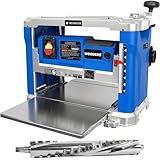
Benchtop or stationary?
A benchtop planer suits a garage or shared shop where floor space is limited and boards are usually narrower than 12 inches. It can be moved or stored, but long boards need infeed and outfeed support, and frequent heavy use can make the lighter frame feel less convenient.
A stationary planer is the better fit for repeated milling, wider boards, and heavier stock. Its mass helps resist vibration, but it needs dedicated floor space and typically requires a 240-volt circuit. Check your electrical service, dust collection, and delivery access as part of the purchase—not after it arrives.
Representative machines compared
| Model | Type and cutterhead | Maximum width | Maximum thickness | Feed rate | Approx. weight | Dust port |
|---|---|---|---|---|---|---|
| DEWALT DW735X | Benchtop, three-knife straight | 13 in. | 6 in. | 96 or 179 cuts per inch settings | About 92 lb. | 4 in. |
| Makita 2012NB | Benchtop, two-knife straight | 12 in. | 6-3/32 in. | 28 ft/min | About 62 lb. | 2-1/2 in. |
| DeWalt DW735 with aftermarket helical head | Benchtop, segmented carbide inserts | 13 in. | 6 in. | Two speed settings; check head compatibility | Varies by configuration | 4 in. |
| JET JWP-15B | Stationary, helical cutterhead | 15 in. | 6 in. | 16 or 20 ft/min | About 500 lb. | 4 in. |
| Powermatic 15HH | Stationary, helical cutterhead | 15 in. | 6 in. | 16 or 20 ft/min | About 500 lb. | 4 in. |
These figures describe different design trade-offs, not a direct ranking. The DW735X is a common high-capacity benchtop choice, while the Makita is lighter and has a smaller dust outlet. The JET and Powermatic are examples of 15-inch stationary machines; confirm current specifications and included accessories with the manufacturer. A retrofit cutterhead is a separate purchase, and compatibility should be checked by exact planer model.
Choose by the work you actually do
| Your situation | Best fit | Why |
|---|---|---|
| Occasional furniture projects, tight budget, limited storage | 12-inch straight-knife benchtop planer | Lowest entry cost; knives are replaceable or resharpenable depending on design. |
| Weekly use, mostly boards under 13 inches, noise-sensitive shop | Benchtop planer with helical head | Staggered inserts can reduce tear-out on difficult grain and avoid changing a full knife set. |
| Frequent milling, wide stock, space and 240-volt power available | 15-inch stationary planer | More stable handling and greater width capacity for production or larger furniture parts. |
| Mostly rough lumber, occasional wide panels, no room for a 500-pound machine | Benchtop planer plus a jointer or flattening workflow | Planer thicknesses parallel faces; it does not flatten a cupped board by itself. |
Straight knives versus helical cutterheads
A straight-knife head uses long blades spanning the cutter width. It is usually less expensive up front and can leave a clean finish on straight-grained stock. Knives eventually dull or nick, and a small defect can leave a line along the board. Replacing or setting blades takes care: uneven projection can cause ridges, poor finish, or unsafe operation.
A helical head uses rows of small, typically carbide inserts set at an angle. The shearing cut often handles figured grain with less tear-out and can run more quietly, though results still depend on grain direction, depth of cut, and feed rate. If an insert gets nicked, rotate or replace that insert rather than removing a full-width blade. The trade-off is higher initial cost and the need to keep the correct replacement inserts on hand.
Neither head eliminates tear-out or maintenance. Avoid deep cuts in figured wood, keep knives or inserts sharp, and make a light finishing pass. A planer is also not a substitute for a jointer: first create one flat face, then plane the opposite face parallel.
Feed rate, dust collection, and real capacity
Feed rate affects the balance between finish and throughput. Some benchtop machines offer a slower setting for more cuts per inch and a finer surface, and a faster setting for rough dimensioning. Stationary models may list feed in feet per minute; compare that number only alongside cutterhead speed and knife or insert arrangement. A faster feed is not automatically better for finish quality.
Dust-port diameter is a compatibility check, not a guarantee of adequate extraction. A 4-inch port is common on larger benchtop and stationary planers; some compact machines use a 2-1/2-inch outlet. A reducer can connect different duct sizes, but the narrow section may restrict airflow. Planer chips are bulky, so use a collector and ductwork capable of moving them without frequent clogging. Keep the hose short where possible, avoid sharp bends, and check the hood for packed chips after use.
Maximum width is not the same as comfortable working width. A nominal 13-inch machine has little margin for a board that is slightly oversized or irregular. Measure your widest finished parts, then allow room for rough-stock variation. Maximum thickness is also only a pass-through limit: a board must be short and stable enough to feed safely, and long stock needs support to prevent snipe or tipping.
Ownership costs and setup details worth checking
- Knives and inserts: Include replacement costs in the budget. Keep a spare set of straight knives or several matching inserts so a nick does not stop a project.
- Rollers and feed surfaces: Dust and resin can reduce grip, leading to slipping or uneven feeding. Clean rollers and wax the table with a suitable non-staining paste wax; keep wax off the rollers.
- Snipe: Slightly deeper cuts at the board ends are common. Support long boards level with the bed, keep pressure on the infeed and outfeed ends as appropriate, and take a final light pass. Test the machine’s head-lock or roller settings if snipe persists.
- Storage and mobility: A benchtop planer still needs a rigid stand and room for long boards. A stationary model needs a stable location, safe chip collection, and enough space to feed stock without obstruction.
As a practical rule, buy for your recurring work rather than the rare widest board. A well-supported 13-inch wood planer machine can serve many small shops; the extra width, mass, and electrical demands of a stationary planer make sense when they solve a regular production bottleneck.