
What's inside
As an Amazon Associate I earn from qualifying purchases. This post may contain affiliate links at no extra cost to you.
The best uv laser engraver for precise material marking in 2026 is, for most buyers, a 5W 355nm air-cooled galvo unit such as the ComMarker Omni 1 UV—powerful enough for permanent, heat-free marks on glass, plastic, and coated metal, without the cost and water-cooling overhead of industrial 10W+ systems. Whether that fits you depends on material, detail tolerance, and daily volume, so this guide breaks down the decision properly.
As an Amazon Associate we earn from qualifying purchases at no extra cost to you.


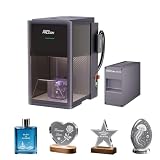
What Makes a UV Engraver Different
UV laser engraving uses a 355nm wavelength—roughly a third of the infrared wavelength used by CO₂ and fiber lasers. That short wavelength marks by photochemical reaction rather than heat, which is why a uv engraver leaves no burn marks, no melted edges, and no micro-cracking on sensitive materials. It’s the technology behind crisp serial numbers on medical plastics and frosted logos on glassware.
Compared to diode and fiber lasers:
- Diode (450nm): Absorbed unevenly; burns or discolors many plastics and can’t mark clear glass.
- Fiber (1064nm): Excellent on bare metal but generates heat that distorts thin plastics and can shatter tempered glass edges.
- UV (355nm): Marks almost everything—glass, ceramics, sapphire, PCB, leather, anodized and coated metals—with a “cold” mark and spot sizes down to roughly 10–20μm.
Comparison: Top UV Laser Engraving Machines for 2026
| Model / Type | Power | Spot Size | Marking Area | Cooling | Typical Price Range | Best For |
|---|---|---|---|---|---|---|
| ComMarker Omni 1 UV | 5W | ~15μm | 70×70mm (up to 150mm with lens swap) | Air | $3,000–$4,000 | Desktop precision, small shops |
| OMTech-style desktop UV (JPT source) | 3W | ~20μm | 110×110mm | Air | $2,000–$2,800 | Entry-level marking, low volume |
| 10W UV galvo (JPT/Inno source) | 10W | ~15μm | 110×110–175×175mm | Air or compact chiller | $5,000–$7,500 | Production runs, deeper glass etching |
| Industrial 15W+ UV with water chiller | 15–20W | ~10μm | 175×175–300×300mm | External water chiller | $10,000+ | Electronics, medical device marking |
Prices move with the UV source brand inside—JPT and Inno Photonics sources command a premium over generic ones but hold pulse stability better over time.
Decision Matrix: Which Power and Format Fits You
| Your Situation | Recommendation | Why |
|---|---|---|
| Budget under $3,000, occasional marking | 3W air-cooled uv laser engraving machine | Cold marks at slower speed; fine for prototypes and gifts |
| Side business engraving glassware, acrylic, phone cases | 5W UV galvo (e.g., Omni 1) | Best speed-per-dollar; air cooling means zero plumbing |
| Need to etch deeper into glass or cut thin plastics | 10w uv laser engraver | 2–3× faster at the same depth; handles volume work |
| Regulated serial marking, daily 8-hour duty | 15W+ with chiller and enclosure | Thermal stability keeps pulse energy consistent all day |
| Mostly bare steel/aluminum parts | Skip UV—buy a fiber marker | Fiber is faster and cheaper on metal; UV’s advantage is heat sensitivity |
Fine-Detail Performance and Speed
A uv laser engraving machine achieves its detail advantage through beam quality: most galvo UV systems resolve line widths under 0.02mm and QR codes down to ~1mm square—something no diode laser can touch. Speed, however, is the trade-off. Expect:
- 3W: 100–300mm/s effective marking; a 25mm logo on glass in 60–120 seconds with multiple passes.
- 5W: Roughly 40–60% faster; same logo in 30–60 seconds.
- 10W: 1,000mm/s+ galvo speeds usable, or fewer passes at lower power for deeper marks.
Rule of thumb: if your marks are surface-level (logos, codes, text), a 5w uv laser engraver is sufficient. Buy 10W for depth or throughput, not for resolution—spot size barely changes between them.
Cooling Requirements
UV sources are less electrically efficient than fiber sources and are sensitive to temperature drift. Under 10W, sealed air cooling is standard and adequate. At 10W and above, verify whether the unit ships with a compact chiller or expects you to add one—an industrial CW-3000/CW-5000 style chiller adds $300–$600 and a maintenance item (distilled water changes every 4–6 weeks). Skipping proper cooling on a 10W source is the most common way buyers shorten a $2,000 laser source to half its rated life.
Ownership Realities: What Wears and What It Costs
- UV source lifespan: Rated around 15,000–20,000 hours, but real-world life drops fast if the unit runs hot or the environment is dusty. Source replacement runs $1,500–$3,000.
- F-theta lens and protective window: The sacrificial window in front of the lens ($20–$60) is a consumable—inspect monthly, replace when hazed or pitted.
- Cost-per-mark example: A 5W system at $3,500 doing 20 marks/day, 250 days/year, over 4 years = $0.175 per mark in hardware, plus trivial electricity (~150W draw). Compare that to outsourced marking at $0.50–$2.00 per part; payback typically lands inside the first year of regular use.
- Common mistakes: Treating UV like a fiber machine (running max power burns the protective coating on lenses), engraving PVC (releases chlorine gas even with UV—avoid it), and marking uncoated glass too fast, which produces faint, frosted-incomplete marks instead of the expected crisp etch.
- Cleaning: Blow dust off the optics rail weekly; clean the protective window with lens tissue and isopropyl only—never abrasives.
Safety Notes
355nm light is invisible, which makes it more dangerous than visible diode lasers—you can’t see the beam or reflections. Always use the enclosed interlock cover or wavelength-rated (OD6+ at 355nm) eyewear, and ventilate the workspace: even “cold” marking of plastics produces fine particulate and VOCs that need extraction, not just an open window.
FAQ
Can a uv laser engraver mark metal?
Yes, on coated, anodized, or lightly surfaced metals it produces excellent fine marks. For deep engraving on bare steel, a fiber laser is faster and cheaper—UV’s strength is heat-sensitive materials.
Is a 10w uv laser engraver worth the extra cost over 5W?
Only for throughput or depth. If you mark dozens of parts daily or need deeper glass etching, yes. For occasional logos and serial numbers, 5W does identical work more slowly for substantially less money.
What’s the difference between uv laser engraving and diode engraving on wood?
UV produces a light, clean mark with minimal charring—good for pale hardwoods and bamboo products where a dark burn isn’t wanted. For the dark, high-contrast marks woodworkers usually want, a diode or CO₂ remains the better (and far cheaper) tool.
Bottom line: Start with a 5W air-cooled galvo UV if you’re marking glass, plastics, or mixed materials at small-business volume. Move to 10W water-cooled only when the speed or depth math justifies it—and always budget for the protective windows and ventilation the listings don’t mention.