
What's inside
- Quick comparison for a compact workshop
- Best enclosed laser engraver for the smallest bench: Glowforge Aura
- Best for speed and larger projects: xTool P2S
- Best compact CO₂ value: OMTech Polar 350
- Best when automation matters: Gweike Cloud Pro
- Decision matrix: match the machine to your workshop
- How to calculate the space you really need
- Filtration versus outdoor exhaust
- Ownership realities: what wears first
- Related Guides
As an Amazon Associate I earn from qualifying purchases. This post may contain affiliate links at no extra cost to you.
For most compact workshops, the best enclosed laser engraver is the Glowforge Aura for simple diode-laser projects, the xTool P2S for faster cutting and larger work, and the OMTech Polar 350 when you want a compact CO₂ machine with more hands-on control.
The right choice depends less on headline laser power than on four practical questions: how much bench space the enclosure consumes, how much material actually fits inside, whether fumes are filtered or exhausted outdoors, and how easily you can load awkward sheets, bottles, and thick stock.
As an Amazon Associate we earn from qualifying purchases at no extra cost to you.
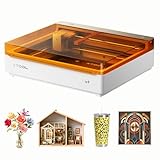


Quick comparison for a compact workshop
| Machine | Laser type | Approx. machine footprint | Usable work area | Fume approach | Loading advantage |
|---|---|---|---|---|---|
| Glowforge Aura | 6W diode | 17.5 × 20.75 in; about 5 in high | 12 × 12 in | Integrated filtration system; filter replacement required | Compact front-loading format; suitable for small flat materials |
| xTool P2S | 55W CO₂ | Approx. 39 × 25 × 10 in | 23.6 × 12 in | Exhaust fan and ducting; optional purifier depending on setup | Pass-through capability for long stock, plus rotary accessories |
| OMTech Polar 350 | 50W CO₂ | Approx. 37 × 21 × 10 in | 20 × 12 in | Rear exhaust port; external ducting normally required | Front door and removable or adjustable work support on some configurations |
| Gweike Cloud Pro | 50W CO₂ | Approx. 38 × 26 × 10 in | 20 × 12 in | Integrated exhaust and filtration options vary by package | Motorized features and rotary compatibility for cylindrical objects |
Dimensions and included accessories can change between regional versions, so measure the exact model before ordering. Also allow at least 4 to 8 inches behind a machine with an exhaust outlet, plus room to open the lid or front door and remove the workpiece.
Best enclosed laser engraver for the smallest bench: Glowforge Aura
The Aura is the easiest fit when your workshop is short on depth and you mainly engrave plywood, leather, paper, acrylic approved by the manufacturer, and other thin craft materials. Its 12-by-12-inch work area is modest, but the enclosure is much easier to accommodate than a full-size CO₂ cabinet.
Its filtration system is useful for apartments, spare rooms, and workshops where routing a duct through a wall is impractical. That does not make every material safe to process: PVC, vinyl, unknown plastics, and treated or coated materials can release dangerous gases or corrode the machine. Filtration also creates an ownership cost because the filter eventually needs replacement.
The limitation is cutting speed and thickness. A low-power diode laser is a sensible choice for occasional signage, ornaments, labels, and thin panels, but it is not the efficient choice for frequent production or thick wood. The compact enclosure also gives you less flexibility with large sheets and tall objects.
Best for speed and larger projects: xTool P2S
The xTool P2S is the stronger all-round choice when a compact workshop can spare roughly a 40-by-30-inch operating zone. Its 55W CO₂ source works on a wider range of nonmetal materials and cuts much faster than a small diode machine. The approximately 23.6-by-12-inch bed is long enough for many cabinet labels, boxes, signs, and layered decorations.
Its major space-saving feature is pass-through work. Instead of requiring a full-size sheet to fit inside the enclosure, you can process longer stock in sections, provided the material is supported safely and the software is aligned correctly. This is particularly valuable for narrow boards and trim.
The P2S is not truly plug-and-play from a ventilation perspective. A ducted exhaust route is preferable, and an optional air purifier may be useful where outdoor venting is restricted. Before buying, check whether your room permits a window adapter, wall penetration, or a suitable flexible duct route. A purifier adds both purchase cost and filter-replacement expense.
Best compact CO₂ value: OMTech Polar 350
The OMTech Polar 350 offers a familiar 50W CO₂ format in a cabinet roughly 37 inches wide and 21 inches deep. It is attractive to owners who want more cutting capability than a diode engraver without moving to a floor-standing industrial machine.
Compared with a highly automated consumer machine, the Polar typically demands more involvement. You must pay attention to exhaust routing, cooling, alignment, lens and mirror cleanliness, and maintenance of the water-cooling system. That makes it a better fit for an experienced maker—or a beginner willing to learn basic laser-machine care—than for someone seeking a sealed appliance.
The bed is approximately 20 by 12 inches, which is productive for small-batch work but not generous for furniture panels. Its front access is convenient for ordinary sheets, while cylindrical or unusually tall objects may require a compatible rotary attachment and removal of internal supports.
Best when automation matters: Gweike Cloud Pro
The Gweike Cloud Pro occupies a similar category to the Polar: an enclosed 50W CO₂ machine with a roughly 20-by-12-inch work area. It is worth considering when you prefer guided software features, camera-assisted positioning, and a more appliance-like workflow.
Its practical weakness is not necessarily laser performance but the total installation footprint. The cabinet, rear exhaust path, computer or network setup, and clearance around the lid can consume much more space than the published dimensions suggest. Confirm whether the specific package includes filtration, a rotary tool, an air assist system, and the exhaust hardware you need; bundles vary.
Decision matrix: match the machine to your workshop
| Your situation | Best fit | Why | Main compromise |
|---|---|---|---|
| Less than 24 inches of usable bench depth | Glowforge Aura | Small footprint and internal filtration | Small bed and slower cutting |
| Weekly cutting of boxes, signs, or layered panels | xTool P2S | Fast CO₂ cutting and larger work area | Needs a serious exhaust plan |
| Lowest-cost route into compact CO₂ work | OMTech Polar 350 | Strong capability per cabinet-sized footprint | More maintenance and setup responsibility |
| Frequent camera-positioned jobs and guided workflow | Gweike Cloud Pro | Automation-oriented controls and enclosed design | Package and ventilation details require careful checking |
How to calculate the space you really need
Do not compare cabinet dimensions alone. Use this simple footprint calculation:
Required depth = machine depth + rear ventilation clearance + front loading clearance.
For example, a 25-inch-deep machine with 6 inches behind it for ducting and 18 inches in front for loading needs about 49 inches of clear depth. If it sits on a 24-inch-deep bench, the rear duct may protrude into a walkway or require a bend that restricts airflow.
For an enclosed machine with a 12-by-20-inch bed, also reserve a separate storage area for 20-by-12-inch sheets. Storing material vertically beside the machine can be more space-efficient than stacking it on the bench, but keep combustible stock away from hot surfaces and electrical equipment.
Filtration versus outdoor exhaust
Internal filtration is convenient, but it is not maintenance-free. Activated-carbon and particulate filters gradually load with smoke and odor; a clogged filter can reduce airflow and leave residue inside the enclosure. Ducted exhaust generally handles smoke more effectively, but it must terminate safely outdoors and should not discharge near windows, air intakes, or neighboring properties.
Never assume an enclosure makes an unsuitable material safe. Avoid PVC, vinyl, ABS, unknown painted plastics, and materials containing chlorine or other hazardous additives. Use the manufacturer’s material guidance, keep the lid closed during operation, and provide supervision rather than treating the machine as unattended equipment.
Ownership realities: what wears first
- Diode machines: expect gradual optical-output decline over long use and contamination of the lens or protective window from smoke.
- CO₂ machines: mirrors, lenses, water-cooling components, belts, and exhaust paths need periodic inspection and cleaning.
- Air-assist hardware: compressors and tubing accumulate dust and moisture; weak airflow causes more scorching and poorer cuts.
- Filters: replacement intervals depend on material, power, and frequency, so budget them as consumables rather than assuming a one-time cost.
- Bed surfaces: honeycomb panels and support pins collect resin and soot. Dirty supports can transfer marks to the underside of work.
For compact workshops, the best purchase is the machine whose ventilation and loading method you can use correctly every time. Choose the Aura when minimal footprint and filtration outweigh speed; choose the P2S when pass-through capacity and fast production justify ducting; and choose the Polar 350 or Cloud Pro when you want compact CO₂ performance and are prepared for more involved ownership.