
What's inside
- Laser stone engraving machine prices by setup
- Which laser type should you budget for?
- How stone type changes the price decision
- Marking area and rotary fixtures: the hidden cost of flexibility
- Choose by situation, not by maximum wattage
- A simple cost-per-use calculation
- Ownership costs and maintenance realities
- Bottom line
- Related Guides
As an Amazon Associate I earn from qualifying purchases. This post may contain affiliate links at no extra cost to you.
In 2026, a realistic laser stone engraving machine price is about $2,000–$6,000 for shallow personalization, $6,000–$18,000 for a more capable small-business setup, and $20,000–$60,000 or more for production equipment with a large bed, automation, extraction, and installation.
The right budget depends less on the word “laser” than on five specifications: laser type, power, marking area, stone surface, and whether you need a rotary fixture. A low-cost machine can mark slate coasters and polished granite, but it is not automatically suitable for deep monument engraving or daily production.
As an Amazon Associate we earn from qualifying purchases at no extra cost to you.
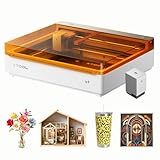

Laser stone engraving machine prices by setup
| Typical setup | Laser and power | Useful work area | Approximate 2026 machine price | Best suited to |
|---|---|---|---|---|
| Entry-level personalization | Diode, 10–20 W optical output | 400 × 400 mm | $700–$2,500 | Slate, coated stone, signs, occasional work |
| Enclosed small-business unit | CO2, 40–60 W | 400 × 600 mm | $3,000–$8,000 | Polished stone, slate, tile, gifts, short runs |
| Large-format CO2 system | CO2, 80–150 W | 600 × 900 to 1,300 × 900 mm | $8,000–$25,000 | Signs, plaques, batches, larger slabs |
| UV marking system | UV, 5–15 W | 110 × 110 to 300 × 300 mm | $8,000–$25,000 | Fine, low-heat marks on selected stone and finished surfaces |
| Production stone shop | CO2, 100–300 W or integrated automation | 900 × 600 mm and larger | $20,000–$60,000+ | Frequent production, commercial signage, repeatable workflows |
These are broad equipment ranges, not quotations. Chillers, exhaust systems, air assistance, lenses, installation, shipping, software, and taxes may be separate. A seemingly inexpensive open-frame machine can therefore cost substantially more after it is made safe and suitable for regular indoor use.
Which laser type should you budget for?
Diode lasers: lowest entry cost
Blue diode machines are attractive because their purchase price and power consumption are modest. They can produce useful contrast on dark slate, painted stone, and some coated surfaces. They are a reasonable choice for names, logos, house signs, coasters, and small decorative pieces.
The limitation is optical power. Natural granite, marble, and pale stone may show weak contrast, uneven results, or little visible change unless the surface has been coated or treated. Open-frame diode machines also require careful enclosure and fume management. Budget roughly $1,000–$3,500 for a practical diode setup after adding an enclosure, extraction, air assist, honeycomb or slat bed, and basic fixturing.
CO2 lasers: the general-purpose choice
CO2 systems are the most common all-round option for stone marking. A 40–60 W unit is often enough for shallow engraving, contrast marking, and moderate batches. An 80–150 W system gives faster passes, a larger usable area, and more headroom when the surface is inconsistent.
For a small shop, a 60 W enclosed CO2 machine with a 400 × 600 mm bed is often a sensible middle ground. Expect approximately $4,000–$10,000 for the machine and essential accessories. Water cooling, an exhaust fan, ducting, a rotary attachment, and spare optics can add another $800–$3,000.
Higher wattage does not automatically create deeper engraving. It mainly allows faster processing or more energy per pass. Stone composition, polish, focus, scan speed, pulse settings, and air flow still determine the result.
UV lasers: precision at a premium
UV systems use shorter wavelengths and can mark some materials with a smaller heat-affected area. They are appealing for detailed artwork, small lettering, and finished surfaces where excessive heat could cause discoloration or cracking. However, a UV machine is not the economical default for large granite plaques. Its smaller work area and higher purchase price make it better suited to precision work than high-volume slab processing.
Fiber lasers are excellent for metals but are generally not the first choice for direct engraving of ordinary stone. A fiber system may mark a coated metal plaque mounted on stone, but buying one solely for natural-stone engraving is usually a mismatch.
How stone type changes the price decision
- Slate: Usually the easiest and most economical material for visible contrast. A diode or 40 W CO2 machine can be sufficient for personalization.
- Granite: Hard, variable, and often polished. A granite engraving machine price should be judged alongside wattage, exhaust, cooling, and bed size. For occasional plaques, a 60–100 W CO2 system is commonly more practical than a low-power diode.
- Marble: Can produce attractive marks, but veining and surface finish affect consistency. Test samples before promising a particular darkness or texture.
- Quartz and engineered stone: Formulations vary. Some contain resins or coatings that behave differently under heat and may create unpleasant fumes. Confirm the material’s safety data and test with the supplier.
- River rock and irregular stone: The challenge is focus, not only power. A height-adjustable bed, rotary fixture, or 3D positioning method may matter more than another 20 W of laser power.
Laser engraving usually produces a surface mark or shallow ablation. It is not equivalent to deep CNC carving. If a customer needs a deeply recessed cemetery inscription or a mechanically cut channel, compare the cost with a CNC router, abrasive engraving system, or hand-finishing process.
Marking area and rotary fixtures: the hidden cost of flexibility
A 300 × 300 mm marking area may be adequate for a coaster or small plaque but too small for a 12 × 18 inch sign. Measure the largest finished workpiece, then leave room for clamps, registration, and edge clearance. A useful rule is to choose a bed at least 50 mm wider and longer than the largest routinely engraved design whenever the workshop has space.
Rotary fixtures commonly add about $250–$1,500, depending on whether they are designed for tumblers, cylinders, irregular objects, or heavier stone pieces. They are valuable for cylindrical memorial pieces, stone bottles, columns, and rounded decorative work. They do not make a rough stone automatically focusable: the object still needs a reasonably consistent surface height, stable support, and a safe rotation path.
Choose by situation, not by maximum wattage
| Your situation | Recommended starting point | Likely total budget | Why |
|---|---|---|---|
| Under 20 pieces per month, mostly slate gifts | 10–20 W diode in a proper enclosure | $1,200–$3,500 | Low running cost and adequate for shallow contrast marks |
| Several orders each week, mixed stone sizes | 40–60 W enclosed CO2, 400 × 600 mm bed | $4,500–$11,000 | Better speed, focus control, and material flexibility |
| Large plaques or repeated batches | 80–150 W CO2, 600 × 900 mm or larger | $10,000–$30,000 | Less repositioning and shorter cycle times |
| Fine detail on premium finished surfaces | 5–15 W UV system | $10,000–$28,000 | Precision and lower thermal impact justify the premium |
| Daily commercial production | Industrial CO2 with automation and service support | $25,000–$60,000+ | Designed for uptime, repeatability, and operator efficiency |
A simple cost-per-use calculation
Suppose a $7,500 CO2 setup, including extraction and a rotary fixture, produces 1,500 saleable pieces over three years. The equipment portion is $5 per piece before labor, electricity, packaging, maintenance, and material waste. If the same machine produces 6,000 pieces, that portion falls to $1.25 per piece.
This is why a cheaper diode can be the better choice for occasional personalization, while a CO2 machine becomes financially sensible when orders are frequent or processing time affects customer delivery. Also account for failed samples: testing one tile from each new stone batch is cheaper than redoing a finished plaque.
Ownership costs and maintenance realities
- Optics wear first: Smoke and stone dust can cloud lenses and mirrors, reducing power at the work surface. Clean them according to the manufacturer’s procedure and replace damaged optics rather than increasing power blindly.
- CO2 tubes are consumables: Glass tubes may last roughly 1,000–3,000 operating hours depending on quality, cooling, settings, and duty cycle. Replacement commonly costs hundreds to several thousand dollars.
- Extraction is essential: Stone dust, coatings, and adhesives can contaminate the machine. Use suitable filtration and ducting, and never assume a small desktop fan is adequate.
- Cooling matters: Water-cooled CO2 machines need a stable chiller or correctly maintained cooling loop. Overheating shortens tube life and causes inconsistent output.
- Focus errors are common: A stone surface that varies by only a few millimeters can noticeably change line width and contrast. Use a height gauge, a reliable autofocus system, or a fixture that supports the work evenly.
Bottom line
For shallow names, logos, and occasional slate or stone personalization, budget around $1,200–$3,500 for a diode setup or $4,500–$11,000 for a more capable CO2 machine. For granite plaques, larger work, and regular orders, the practical range begins around $8,000–$15,000 and rises with bed size, wattage, automation, and service support. Production shops should budget $20,000 or more and select for uptime rather than headline laser power.
The best purchase is the smallest enclosed system that accommodates your largest stone, provides enough speed for your order volume, and includes proper extraction, cooling, and fixturing. Sample the exact stone before committing: surface finish and mineral variation can matter as much as the listed laser wattage.