
What's inside
As an Amazon Associate I earn from qualifying purchases. This post may contain affiliate links at no extra cost to you.
Quick Answer: Which Mortiser Should You Buy?
For most furniture makers, a benchtop mortiser like the Jet JBM-5 (roughly $300–$450) handles mortises up to 1/2 inch wide and covers 90% of chair, table, and cabinet joinery. Step up to a floor-standing machine like the Powermatic 719T if you regularly cut 3/4-inch or larger mortises in hardwoods thicker than 4 inches, or if you produce doors and timber-frame work where a 1 hp motor and heavy cast-iron table earn their floor space. If you’re not sure what a mortiser is: it’s a dedicated machine that drives a hollow chisel and auger bit downward to punch square holes (mortises) for mortise-and-tenon joints — the strongest joint in furniture making.
Benchtop vs. Floor-Standing: The Real Differences
A wood mortiser’s job looks simple — plunge, square hole, retract — but the differences between benchtop and floor models show up in four places that matter to your joinery.
As an Amazon Associate we earn from qualifying purchases at no extra cost to you.


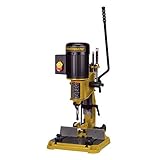

Chisel capacity. Benchtop mortisers typically accept chisels from 1/4 inch to 1/2 inch. That’s enough for chair rails, table aprons, and face frames. Floor machines like the Powermatic 719T accept up to 3/4 inch and sometimes 1 inch, needed for entry doors, bed rails, and structural joinery. Going past a machine’s rated chisel size is the fastest way to stall a motor or break an auger.
Motor torque. Benchtop units run 1/2 to 3/4 hp induction motors. Fine in white oak at moderate feed rates; they bog down in dense stock like hard maple or ipe. Floor models run 1 hp or more, sometimes 3-phase-capable, and push through without complaint.
Table and fence stability. This is where budget machines quietly cost you accuracy. A mortise is only as good as the fence holding the stock square. Benchtop machines have lighter castings and shorter fences; under heavy downward force, flex shows up as a mortise wall that’s slightly out of plumb. Floor machines use longer fences, heavier tables (often 60+ lbs of cast iron), and front-mounted hold-downs that stay put.
Fence travel and depth stop range. Fence travel determines how far from the board edge you can place a mortise — critical for offset joinery in wide stiles. Depth stop repeatability determines whether ten mortises are identical or nine-and-a-bit. Look for a micro-adjustable depth stop; slotted-bolt stops drift over a production run.
Spec Comparison: Real Machines, Real Numbers
| Machine | Type | Motor | Max chisel | Stock capacity (H x W) | Table size | Weight | Typical price range |
|---|---|---|---|---|---|---|---|
| Jet JBM-5 | Benchtop | 1/2 hp, 1,725 rpm | 1/2 in | ~5 in H under chisel | 13-1/2 x 8 in approx. | ~95 lbs | $300–$450 |
| Powermatic 701 | Benchtop | 1/2 hp | 1/2 in | ~4-3/4 in H | Tilting table, similar footprint | ~100 lbs | $400–$600 |
| Grizzly G0645 | Benchtop | 1/2 hp | 1/2 in | ~5-1/2 in H | Compact | ~90 lbs | $275–$400 |
| Jet 719-series / JBM-5 upgrade path | Benchtop+ | 3/4 hp class | 5/8 in | Larger headroom | Larger | 120+ lbs | $500–$800 |
| Powermatic 719T | Floor-standing | 1 hp, tilting head | 3/4 in | ~9 in H, wide fence travel | ~20 x 8 in with gas-cylinder tilt | ~300 lbs | $1,800–$2,600 |
| Generic import floor models | Floor-standing | 1–1.5 hp | 3/4 in | Variable | Variable | 250–350 lbs | $1,200–$2,000 |
Specs are manufacturer-published ranges; verify current figures before purchase, as models are periodically revised.
Decision Matrix: Match Your Situation
| Your situation | Best choice | Why |
|---|---|---|
| Hobbyist, garage shop, chairs and tables, occasional use | Benchtop (Jet JBM-5, Grizzly G0645) | 1/2-inch chisels cover apron and rail joinery; stores on a shelf or mobile base |
| Serious furniture maker, weekly use, white oak and maple | Benchtop with 3/4 hp, or entry floor model | Torque headroom prevents stalling; better fence pays off across hundreds of joints |
| Doors, beds, timber work, production runs | Floor-standing (Powermatic 719T class) | 3/4-inch chisels, 1 hp, stable fence under heavy feed pressure |
| Budget under $150, occasional mortises | Drill-press mortising attachment | Slower and less precise, but works; budget for chisel sharpness |
| Already own a router setup | Consider spiral-bit router mortising | Routers round the ends — fine if you also round the tenon; mortisers give square corners automatically |
What to Inspect Before Buying
- Chisel shank standard. Most machines use chisels with a 3/4-inch collar and auger bits with a 19/32-inch or 5/8-inch shank. Confirm the machine accepts standard aftermarket chisels — proprietary fittings lock you into one supplier.
- Hold-down quality. A cam-action hold-down that clamps stock to the fence is worth real money. The single most common cause of sloppy mortises is stock lifting or drifting during the plunge.
- Fence travel. For furniture-sized stock (stiles and rails 2–4 inches wide), you want at least 3 inches of fence adjustment so mortises can be centered or offset without shimming.
- Return spring and handle. Long handles give leverage on big chisels. On benchtop machines, bolt them to a stable surface — a 90-lb machine walking across the bench under load is a real failure mode.
Ownership Realities Listings Don’t Mention
Chisels wear before anything else. The hollow chisel takes the abuse; expect to sharpen or replace it periodically, especially in hard woods. Budget $25–$60 per quality chisel. Sharpen the inside with a cone-shaped diamond hone and keep the auger bit’s spur trimmed.
Chip ejection is the maintenance task. Chips pack between auger and chisel wall, generate heat, and burnish mortise walls. Set the auger-to-chisel gap at about 1/32 to 1/16 inch — too tight and it binds, too loose and chips don’t clear. This 30-second adjustment is the difference between clean mortises and burnt ones.
Common mistakes: plunging the full depth in one pass (take overlapping passes of half the chisel width), mortising across grain tear-out zones without a backer, and skipping the fence-to-chisel squareness check after moving the machine. Check squareness with an engineer’s square against the chisel face before every session — it takes 60 seconds and saves a stile.
Cost per use math. A $400 benchtop mortiser over 10 years at even 50 projects works out to roughly $8 per project plus chisels — cheap insurance versus hand-chopping. A $2,400 floor machine needs roughly 300 furniture projects to hit the same rate, which is why it only makes sense for production or big joinery.
FAQ
Can I just use a drill press with a mortising attachment?
Yes, for occasional work under 1/2 inch. Dedicated mortisers have geared-down handles with more leverage, better fences, and rigid heads — the attachment works but is slower and demands more downward force from you.
Is a Jet mortiser enough for hardwood furniture?
The JBM-5 is the standard recommendation for hardwood furniture work at 1/2 inch and under. In dense exotics, take shallower passes or step up to a 3/4 hp machine.
Benchtop mortiser vs. a Domino — which is better?
Different joints. A mortiser makes true rectangular mortises for traditional tenons; a Domino uses loose tenons. For chairs and heirloom furniture, traditional mortise-and-tenon remains the stronger, repairable joint.