
What's inside
- Best Hobby CNC Routers for Beginners and Home Shops
- Shortlist by situation
- Comparison: size, setup, and realistic ownership cost
- How they handle plywood, hardwood, and plastics
- Choose by budget, space, and how often you’ll cut
- What a first project really costs
- Setup details that separate clean results from frustrating ones
- Ownership realities to budget for
- Related Guides
As an Amazon Associate I earn from qualifying purchases. This post may contain affiliate links at no extra cost to you.
Best Hobby CNC Routers for Beginners and Home Shops
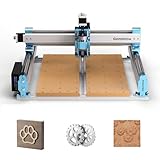
The best hobby CNC router for most beginners is a rigid, supported machine with a roughly 400 × 400 mm working area, straightforward assembly, and a standard trim-router mount—not the largest machine your budget can buy. For small signs, templates, and plywood parts, the Genmitsu 3018-PRO is a low-cost entry point; for more capable woodwork, compare the Shapeoko 4 and Onefinity Woodworker, budgeting for the router, bits, dust collection, and workholding as well as the machine.
Shortlist by situation
- Lowest-cost way to learn: SainSmart Genmitsu 3018-PRO. Its compact work area suits engraving, small signs, and light cuts. It is not a substitute for a full-size woodworking router.
- Best balanced enclosed-style choice: Carbide 3D Shapeoko 4. Its larger work area and established desktop CNC workflow suit regular home-shop projects, though the footprint and full setup cost are substantial.
- Best for a larger, open-frame workspace: Onefinity Woodworker. Its rail-based design can accommodate longer workpieces than many desktop frames, but you need to plan and build a suitable table and enclosure or guarding.
These machines occupy different price and capability tiers, so compare the exact configuration available in your region. A spindle, router, controller, wasteboard, enclosure, and software license may be included—or sold separately.
As an Amazon Associate we earn from qualifying purchases at no extra cost to you.



Comparison: size, setup, and realistic ownership cost
The figures below are useful planning ranges, not guaranteed specifications or live quotes. Manufacturers revise configurations, and usable cutting area can be smaller than the advertised machine or frame dimensions. Check the current package’s manual and included accessories before ordering.
| Machine | Approx. working area | Typical machine price range | Likely all-in starter budget | Assembly and learning curve |
|---|---|---|---|---|
| Genmitsu 3018-PRO | 300 × 180 mm | $150–$300 | $300–$650 | Several hours of assembly; moderate learning, especially for feeds, workholding, and zeroing |
| Carbide 3D Shapeoko 4 | About 660 × 660 mm on the standard-size model; larger versions vary | $1,500–$2,500, depending on package | $2,000–$3,500 | Plan a day for assembly and setup; moderate learning with a more woodworking-oriented workflow |
| Onefinity Woodworker | About 800 × 800 mm on common Woodworker configurations; verify the exact model | $2,000–$3,500, depending on configuration | $2,700–$4,500 | Several hours to a day, plus table and dust-management setup; moderate learning |
Starter-budget estimates allow roughly $100–$300 for cutters, $50–$200 for clamps or other workholding, and $100–$500 or more for dust collection, guarding, and shop setup. A trim router, spoilboard, computer, and software can add further cost if they are not included. The 3018’s advertised area is particularly easy to misread: clamps, tool clearance, and machine travel reduce the practical size of a job.
How they handle plywood, hardwood, and plastics
Plywood: All three can cut plywood when the sheet is securely supported and the cutter is sharp. The 3018 is best for small parts in thin stock and shallow passes. Larger machines handle useful panel components more comfortably, but a full sheet still needs a carefully planned tiling workflow or a larger-format CNC. Plywood quality matters: voids and uneven veneers can spoil edges even when the toolpath is correct.
Hardwood: A hobby CNC router can machine hardwood, but stiffness, cutter choice, and conservative cutting depth matter more than headline spindle power. On a small 3018, treat hardwood as light-duty work—small parts and shallow cuts. A Shapeoko 4 or Onefinity is a better fit for repeated hardwood projects, though neither makes a light machine behave like an industrial CNC. Secure the stock, use sharp carbide tooling, and make test cuts before committing valuable material.
Plastics: Acrylic, HDPE, and similar plastics can work well if chips clear the cut rather than melting back onto the edge. Use a cutter intended for the material, avoid excessive rubbing, and test feed and speed on scrap. Acrylic can chip or crack if poorly supported; plastics that soften easily may need more effective chip evacuation and a different cutting strategy.
Choose by budget, space, and how often you’ll cut
| Your situation | Best fit | Why |
|---|---|---|
| Under $650 all-in; small projects; first CNC | Genmitsu 3018-PRO | Affordable way to learn CAD/CAM, zeroing, and toolpaths, with limited cutting area and material-removal capacity |
| Several projects a month; room for a dedicated bench; mixed woodwork | Shapeoko 4 | A more practical work area and woodworking-focused ecosystem justify the higher investment for regular use |
| Longer parts or a custom-built shop layout | Onefinity Woodworker | Open-frame format offers layout flexibility, provided you account for the table, guarding, and dust control |
| Rarely use CNC, or mainly need large flat panels | Consider outsourcing or a larger-format service | Machine cost, setup, and sheet handling may outweigh the savings from owning a compact CNC |
If your workspace is shared with other activities, include the enclosure, vacuum hose, computer, and room to load stock in your footprint calculation. A machine that technically fits on a bench can still be awkward to use if there is no access to its sides or room to clamp material.
What a first project really costs
Suppose a $250 3018 package needs $120 of cutters and workholding plus $180 of dust control and guarding. The practical starting cost is about $550 before materials or a computer. If you make 50 projects over two years, that is $11 per project in machine and setup cost alone ($550 ÷ 50); at 10 projects, it is $55. This does not include replacement cutters, repairs, software, or your time. The calculation helps explain why a low machine price is not automatically the best value—and why outsourcing can make sense for occasional large cuts.
Setup details that separate clean results from frustrating ones
- Build a level, rigid base. Follow the manufacturer’s squaring and belt or rail tension instructions. A frame that shifts or racks can cause uneven cuts and poor dimensional accuracy.
- Surface the wasteboard. Once the machine is assembled, lightly flatten the spoilboard with the CNC. This creates a more consistent reference plane; do not cut deeply enough to damage the table beneath it.
- Secure the material and set the Z zero carefully. Clamps must stay clear of the cutter path. Incorrect stock thickness or zero height can break a bit or cut into the wasteboard.
- Run a test cut in scrap. Check dimensions, edge quality, chip formation, and whether the workpiece stays fixed before cutting the final material. A shallow test is cheaper than replacing a damaged panel.
- Control dust and debris. Wood dust can accumulate on rails and screws, while chips left in a cut can recut and damage the edge. Use suitable extraction and follow the machine and router safety guidance.
Ownership realities to budget for
Cutters are consumables: dull edges and chips are common reasons for rough cuts, burning, or broken bits. Keep a few suitable end mills on hand and use the correct collet size; a poor fit can cause runout and vibration. Dust and resin can collect on motion components, so clean the machine regularly and follow the maker’s lubrication guidance rather than applying oil indiscriminately.
Workholding is another frequent weak point. Thin stock can lift, warped boards can shift, and clamps placed too close to a toolpath can cause a collision. A flat spoilboard, reliable clamping, and a conservative first pass usually improve results more than buying a higher-powered router. For a beginner, the best hobby CNC router is therefore the one that fits the actual parts you plan to make and leaves enough budget for cutters, dust control, and practice material.