
What's inside
- Quick verdict: which CNC router spindle fits your machine?
- 0.8kW versus 1.5kW versus 2.2kW
- ER11, ER16, and ER20: the collet decision
- Water-cooled versus air-cooled CNC router spindles
- Will your gantry carry a larger spindle?
- 110V and 220V: VFD wiring and compatibility
- Decision matrix for common buyers
- What ownership is really like
- Bottom line
- Related Guides
As an Amazon Associate I earn from qualifying purchases. This post may contain affiliate links at no extra cost to you.
For most hobby CNC routers, a 1.5–2.2kW water-cooled ER20 spindle is the best all-round choice, while a 0.8kW air-cooled ER11 spindle is the simpler fit for small gantries, light cuts, and limited electrical capacity.
As an Amazon Associate we earn from qualifying purchases at no extra cost to you.

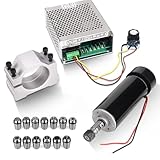
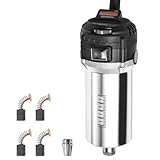

Quick verdict: which CNC router spindle fits your machine?
- Choose a 0.8kW air-cooled spindle for compact desktop machines, 1/4-inch and smaller cutters, shallow passes, and a low-cost installation.
- Choose a 1.5kW water-cooled spindle when you want quieter operation, ER16 tooling, and more cutting reserve without a large electrical or mechanical upgrade.
- Choose a 2.2kW water-cooled spindle for a rigid gantry, regular hardwood or aluminum work, and the wider cutter range provided by ER20 collets.
- Choose an air-cooled 1.5–2.2kW spindle if you cannot accommodate a reservoir, pump, hoses, or antifreeze-safe coolant.
The wattage is not the only decision. A spindle for a CNC router must match the gantry’s stiffness, the available voltage, the VFD’s input rating, the collet system, and the machine’s ability to remove chips safely.
0.8kW versus 1.5kW versus 2.2kW
| Typical spindle | Common collet | Typical speed | Approx. spindle weight | Practical cutting role | Typical electrical demand |
|---|---|---|---|---|---|
| 0.8kW air-cooled | ER11 | 8,000–24,000 rpm | 2.5–3.5 kg | Engraving, plywood, plastics, light hardwood | About 4–8A at 110V, depending on efficiency and load |
| 1.5kW air- or water-cooled | ER16 | 8,000–24,000 rpm | 4.5–6 kg | General woodworking, signs, furniture parts, occasional aluminum | About 7–14A at 110V or 4–8A at 220V |
| 2.2kW water-cooled | ER20 | 8,000–24,000 rpm | 5.5–7.5 kg | Deeper cuts, hardwood, large panels, light aluminum work | About 12–20A at 110V or 6–10A at 220V |
These current figures are planning ranges rather than nameplate specifications. VFD efficiency, acceleration settings, cutting load, and the motor’s actual rated input can change the result. Check the spindle and VFD labels before selecting a circuit or plug.
ER11, ER16, and ER20: the collet decision
Collet size determines which cutters you can hold accurately and how much tool shank support is available. ER11 spindles commonly accept shanks up to about 7mm, although the supplied collets may cover only 1/8-inch, 3mm, and 1/4-inch tooling. They are compact and light, but the smaller nose and collets offer less reserve for aggressive roughing.
ER16 is a useful middle ground. It commonly supports shanks up to approximately 10mm and works well with 1/4-inch, 6mm, and many 8mm cutters. A 1.5kW spindle with ER16 is often easier for a modest gantry to carry than a 2.2kW motor.
ER20 is the most flexible of these three for a full-size hobby machine. It commonly accepts shanks up to approximately 13mm, including 1/2-inch tooling. The larger collet does not automatically make cuts more accurate, but it gives access to larger roughers and improves tool-holding options. It also increases spindle weight and nose clearance requirements.
Do not buy a 2.2kW spindle only to use a 1/8-inch cutter. Small tools still require conservative feeds, correct runout, and suitable chip evacuation. For fine engraving, a lighter 0.8kW spindle may fit the machine better.
Water-cooled versus air-cooled CNC router spindles
Water-cooled advantages
A water-cooled CNC router spindle uses a jacket around the motor, usually with a small pump, reservoir, and hoses. Water absorbs heat efficiently, so the motor can remain relatively quiet during long jobs. It is usually the better choice for a 1.5kW or 2.2kW spindle running for hours.
- Lower acoustic noise because there is no cooling fan mounted to the spindle.
- More stable temperature during extended cutting.
- Less air blown across the workpiece, which can be helpful when dust extraction is carefully positioned.
- Good suitability for enclosed machines and long production cycles.
Air-cooled advantages
An air-cooled spindle motor for a CNC router has a built-in fan. Installation is simpler because there is no coolant loop to fill, protect from freezing, or inspect for leaks. This makes air cooling attractive for portable machines, garages, and occasional users.
- No pump, reservoir, hoses, radiator, or coolant maintenance.
- Faster installation and fewer leak-related failure points.
- Works well where temperatures remain moderate and jobs are relatively short.
- Often costs less as a complete spindle-and-VFD package.
The trade-off is noise. The fan can be distinctly louder than the cutting operation, especially at high speed. It also blows dust around the spindle, so a properly fitted dust shoe and extraction system matter more.
Will your gantry carry a larger spindle?
Compare the spindle’s weight with the machine’s Z-axis capacity, not merely the advertised motor power. A heavier spindle can increase Z-axis sag, reduce acceleration, and expose looseness in linear bearings. It may also require a larger clamp, longer mounting plate, and additional clearance below the gantry.
As a practical screening method, weigh the existing router and compare its center of mass with the proposed spindle. If the replacement is twice as heavy, expect to retune acceleration and possibly reinforce the Z-axis. A flexible gantry cannot exploit 2.2kW power; vibration will reduce finish quality before the motor reaches its cutting potential.
110V and 220V: VFD wiring and compatibility
Many spindle packages use a three-phase spindle controlled by a variable-frequency drive, or VFD. The VFD converts the available single-phase supply into a variable-frequency output. The spindle is not connected directly to a household receptacle.
Before buying, verify these four ratings:
- VFD input: Confirm whether it accepts 110–120V single-phase or 200–240V single-phase input. A VFD designed only for 220V is not made compatible with 110V by changing a plug.
- VFD output: Match the output voltage and current to the spindle nameplate. A common configuration is a 220V three-phase output spindle, but the exact rating must be checked.
- Motor wiring: Use the VFD’s U, V, and W terminals for the three spindle conductors and connect protective earth to the spindle body and VFD ground. Do not guess terminal assignments.
- Control wiring: Run shielded, correctly rated cable for the VFD-to-spindle connection. Keep it separate from limit-switch, probe, USB, and stepper wiring to reduce electrical interference.
A 2.2kW spindle can exceed the capacity of a typical 15A 110V circuit once startup and conversion losses are included. On 220–240V, the same output power generally requires lower current, making wiring and breaker sizing easier. Have a qualified electrician install a new circuit or verify the machine’s electrical design when the nameplate current approaches the circuit limit.
Decision matrix for common buyers
| Your situation | Best starting choice | Why |
|---|---|---|
| Small desktop gantry, 110V, occasional engraving | 0.8kW air-cooled ER11 | Light, simple, and less demanding electrically |
| Hobbyist making signs and plywood parts weekly | 1.5kW water-cooled ER16 | Quieter long jobs with useful 6–8mm tooling capacity |
| Rigid 220V gantry cutting hardwood panels frequently | 2.2kW water-cooled ER20 | More tool choice and thermal reserve for deeper roughing |
| Workshop where coolant maintenance is undesirable | 1.5kW or 2.2kW air-cooled | Fewer components, provided noise and airflow are acceptable |
| Production machine needing automatic tool changes | Dedicated ATC spindle system | ATC spindles require compatible holders, drawbar hardware, controls, and air supply |
What ownership is really like
Runout and collet condition often affect results before the motor wears out. Clean the spindle taper, collet, and nut before every tool change; a single chip trapped under the collet can create visible runout. Replace damaged or rusted collets rather than compensating with excessive tightening.
Water-cooled systems need periodic inspection of hose connections, pump flow, and coolant condition. Use clean distilled or deionized water with a suitable corrosion inhibitor recommended for the loop. Do not let the pump run dry, and protect the reservoir from freezing.
Air-cooled systems need clear intake and exhaust openings. Fine wood dust can restrict airflow, so keep the fan area clean and avoid allowing a dust shoe to seal against the spindle’s cooling path. In either design, bearings are usually the eventual wear item, while crashes, contaminated collets, loose mounts, and incorrect VFD settings are common earlier failure causes.
Bottom line
For a light 110V desktop router, buy the 0.8kW air-cooled option only if ER11 tooling meets your work. For the broadest balance of noise, capacity, and machine load, a 1.5kW ER16 spindle is the safest general recommendation. Select a 2.2kW water-cooled ER20 spindle when the gantry is genuinely rigid, the machine has suitable 220–240V power or a correctly rated VFD, and you will use larger cutters or run long jobs. An ATC spindle is a different class of upgrade, not simply a higher-powered replacement, because its tool holders, drawbar, air system, and controller must all work together.