
What's inside
- Quick comparison: six useful choices in 2026
- 1. RIDGID EB4424: the best all-purpose choice
- 2. JET JBOS-5: best for frequent contour work
- 3. RIKON 50-300: best durability-oriented spindle sander
- 4. Triton TSPS450: best value for occasional users
- 5. Shop Fox W1831: best compact option
- 6. SuperMax Tools 19-38: best for flat panels
- What the numbers mean in actual use
- Decision guide by shop situation
- How to prevent scallop marks and uneven curves
- Ownership costs and maintenance
As an Amazon Associate I earn from qualifying purchases. This post may contain affiliate links at no extra cost to you.
The best oscillating drum sander for most woodworkers is the RIDGID EB4424 because its 4-inch drum, interchangeable spindle drums, 24 oscillations per minute, and effective dust port make it the most versatile choice for panels, curved parts, and edge work; however, a true thickness drum sander is still the better tool for flattening broad panels.
That distinction matters. An oscillating spindle sander removes marks from curves, inside radii, and end grain, but its narrow abrasive drum cannot flatten a wide panel evenly. A conventional drum sander feeds the panel beneath a wide sanding head and is the correct choice for thicknessing boards. The recommendations below therefore include the strongest oscillating spindle machines for contour work and the most suitable oscillating-style drum sanders where flat-panel capacity is the priority.
As an Amazon Associate we earn from qualifying purchases at no extra cost to you.

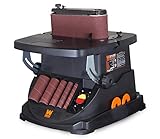
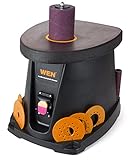

Quick comparison: six useful choices in 2026
| Machine | Best use | Largest commonly supplied sanding size | Oscillation information | Dust connection | Approximate market range |
|---|---|---|---|---|---|
| RIDGID EB4424 | Best all-rounder for curves and small panels | 4 in. drum; 4 in. × 24 in. belt mode | 24 OPM; approximately 3/4 in. vertical travel | 2-1/2 in. port | $250–$350 |
| JET JBOS-5 | Best premium benchtop spindle sander | 5 in. drum; multiple spindle sizes | Approximately 30 OPM; about 1/2 in. travel | 2-1/2 in. port | $500–$700 |
| RIKON 50-300 | Best heavier-duty contour machine | 4 in. drum; interchangeable spindles | Slow oscillation designed to reduce loading | 2-1/2 in. port | $400–$550 |
| Triton TSPS450 | Best value for occasional shaping | 4-1/2 in. drum; several spindle sizes | Approximately 58 OPM; roughly 5/8 in. travel | 2-1/2 in. port | $250–$350 |
| Shop Fox W1831 | Best compact shop machine | 4 in. drum; multiple spindle sizes | Approximately 58 OPM; about 5/8 in. travel | 2-1/2 in. port | $250–$350 |
| SuperMax Tools 19-38 | Best for genuinely flat, wide panels | 19 in. sanding width; 38 in. drum length | Conventional drum-sanding head, not contour spindle oscillation | 4 in. port | $2,000–$2,700 |
Oscillation figures can vary slightly by revision and manufacturer terminology. OPM means oscillations per minute. The important practical measurement is vertical travel: a longer stroke spreads heat and wear over more of the oscillating drum, while a short stroke can leave a visible repeated pattern if the operator feeds too slowly.
1. RIDGID EB4424: the best all-purpose choice
The RIDGID EB4424 is the easiest recommendation when one machine must handle inside curves, outside curves, straight edges, and occasional narrow panel work. It changes between spindle and belt-sanding modes, giving it more useful working area than a dedicated small spindle sander. Its approximately 4-inch sanding width is still too narrow to flatten a cabinet side efficiently, but it is excellent for cleaning up routed profiles and bandsawn curves.
The 24 OPM oscillation is relatively slow. That helps keep sleeves from overheating and reduces the chance of burning dense hardwood. The tradeoff is slower stock removal, so use a coarse sleeve for shaping and a finer sleeve only for final smoothing. A shop vacuum connected to the 2-1/2-inch port is adequate for normal use; a cyclone separator helps prevent the fine dust from quickly clogging the filter.
2. JET JBOS-5: best for frequent contour work
The JET JBOS-5 is a heavier benchtop oscillating spindle sander with a 5-inch drum and a broad selection of spindle diameters. It is a better fit than a lightweight machine for a cabinet shop that sands curved parts every week. The larger table and more substantial construction make it easier to keep workpieces flat while removing material.
Its slower oscillating action is useful with hardwood and plywood edges because the abrasive does not remain in one vertical track for long. It is also less likely to produce the tight horizontal witness lines associated with aggressive hand feeding. The main disadvantage is price and weight: this is a dedicated contour machine, not a portable tool to store on a shelf after every project.
3. RIKON 50-300: best durability-oriented spindle sander
The RIKON 50-300 suits users who want a solid machine for repeated shaping rather than the lowest purchase price. It uses interchangeable drums and sleeves, allowing the operator to match the abrasive diameter to the curve. A small drum reaches tighter inside radii; a large drum leaves a flatter transition on broad curves.
Its slower oscillation favors controlled sanding and helps reduce sleeve loading. It will not replace a thickness planer or wide drum sander for flattening a panel. Choose it when the work consists of chair parts, guitar components, templates, routed profiles, or bandsawn furniture curves.
4. Triton TSPS450: best value for occasional users
The Triton TSPS450 is a practical oscillating spindle sander for a home shop that needs several drum diameters without moving to industrial equipment. Its roughly 4-1/2-inch sanding capacity is useful on medium-sized curves, and its supplied accessories cover common woodworking radii.
The faster oscillation can remove material quickly, but it places more importance on feeding the work continuously. Pausing over one spot can create a shallow dip or a darker burn mark. It is a good choice for an intermediate woodworker who understands that the table, not the operator’s hands, must control the workpiece angle.
5. Shop Fox W1831: best compact option
The Shop Fox W1831 occupies relatively little bench space while providing the basic features needed for furniture and hobby work. It is a sensible choice when storage is limited and use is occasional. The range of spindle sizes makes it more flexible than a fixed-diameter drum, although the smaller table demands more careful support for large pieces.
Use it for curved cutouts, inside corners, and smoothing bandsawn parts. For a wide panel, make a straight-line sled or use a hand plane, router sled, or thickness sander instead. A compact spindle sander is a finishing and shaping tool, not a panel-flattening machine.
6. SuperMax Tools 19-38: best for flat panels
The SuperMax Tools 19-38 belongs in this list for a different reason: it is the correct answer when “flat, smooth panels” is the dominant requirement. Its 19-inch sanding width and 38-inch drum length let it process tabletops, cabinet panels, and glued-up boards in repeated passes. It is not an oscillating spindle sander, and its drum does not travel vertically around a small contour.
Instead, the broad sanding drum removes a controlled amount across the panel width. Some models use a conveyor and abrasive drum arrangement that requires careful setup, dust collection, and light passes. Expect a much higher cost, larger footprint, and greater electrical and dust-collection demands than with a benchtop spindle machine.
What the numbers mean in actual use
Drum diameter determines the smallest practical inside radius. A 1-inch sanding drum can reach a much tighter curve than a 4-inch drum, but the smaller contact area removes material more slowly and leaves a more pronounced transition. Drum length determines how much edge can be sanded in one pass; it does not mean the machine can flatten a panel of that width unless the workpiece is supported and the machine is designed for pass-through sanding.
For dust collection, a 2-1/2-inch port generally needs about 250–350 CFM at the machine to capture sanding dust effectively. A 4-inch port on a wide drum sander commonly needs approximately 500–800 CFM, measured at the machine rather than at the collector’s unrestricted inlet. A small shop vacuum may show high advertised airflow but lose much of it through a clogged filter, long hose, or undersized separator.
For example, if a spindle sander produces 300 CFM at the port and a hose and separator reduce that by 25 percent, usable airflow is approximately:
300 × 0.75 = 225 CFM.
That may be adequate for occasional sanding, but it is marginal for fine hardwood dust. Keep the hose short, clean the filter, and use a cyclone separator with enough capacity that the vacuum is not ingesting the entire waste stream.
Decision guide by shop situation
| Your situation | Best choice | Why |
|---|---|---|
| Lowest practical cost and occasional projects | Triton TSPS450 or Shop Fox W1831 | Multiple spindle diameters without a large footprint |
| One machine for curves, edges, and belt sanding | RIDGID EB4424 | Switchable belt and spindle modes |
| Frequent furniture or cabinet production | JET JBOS-5 or RIKON 50-300 | Heavier construction and better support for repeated work |
| Wide glued-up panels and tabletops | SuperMax 19-38 | Broad pass-through sanding capacity |
| Very limited storage | Shop Fox W1831 | Compact benchtop format |
How to prevent scallop marks and uneven curves
- Flatten or bandsaw the workpiece close to its final shape before sanding. Removing 1/8 inch of stock with a sleeve creates unnecessary heat and uneven wear.
- Install a drum diameter that matches the curve. A large drum on a tight radius sands only at two contact points and encourages rocking.
- Connect dust collection before starting. Abrasive dust between the sleeve and wood can create scratches that finer grit will not remove.
- Feed continuously from one end of the curve to the other. Do not stop over a hollow or corner.
- Use light pressure. The oscillation should create the cutting action; pressing down compresses the abrasive and can produce flats.
- Change sleeves when their cutting edges are dull. A worn sleeve generates heat, burns hardwood, and makes the operator compensate with excessive pressure.
Ownership costs and maintenance
Oscillating drum and spindle sander sleeves are consumables. Keep coarse, medium, and fine sleeves in each frequently used diameter rather than trying to make one worn sleeve perform every operation. Replace rubber drums that crack, swell, or no longer hold the sleeve tightly. A loose sleeve can wrinkle, wander, or damage the workpiece.
Clean the table and spindle after each session, vacuum the motor vents, and inspect the oscillating mechanism for packed dust. Do not lubricate moving parts unless the manual specifies the lubricant; oily residue attracts abrasive dust. On belt-equipped machines, check belt tracking and tension before sanding a visible surface.
Choose an oscillating spindle sander when contours and inside radii are the problem. Choose a wide drum sander when thickness consistency and flat panels are the problem. That distinction is more important than the brand name: the best oscillating drum sander is the one whose sanding width, drum diameter, oscillation travel, and dust collection match the shape and volume of your work.