
What's inside
As an Amazon Associate I earn from qualifying purchases. This post may contain affiliate links at no extra cost to you.
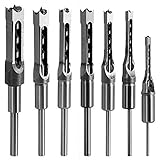
The best hollow chisel mortiser bits for most woodworkers are high-speed-steel (HSS) sets with accurately ground, slightly relieved chisels; choose a 1/4-inch or 3/8-inch set for general furniture work, a 1/2-inch set for heavier joinery, and a premium coated or HSS set if you regularly mortise dense hardwood.
A hollow chisel mortiser bit is a matched pair: the square outer chisel cuts the mortise corners while the internal auger bit removes waste. The chisel and bit must be the correct size combination, and a good fit between them matters more than a low purchase price. Poorly matched components create excessive heat, clogging, rough walls, and premature edge failure.
As an Amazon Associate we earn from qualifying purchases at no extra cost to you.



Quick picks by situation
| Situation | Recommended size or type | Why it fits | Typical market range |
|---|---|---|---|
| Occasional repairs and small furniture | 1/4-inch or 5/16-inch HSS set | Low cutting load and suitable for narrow rails, backs, and light frames | $25–$60 per set |
| General-purpose workshop | 3/8-inch HSS set | Useful balance of strength, availability, and mortise capacity | $35–$80 per set |
| Heavy doors, benches, and structural furniture | 1/2-inch or 5/8-inch premium HSS set | Handles deeper and wider mortises without the fragility of small chisels | $50–$120 per set |
| Frequent hardwood production | Precision-ground HSS or coated HSS set | Better wear resistance and more consistent sizing over repeated cuts | $70–$160 per set |
| Limited bench space | Compact benchtop-compatible set | Prioritizes shank, collar, and machine compatibility over maximum depth | $30–$90 per set |
What to compare before buying
Chisel-and-bit size
Nominal size refers to the outside width of the square chisel, not necessarily the diameter of the auger. A 3/8-inch set normally makes a mortise approximately 3/8 inch wide, while its auger is smaller to leave enough steel at the chisel corners. The exact bit diameter varies by manufacturer, so replacement bits should come from the same size system whenever possible.
Use the narrowest mortise that provides adequate tenon strength. A useful starting point is a tenon thickness between one-third and one-half of the stock thickness, provided the surrounding walls remain strong. For a 3/4-inch rail, a 1/4-inch tenon leaves about 1/4 inch of material on each side; a 3/8-inch tenon leaves only 3/16 inch per side. The larger option may be stronger, but it also removes more material and puts greater load on the machine.
| Chisel size | Typical auger diameter | Practical mortise depth | Good applications |
|---|---|---|---|
| 1/4 inch | About 3/16 inch | 1 1/2–2 1/2 inches | Small boxes, narrow rails, light cabinet work |
| 5/16 inch | About 1/4 inch | 1 1/2–3 inches | Cabinet doors and compact furniture |
| 3/8 inch | About 5/16 inch | 2–3 1/2 inches | General furniture and frame-and-panel work |
| 1/2 inch | About 7/16 inch | 2–4 inches | Heavy tables, doors, workbenches |
| 5/8 inch | About 9/16 inch | 2–4 inches | Large joinery in substantial stock |
These depth figures are working ranges rather than machine limits. The mortiser’s column height, chisel length, quill travel, and the workpiece all set the real limit.
Steel quality and edge geometry
HSS is the safest general recommendation. It tolerates the heat generated when an auger clears chips through a confined chisel and normally holds an edge longer than basic carbon steel. Precision-ground HSS chisels tend to have more consistent wall thickness and sharper corners. Hardened carbon-steel sets can cut cleanly in softwood, but their edge life is usually less forgiving when the setup is tight or the wood is abrasive.
Coatings can improve wear resistance, but they cannot compensate for poor geometry. Look for square, even corners; a clean internal bore; smooth outside faces; and a relief grind behind the cutting edges. The cutting edges should be sharp without a rolled lip or visible burr. The auger’s lead screw should start cleanly, and its flutes should be deep enough to carry chips rather than pack them into the chisel.
Softwood versus dense hardwood performance
In pine, spruce, fir, and other softwoods, almost any correctly sized, sharp set can perform well. The main problems are crushed fibers at the mortise entrance and resin buildup inside the chisel. A slower feed, a sharp auger, and occasional cleaning usually matter more than premium steel.
Dense hardwoods such as hard maple, white oak, beech, and hickory expose weaknesses quickly. They demand a rigid machine, a sharp bit, accurate alignment, and more frequent chip clearing. Make several shallow plunges rather than forcing one deep cut. For a 3-inch mortise, cutting in three 1-inch stages is often more reliable than continuous pressure, especially in end grain.
Dense or abrasive stock also makes sharpening quality important. A dull outer chisel increases friction, while a dull auger fails to evacuate chips. The resulting heat can discolor the steel and make the machine appear underpowered. If your work is mostly hardwood, pay for consistent HSS geometry before paying for decorative coatings.
Compatibility: the overlooked buying decision
Do not buy by chisel width alone. Check the mortiser’s manufacturer specifications for the maximum chisel size, maximum shank diameter, collar dimensions, and required chisel length. Many benchtop machines accept smaller sets but cannot safely accommodate large 1/2-inch or 5/8-inch assemblies.
- Shank fit: The auger shank must fit the chuck without excessive projection or slipping.
- Chisel collar: The square chisel’s mounting collar must seat fully in the machine’s holder.
- Clearance: The chisel should not contact the bit’s chuck or the holder during the full stroke.
- Bit projection: The auger should project below the chisel by roughly 1/16 to 3/32 inch, unless the manufacturer specifies another setting.
- Machine capacity: A large chisel in a light benchtop mortiser can overload the drive even when it physically fits.
Brand matching is helpful but not mandatory. Fisch offers recognizable Wave Cutter hollow chisel systems, while Narex and Robert Sorby are established names in cutting tools and woodworking accessories. Availability and exact dimensions vary by market, so compare the actual shank and collar measurements rather than assuming all nominally identical sets interchange.
Setup that improves accuracy and edge life
- Install the auger first and leave it slightly loose. This allows the chisel to be positioned without forcing the bit off-center.
- Slide the chisel into its holder with the open face oriented correctly. The opening should face the direction that lets chips escape according to the machine’s instructions.
- Set the auger projection. Too little projection makes the chisel plug with chips; too much leaves rounded or torn mortise ends.
- Center the auger inside the chisel. Rotate the assembly by hand and check that clearance is even on all sides before tightening.
- Set the depth stop and clamp the workpiece. A moving board is a common cause of oversized, tapered mortises.
- Make a test cut in matching scrap. Check tenon fit, depth, and wall quality before cutting the finished parts.
For a tight-fitting joint, cut the first mortise at the marked position, then clear chips before each subsequent plunge. In a 3-inch hardwood mortise, three 1-inch plunges with chip-clearing pauses may take only a few seconds longer than one continuous plunge, but they reduce heat and the chance of a packed chisel.
Sharpening and ownership costs
The outside faces and four corner edges of the chisel can be honed with a slip stone or purpose-made mortiser-chisel sharpener. Do not aggressively enlarge the inside of the chisel: removing too much metal increases the mortise size and weakens the cutting edge. The auger can be touched up with a small file or sharpening stone, preserving the lead point and cutting lips symmetrically.
What usually wears first is the auger’s lead point and cutting lips, followed by the chisel corners. Resin, glue, and compacted chips can cause more damage than ordinary cutting. Brush debris from the set after use, wipe resin from the auger, and apply a light rust preventive to clean, dry steel. Store chisels so their corners cannot strike other tools.
As a simple ownership calculation, a $90 premium set used for 60 furniture projects costs $1.50 per project before sharpening. A $35 basic set used for only 15 projects costs about $2.33 per project, even before accounting for replacement bits or extra setup time. For occasional softwood work, the cheaper set may still be the sensible choice; for repeated hardwood joinery, consistent geometry often pays for itself through fewer failed mortises and less rework.
Final buying recommendation
Choose a 3/8-inch HSS hollow chisel mortiser bit set from a reputable cutting-tool manufacturer if you want one versatile size. Move down to 1/4 inch or 5/16 inch for narrow stock and delicate cabinet parts, and up to 1/2 inch for substantial hardwood joinery. Prioritize accurate chisel geometry, a compatible shank and collar, sensible auger projection, and replacement-bit availability. Those details have a larger effect on clean, accurate joinery than a premium label or coating alone.