
What's inside
As an Amazon Associate I earn from qualifying purchases. This post may contain affiliate links at no extra cost to you.
The best gaming monitor arms for ultrawide screens are heavy-duty, VESA-compatible arms rated above your monitor’s actual weight: choose an Ergotron HX with the Heavy-Duty Tilt Pivot for a large 49-inch display, a standard HX or comparable 20–30 lb arm for most 34-inch monitors, and a 30–40 lb reinforced arm for 38-inch or unusually deep curved screens.
Ultrawides create more leverage than their weight suggests. A 49-inch panel may weigh 25–35 lb without its stand, while its deep curve pushes the center of gravity farther from the desk clamp. That is why a compact arm rated for an ordinary 27-inch monitor can sag, loosen, or slowly rotate even when its published weight limit appears close.
As an Amazon Associate we earn from qualifying purchases at no extra cost to you.
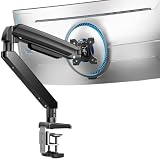


Quick comparison: which arm fits your ultrawide?
| Monitor size | Typical monitor weight without stand | Recommended arm rating | Minimum useful reach | Best arm type |
|---|---|---|---|---|
| 34-inch | 13–22 lb | At least 25 lb | 18–22 inches | Standard gas-spring or pole arm |
| 38-inch | 18–30 lb | At least 35 lb | 20–24 inches | Reinforced heavy-duty arm |
| 49-inch | 25–40 lb | At least 40 lb, preferably with reserve capacity | 22–28 inches | Heavy-duty arm with a broad clamp or grommet mount |
These are practical planning ranges, not substitutes for the specifications of your exact monitor. Always weigh the display without its original stand and check whether the arm’s capacity changes when the monitor is extended away from the pole.
Best picks by situation
Best for a 49-inch ultrawide: Ergotron HX with Heavy-Duty Tilt Pivot
The Ergotron HX is one of the clearest choices for a large curved ultrawide when fitted with its Heavy-Duty Tilt Pivot. The standard HX configuration is intended for lighter displays, while the heavy-duty pivot is designed for substantially heavier monitors. Depending on the exact configuration, Ergotron lists capacity ranges around 30–49 lb for the heavy-duty setup.
Its main strengths are a rigid mechanical design, smooth adjustment, and a high-quality desk attachment. The arm has enough reach for a deep desk, and its cable-routing channels keep power and display cables close to the links rather than dangling below the screen. It also supports common VESA patterns, including 100 × 100 mm and 75 × 75 mm, but the monitor’s weight and rear housing still need to fit the pivot.
For a 49-inch Samsung Odyssey G9-style display, check three things before ordering: the exact weight without the stand, the VESA bolt pattern, and whether the monitor’s curved rear shell interferes with the pivot plate. A 49-inch screen that weighs 26 lb may fit comfortably; a heavier model with a deep rear enclosure may require spacers or a different mounting plate.
Best premium option for frequent adjustment: Humanscale M8.1
The Humanscale M8.1 is a strong premium alternative for users who regularly move a monitor between sitting and standing positions. Its counterbalanced mechanism is designed for heavier displays, with configurations commonly specified for roughly 12–40 lb. The broad range is useful for 34- and 38-inch ultrawides, and some 49-inch models, but the upper limit must be checked against the specific M8.1 configuration.
The arm is especially attractive in a shared workstation because it is easier to reposition than a basic friction arm. Its cable management is integrated into the arm rather than relying only on loose clips. The tradeoff is cost: premium heavy-duty arms commonly occupy the $300–$500 market range, while simpler reinforced arms may cost $80–$180.
Best budget approach: a fixed-pole heavy-duty arm
For a monitor that will stay in one position, a fixed-pole heavy-duty arm can be a better buy than a gas-spring arm. These designs generally provide height adjustment on a vertical post, plus tilt and swivel at the VESA head. They are less elegant for frequent repositioning, but they place fewer demands on the internal spring and often provide a more stable platform for a heavy 38- or 49-inch panel.
Look for a stated capacity of at least 35 lb for a 38-inch monitor and 40 lb or more for a 49-inch monitor. Avoid models that advertise a high capacity only at the center of the pole but offer a much lower rating when the arm is fully extended. A reinforced steel clamp, a 3-inch or larger mounting base, and a thick lower support plate matter as much as the headline weight rating.
Head-to-head buying criteria
Weight limit and reserve capacity
Do not select an arm whose maximum rating exactly matches the monitor. A useful rule is to leave 20–30% capacity in reserve. For example, a 30 lb display should ideally use an arm rated for at least 36–39 lb. This reserve accounts for leverage, cable drag, small movements, and the fact that gas springs often behave less predictably near their limit.
A published limit of 35 lb is not automatically stronger than a 30 lb limit. Read whether the figure applies to one monitor, whether it includes the VESA plate, and whether it changes across the arm’s reach range.
VESA compatibility
Most ultrawides use 75 × 75 mm or 100 × 100 mm VESA mounting holes. Some larger displays use recessed holes, long mounting screws, or an adapter supplied with the monitor. Confirm the screw size—often M4—and use the manufacturer’s supplied spacers when the rear shell is curved or recessed. Never force a screw deep enough to contact internal electronics.
Arm reach and desk depth
Reach is not simply a comfort feature. If the arm is too short, the monitor may sit too close to the user or force the clamp into an awkward location. For a 34-inch monitor, 18–22 inches of horizontal reach is usually sufficient. A 49-inch screen benefits from 22–28 inches, particularly on a 30-inch-deep desk.
Measure from the center of the proposed clamp to the desired center of the screen. Then account for the monitor’s width. A 49-inch 32:9 display is approximately 47 inches wide, so even a small horizontal positioning error can leave one edge too close to a wall or speaker.
Clamp stability versus a grommet mount
A desk clamp is convenient, but the desk itself is part of the mounting system. A thin hollow desktop can flex under a large curved monitor. Use a broad steel or reinforced backing plate, position the clamp over a structural section, and avoid placing it directly over a cable-management cutout.
A grommet mount is often more stable for a 49-inch display because it transfers force through the desktop rather than squeezing its edge. If your desk has a suitable 2–3 inch cable hole, a grommet installation may reduce rocking. A sit-stand desk deserves extra care: make sure the frame and desktop can handle the concentrated load at the mounting point.
Worked fit calculation for a 49-inch ultrawide
Suppose your monitor weighs 28 lb without its stand. Applying a 25% reserve gives:
28 lb × 1.25 = 35 lb minimum recommended capacity.
If the display is 32 inches deep from its rear mounting area to the front edge and the arm places the VESA plate 24 inches from the clamp, the screen’s center of mass may sit roughly 16–20 inches from the clamp. That creates much more torque than a 27-inch monitor mounted close to the pole. In this case, a 35 lb arm is a minimum; a 40–49 lb heavy-duty model with a rigid clamp is the safer choice.
Installation steps that prevent sagging
- Measure and weigh the monitor. Remove the original stand and record the actual weight.
- Inspect the desk underside. Add a reinforcement plate if the desktop flexes or has a honeycomb core.
- Install the clamp or grommet evenly. Tighten until secure, but do not crush a thin desktop.
- Attach the VESA plate before lifting the monitor. Use the correct screw length and spacers.
- Adjust spring tension with the monitor mounted. If the screen rises or drops, the counterbalance is not set correctly.
- Route cables after positioning. Leave a gentle service loop so cable tension does not pull the arm downward.
- Recheck all joints after a week. Large monitors can expose clamp or desk movement that is not obvious on the first day.
Ownership realities
The first parts to show wear are commonly clamp pads, friction joints, cable clips, and gas-spring mechanisms. Dust in exposed joints can make movement gritty; clean with a dry or slightly damp microfiber cloth and avoid spraying lubricant into the spring or pivot. Do not use adhesive cable ties so tightly that they restrict arm movement.
The most common mistake is treating a monitor arm’s maximum load as a target rather than a ceiling. Another is mounting a 49-inch monitor to a narrow clamp on a thin desk. If the screen slowly tilts, the desk flexes, or the arm bounces whenever you type, the solution may be a reinforcement plate or grommet mount—not simply more joint tension.
Final recommendation
For a 34-inch ultrawide, choose a reputable arm rated for at least 25 lb with 18 inches or more of reach. For a 38-inch model, move to a reinforced 35 lb arm. For a 49-inch display, prioritize a 40 lb-plus heavy-duty arm, a broad clamp or grommet base, and verified VESA clearance. The Ergotron HX with Heavy-Duty Tilt Pivot is the most defensible premium choice for very large curved screens, while a fixed-pole heavy-duty arm offers the best value when the monitor rarely moves.