
What's inside
As an Amazon Associate I earn from qualifying purchases. This post may contain affiliate links at no extra cost to you.
The best portable printers for workshop and jobsite use are the Canon PIXMA TR150 for sharp, full-colour plans, the Epson WorkForce WF-110 for a similar inkjet setup with a compact footprint, and the Brother PocketJet 773 when dust-resistant, monochrome document printing matters more than colour.
For labels rather than drawings, a dedicated thermal label printer such as the Brother PT-E560BT or Brady M211 is usually the better choice: it avoids wet ink, prints quickly, and produces labels that are easier to handle around tools, bins, cables, and material racks.
As an Amazon Associate we earn from qualifying purchases at no extra cost to you.

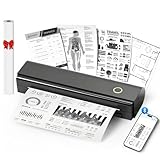


Quick comparison: portable printers for workshop use
| Printer | Print method | Useful strengths | Approx. size and weight | Best jobsite role |
|---|---|---|---|---|
| Canon PIXMA TR150 | Colour inkjet | Sharp plans, colour notes, USB and Wi-Fi | 322 × 185 × 66 mm; about 2.1 kg with battery | Portable drawings, cut lists, customer approvals |
| Epson WorkForce WF-110 | Colour inkjet | Compact body, Wi-Fi, USB, rechargeable battery | 309 × 154 × 61 mm; about 1.6 kg | Occasional A4 or letter-size colour printing |
| Brother PocketJet 773 | Direct thermal | No ink cartridges, 300 dpi, very light | 255 × 55 × 30 mm; about 610 g | Text plans, checklists, invoices, field notes |
| Brother PT-E560BT | Thermal label printing | Portable keyboard, durable laminated tape options | About 295 × 121 × 97 mm; about 1.1 kg | Tool, cable, drawer, and material labels |
| Brady M211 | Thermal label printing | Bluetooth operation, rugged label-focused design | About 113 × 76 × 48 mm; about 540 g | Compact cable and asset identification |
Dimensions and weights can vary with the battery, roll, or accessories installed. Inkjet battery figures also depend heavily on page coverage, Wi-Fi use, and whether the printer is charging while operating.
Our picks by workshop situation
Best for full-colour plans: Canon PIXMA TR150
The Canon PIXMA TR150 is the strongest general-purpose choice when a workshop needs to print drawings, annotated photographs, supplier documents, and customer sign-off sheets. Its colour inkjet engine is better suited to shaded elevations, measured sketches, and diagrams where line weight or colour coding carries useful information.
It supports wireless printing and USB connectivity, and its optional rechargeable battery makes it practical away from a mains outlet. The main compromise is inkjet ownership: cartridges can dry during long periods of inactivity, and sawdust or grit should not be allowed to settle in the paper path. Keep it closed when not in use and print a small maintenance page periodically.
Best compact colour alternative: Epson WorkForce WF-110
The Epson WorkForce WF-110 is a good fit for a small van, site office, or workshop bench where every centimetre matters. It offers colour printing, Wi-Fi, USB, and a rechargeable battery in a body that is slightly narrower than the Canon. It is suitable for occasional plans and paperwork rather than high-volume production.
Choose it when portability and modest size matter more than the fastest output. Like the Canon, it is an inkjet printer, not a dust-proof industrial device. Store it in a padded case, protect spare paper from humidity, and avoid opening the cartridge area in a dusty cutting zone.
Best for black-and-white plans and paperwork: Brother PocketJet 773
The Brother PocketJet 773 uses direct thermal paper instead of ink. That removes cartridge drying, leaking, and the need to carry spare ink, which makes it attractive for jobsite checklists, text-heavy plans, delivery records, and punch lists. Its small size and low weight are particularly useful for a tradesperson who carries the printer between buildings.
Its limitation is fundamental: thermal output is monochrome and requires special thermal paper. Pages can fade or darken if stored in heat, direct sunlight, or contact with some plastic folders. It is not the right choice for colour-coded drawings or permanent archival documents, but it is highly convenient for information that needs to be readable immediately.
Best for workshop labels: Brother PT-E560BT
The Brother PT-E560BT is better than a document printer for identifying tool drawers, clamps, electrical leads, fastener bins, and partially completed assemblies. Compatible laminated tapes are designed to resist handling and are available in different widths and colour combinations.
The built-in keyboard means it can be used without a phone, while Bluetooth provides a quicker route for longer labels or imported lists. A label printer also wastes less material than printing a whole sheet of adhesive labels. For a workshop that repeatedly labels components, this is usually a more durable and efficient purchase than adapting a small inkjet printer.
Best for a very small label kit: Brady M211
The Brady M211 is a compact Bluetooth label printer for users who already work from a phone or tablet. It is convenient for cable identification, asset tags, and small batches of labels where pocket size matters. Its usefulness depends on the availability and cost of compatible Brady label supplies, so check the width, adhesive type, and expected outdoor exposure before buying.
Print quality, battery life, and connectivity compared
Print quality
Colour inkjets produce the best-looking workshop plans, especially when a drawing contains photographs, coloured dimensions, or several layers of information. Use ordinary or matte paper for working copies and reserve heavier paper for documents that must survive repeated handling.
Direct thermal printers are crisp for text and simple line diagrams, but they cannot reproduce colour. Thermal labels are often the most legible option for small identifiers because the printer is designed around narrow tape rather than full pages.
Battery life
Do not compare battery claims as though every page uses the same amount of power. A colour page with large shaded areas consumes more energy than a black-and-white text page. As a planning estimate, a portable inkjet with a fully charged battery may handle roughly 50 to 100 light-coverage pages, while a small thermal document printer may handle several hundred pages under favourable conditions. Treat these as working ranges, not guarantees.
A useful calculation is to divide your maximum daily output by the printer’s practical battery capacity. If you expect 20 plan pages and estimate 60 pages per charge, the battery has a theoretical three-day capacity. In a cold van, with repeated wireless wake-ups and phone charging, plan closer to two days and carry the AC adapter or a compatible power bank.
Connectivity
- Wi-Fi: best when printing from laptops, tablets, or several phones, but it may require joining the printer’s own network.
- USB: the most dependable fallback when a wireless connection is blocked by a site network or pairing problem.
- Bluetooth: convenient for labels and direct phone operation, especially when the printer has a dedicated mobile app.
- Built-in keyboard: useful when working in gloves, in a noisy area, or without a phone.
Before buying, confirm that your operating system and phone support the printer app or driver. A printer with excellent hardware is frustrating if the workshop laptop cannot find it.
Durability realities in a dusty workshop
Portable does not mean sealed. Inkjet printers have exposed paper paths, rollers, and printheads that dislike fine sanding dust. The first parts to show trouble are commonly feed rollers, cartridge contacts, and the printhead nozzles. Keep the printer closed, place it on a clean shelf rather than beside a sander, and transport it in a case with the paper removed if the manufacturer recommends this.
Thermal printers avoid ink-related problems but still have a printhead and feed roller that can collect adhesive residue, paper dust, or label fragments. Use the manufacturer’s cleaning material, remove scraps with care, and never scrape the printhead with a knife or screwdriver. Store thermal paper and labels in their original packaging, away from heat and sunlight.
For jobsite use, the consumables may cost more over time than the printer. Compare ink cartridge yields, thermal paper roll length, label width, adhesive grade, and whether supplies are easy to obtain locally. A cheap label printer is poor value if its proprietary tape costs several times more than standard alternatives for your volume.
How to set up a portable printer for reliable field use
- Load the right media before leaving. Use paper that matches the printer’s size and feed requirements. Keep a sealed spare pack in the vehicle.
- Pair and test every device. Print from the actual phone, tablet, and laptop you will use. Wireless setup problems are easier to solve at the workshop than on a roof or unfinished site.
- Set a default paper size. Choose A4 or letter, set scaling to 100% for measured drawings, and disable “fit to page” when dimensions must remain accurate.
- Print a small test page. Check line weights, text size, orientation, and margins before printing a long plan set.
- Pack a recovery kit. Carry the charging cable, spare media, a soft brush, lint-free cloth, and— for inkjets—spare cartridges if the work is time-critical.
- Clean before storage. Remove dust from the exterior and paper path, close all covers, and store the printer dry and level.
Final buying decision
Choose the Canon PIXMA TR150 if colour drawings and general documents are central to your work. Choose the Epson WorkForce WF-110 when you need similar colour capability in a particularly compact package. Choose the Brother PocketJet 773 for lightweight monochrome plans and paperwork with minimal consumables. If the real requirement is identifying tools, parts, cables, or assemblies, skip document printers and buy a thermal label printer such as the Brother PT-E560BT or Brady M211.
The best portable printers are not the ones with the longest feature list. They are the ones whose print method, media, battery, and cleaning requirements match the dust, volume, and information type in your workshop.