Key takeaways
- Find the best dual drum sanders for experienced diy woodworkers, with two-drum sanding, strong motors, and steady feed control for wide panels.
As an Amazon Associate I earn from qualifying purchases. This post may contain affiliate links at no extra cost to you.
Choosing the best dual drum sanders for experienced diy woodworkers is about saving passes without giving up surface quality. A dual drum sander carries two sanding drums in one machine, so you can load a coarse grit on the front drum and a fine grit on the rear drum and finish a board in a single trip through the conveyor. For an experienced maker, that second drum is not a shortcut. It is a way to keep a steady rhythm, reduce handling, and bring panels, doors, and tabletops to final thickness with fewer trips back to the infeed side.
Experienced DIY woodworkers already understand the limits of a single drum. One drum can remove material or refine a surface, but it cannot do both at the same depth setting. A dual drum machine changes that balance. The front drum does the heavier work, the rear drum refines the surface, and the conveyor moves the stock through at a controlled rate. When the grits are staged well and the passes stay light, the result is a flat panel with fewer visible lines and less hand sanding at the bench.
Disclosure: As an Amazon Associate, we earn from qualifying purchases.
At a glance
| Product | Key spec | Best for |
|---|---|---|
| Powermatic DDS-225 Dual Drum Sander | 25-inch width, 5 HP motor, 230V | Wide panels and production-style sanding |
| Shop Fox W1678 Dual Drum Sander | 26-inch width, 5 HP motor, 220V | Large glue-ups and two-grit sanding |
| Powermatic DDS-237 Dual Drum Sander | 37-inch width, 7-1/2 HP motor, 230V | Very wide panels and heavy shop use |
How to choose
Two-drum layout and grit staging. The main advantage of a dual drum machine is grit staging. Load a coarse grit on the front drum for material removal and a fine grit on the rear drum for surface refinement. Check that each drum can be adjusted independently, because the rear drum needs a precise setting to clean up after the front drum without cutting too deep. A micro-adjustable rear drum is a useful feature for fine work.
Sanding width and thickness range. Dual drum machines are usually wide, from 25 inches to 37 inches in this guide. Match the width to your largest panels, and remember that a wider machine needs more floor space and more dust extraction. Check the maximum thickness for thick glue-ups and the minimum thickness for thin parts, and make sure the height adjustment is smooth across the full range.
Motor power and electrical supply. Two drums cutting at once need a strong motor and a suitable circuit. A 5 HP motor suits most experienced home shops that have 220V or 230V power. A 7-1/2 HP motor suits very wide panels and dense hardwoods, but it needs a heavier circuit and a larger dust system. Confirm the voltage, phase, and amperage before you buy, and plan the wiring with a qualified electrician if you are unsure.
Conveyor feed and speed control. Variable feed speed lets you slow down for figured wood and speed up for straight-grained stock. A dual drum machine should hold a steady feed under load, because a change in speed can leave a visible line across a panel. Look for a conveyor belt that tracks well, a feed control within easy reach, and a table that stays parallel to both drums.
Drum adjustment and parallelism. Both drums must stay parallel to the conveyor table, or one side of a panel will sand deeper than the other. Check how the drums are adjusted, whether the settings hold through a long session, and how easy it is to check parallelism with a test board. A machine that is easy to align will stay accurate longer than one that needs tools and patience for every small change.
Dust handling. Two drums create dust at twice the rate of a single drum, so dust ports, hoods, and airflow matter even more. Look for dual dust ports, a hood that covers both drums, and a port size that matches your dust system. A clogged hood or a kinked hose will show up quickly as dust on the conveyor and heat on the abrasive, so keep the path clear and check it often.
Top picks
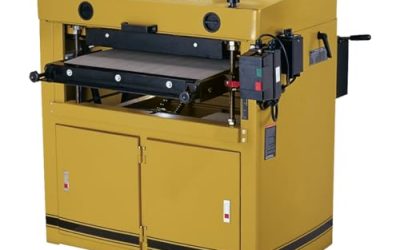
Powermatic DDS-225 Dual Drum Sander

Key specs: 25-inch dual drum head; 5 HP motor; 230V single-phase power; two-speed gearbox; dual dust ports; forward and reverse conveyor; cast iron table; maximum stock thickness 4 inches.
Best for: Experienced makers who want a true dual drum machine for wide panels, doors, and tabletops, with a two-speed gearbox for coarse and fine work.
Considerations: This machine needs a 230V circuit and a strong dust system, and its weight and footprint suit a dedicated floor station rather than a shared bench area. The two-speed gearbox adds flexibility, but it also adds a control to learn, so read the manual and run test boards before sanding a finished panel. Keep spare abrasive wraps for both drums, because grit staging only works when both drums are cutting cleanly.
Shop Fox W1678 Dual Drum Sander
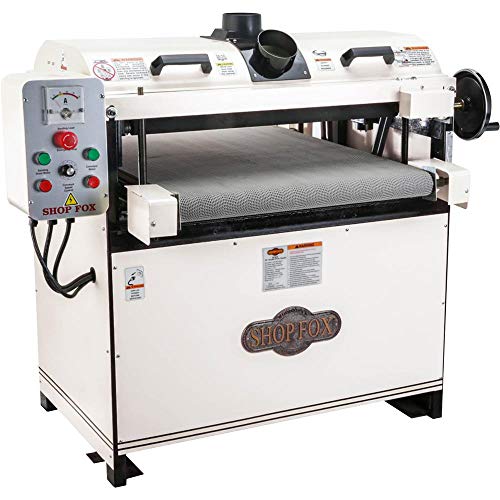
Key specs: 26-inch width; 5 HP sanding motor; 220V single-phase power; two 6-inch aluminum drums; variable feed from 0 to 20 FPM; micro-adjustable rear drum; dual 4-inch dust ports; hook-and-loop abrasive attachment.
Best for: Large glue-ups and cabinet panels where two grits in one pass save time and handling, and where a wide, stable machine suits a permanent shop station.
Considerations: The machine is heavy and needs a level floor, a 220V circuit, and a dust system that can serve two 4-inch ports. The hook-and-loop abrasive system makes grit changes fast, but the wraps need to sit flat on the drums or they can leave lines. Plan for infeed and outfeed support, because a 26-inch panel is awkward to handle alone without rollers or a helper.
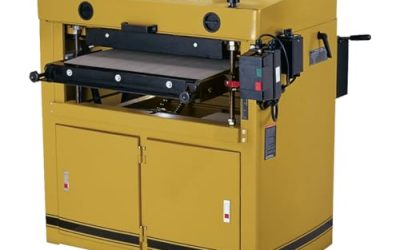
Powermatic DDS-237 Dual Drum Sander

Key specs: 37-inch dual drum head; 7-1/2 HP motor; 230V single-phase power; two-speed gearbox; dual dust ports; forward and reverse conveyor; cast iron table; maximum stock thickness 4 inches.
Best for: Very wide panels, large tabletops, and shops that sand a high volume of wide stock and need the capacity of a 37-inch machine.
Considerations: This is the largest machine in this guide, with the highest power demand and the largest footprint. It suits a shop with a dedicated sanding station, a strong dust system, and room to feed a 37-inch panel safely. The 7-1/2 HP motor and 230V supply need careful electrical planning, and the machine is best moved with help and a clear path through the shop.
Which one fits your shop
If you sand panels up to 25 inches wide and want a proven dual drum design, the Powermatic DDS-225 is a strong fit. If you want a slightly wider machine with variable feed up to 20 FPM and a micro-adjustable rear drum, the Shop Fox W1678 gives you that flexibility at 26 inches. If your panels run wider than 30 inches, or you sand a high volume of large tabletops and doors, the Powermatic DDS-237 is the only machine here that covers that width in a single pass.
FAQ
How do dual drum sanders save time?
A dual drum sander holds two grits at once, so the front drum removes material and the rear drum refines the surface in the same pass. That cuts handling and reduces the number of trips through the machine. The time saving is greatest on wide panels and repeated parts, where each extra pass adds up across a full project.
What grit pairing works well on a dual drum machine?
A common pairing is a coarse grit on the front drum and a medium or fine grit on the rear drum. The front drum should remove planer marks and bring the panel close to thickness, while the rear drum should clean up the surface without cutting deep. Test the pairing on scrap from the same wood, and adjust the rear drum in small steps until the surface looks even.
Can a dual drum sander replace a planer?
No. A planer removes material quickly and flattens one face against a reference surface, while a drum sander refines thickness and surface quality with light passes. Use the planer and jointer to establish flat faces, then use the drum sander to bring parts to final thickness and remove planer marks. A drum sander is not a good tool for heavy stock removal.
Bottom line
The best dual drum sanders for experienced diy woodworkers turn two grits into one smooth pass. The Powermatic DDS-225 suits wide panels up to 25 inches, the Shop Fox W1678 suits 26-inch glue-ups with variable feed control, and the Powermatic DDS-237 suits very wide panels up to 37 inches. Check your largest panels, your electrical supply, and your dust system, then choose the width and power that match your shop. With the right grit staging and light passes, a dual drum sander will flatten panels and refine surfaces with less handling and a more consistent finish.
Related guides
More from Amazon
Programs that pair well with the guide above. Offers and eligibility are set by Amazon and may change.
A free business account with business pricing and bulk-buying tools for work, shop or home office.
Create a business accountFree shipping on eligible items, Prime Video and more. Eligible new members can start with a free trial.
Start a Prime free trialAudiobooks and podcasts to listen to on the go. Eligible new members can start with a free trial.
Try Audible freeAd-free music streaming. Eligible new subscribers can start with a free trial.
Try Music Unlimited freeAs an Amazon Associate we earn from qualifying purchases.