Key takeaways
- Benchtop drum sanders for garage workshops compared by width, motor and dust port, with verified picks that store compactly and surface wide panels well.
As an Amazon Associate I earn from qualifying purchases. This post may contain affiliate links at no extra cost to you.
As an Amazon Associate, we earn from qualifying purchases made through links on this page.
A garage workshop imposes two rules on a drum sander: it must earn its footprint every day, including the days it is not used, and it must survive an environment shared with cars, bikes, and storage. Benchtop models answer the first rule — they live on a bench or a rolling stand and can be moved aside — and their enclosed drums and 4-inch dust ports answer the second, provided the dust collection is up to the job.
This roundup compares benchtop drum sanders on the specs a garage shop actually feels: single-pass width, motor size for hardwood glue-ups, conveyor control, and how the machine stores when the car needs its space back.
What to Look For
- Storage footprint. Measure the bench or stand space the sander will occupy full-time. Open-ended models need clear space on the left side for two-pass work, which affects where they can live.
- Width for your typical panel. Garage projects skew toward cutting boards, small tabletops, and cabinet doors. A 10-inch machine covers boards; a 16-inch machine covers most doors and panels in one pass.
- Motor and pass discipline. Drum sanders remove little per pass regardless of motor size, but a larger motor holds drum speed better on wide, dense stock. Plan on multiple shallow passes either way.
- Dust control in a shared space. In a garage, airborne dust lands on everything. A sealed dust hood and a 4-inch port hooked to a collector are close to mandatory; an ambient air cleaner helps with what escapes.
- Power circuit. Larger benchtop sanders may specify a 20-amp circuit. Check your garage wiring before choosing the biggest model.
- Mobility. A sander on a rolling stand with locking casters can share one parking spot with other tools — a common garage pattern worth planning around.
The Picks
JET JWDS-1020 Benchtop Drum Sander (723510)
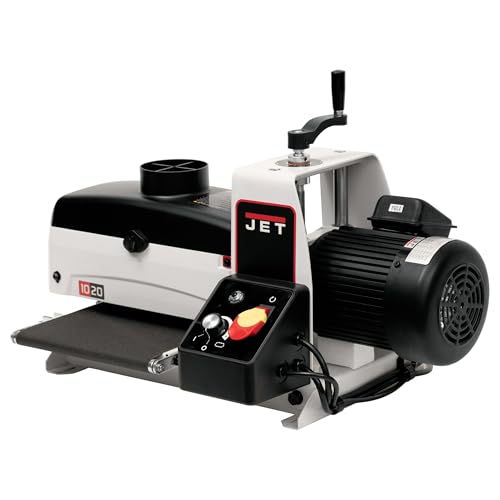
The JWDS-1020 is JET’s compact benchtop drum sander, built around a 1 HP motor and a 10-inch drum. Because the design is open-ended, a board up to 20 inches wide can be surfaced in two passes by flipping it end for end. The variable-speed conveyor, adjustable from 0 to 10 feet per minute, is the headline feature at this size: slowing the feed gives figured or resinous stock more drum contact per inch, while faster settings suit light finish passes on straight-grained boards. A parallelism adjustment dial helps keep the drum level with the conveyor bed, and the redesigned dust hood concentrates extraction at the drum through a 4-inch port.
The JWDS-1020 is the garage-friendly starting point: true benchtop size, a variable conveyor for finish control, and two-pass capacity for the occasional wide panel without a permanent stand.
Key features and specifications (manufacturer):
- Sanding width: 10 inches in a single pass, 20 inches in two passes
- Motor: 1 HP, 115V
- Conveyor: variable speed, 0 to 10 feet per minute
- Stock thickness range: 1/32 inch to 3 inches
- Dust collection: 4-inch dust port
- Drum: self-cooling aluminum drum with toolless abrasive take-up fasteners
Best for: Garage shops with one bench position available and mostly board-width work.
Limitations to know: The 10-inch single-pass width means most cabinet panels and wide glue-ups need two passes, and the 1 HP motor calls for shallow passes on dense hardwoods rather than heavy stock removal.
JET JWDS-1632 Drum Sander with Stand (723520K)

The JWDS-1632 doubles single-pass width over the smallest benchtop models and adds Sandsmart, JET’s load-sensing feed control that slows the conveyor automatically when the drum load rises. For a home shop surfacing cutting boards, drawer parts, and panel glue-ups, that combination of 16-inch capacity and self-regulating feed is the practical sweet spot. The variable conveyor covers the same 0 to 10 feet per minute range, and the open-ended frame allows 32-inch work in two passes. It ships with an open stand, so it can live on the floor or be bench-mounted in tighter spaces.
With its included open stand, the JWDS-1632 parks like a floor tool but keeps a modest footprint, and Sandsmart feed control forgives the interrupted, learn-as-you-go pace of garage projects.
Key features and specifications (manufacturer):
- Sanding width: 16 inches in a single pass, 32 inches in two passes
- Motor: 1-1/2 HP, 115V, 20-amp service recommended by the manufacturer
- Conveyor: variable speed with Sandsmart control that monitors load and adjusts feed
- Stock thickness range: 1/32 inch to 3 inches
- Dust collection: 4-inch dust port
- Includes open stand; built-in digital readout on current models
Best for: Garage woodworkers surfacing 16-inch panels regularly who can give the sander a fixed corner.
Limitations to know: At roughly 156 pounds with the stand it is not a move-it-every-session machine, and the manufacturer specifies 20-amp service, which some older garage circuits cannot supply.
JET JWDS-2244 Oscillating Drum Sander (723540B)

The JWDS-2244 is the step-up option for shops that regularly surface wide panels. Its 22-inch drum handles most cabinet doors and tabletop glue-ups in one pass, and the drum oscillates side to side as it spins, which spreads abrasive wear and reduces the straight-line scratch pattern a fixed drum can leave. Sandsmart feed control and a variable conveyor carry over from the smaller JET models, and the 4-inch maximum stock thickness covers chunky workbench tops and thick door stock that smaller sanders cannot accept.
The JWDS-2244 is the stretch choice for a two-car garage with a dedicated tool wall: oscillating action for finer finishes and 22-inch width for doors and tabletops in one pass.
Key features and specifications (manufacturer):
- Sanding width: 22 inches in a single pass, 44 inches in two passes
- Motor: 1-3/4 HP, 115V
- Oscillating drum action for a finer finish pattern
- Conveyor: variable speed with Sandsmart load control
- Stock thickness range: 1/32 inch to 4 inches
- Dust collection: 4-inch dust port
Best for: Garage shops with a permanent sanding station and wide work as the norm.
Limitations to know: This is a floor-standing machine with a footprint and weight to match, so it suits a permanent sanding station rather than a bench that must be cleared for other work.
Quick Comparison
| Product | ASIN | Width | Motor | Feed |
|---|---|---|---|---|
| JET JWDS-1020 Benchtop Drum Sander | B07Y9546K5 | 10 in (20 in two-pass) | 1 HP | Variable 0–10 FPM |
| JET JWDS-1632 Drum Sander with Stand | B07CHGFJ35 | 16 in (32 in two-pass) | 1-1/2 HP | Variable, Sandsmart |
| JET JWDS-2244 Oscillating Drum Sander | B07JMF88QN | 22 in (44 in two-pass) | 1-3/4 HP | Variable, Sandsmart |
Frequently Asked Questions
Can I run a benchtop drum sander on a regular garage outlet?
Smaller models are built for standard 15-amp household circuits. Larger models may specify 20-amp service in the manual; check the nameplate and manual for the model you choose and avoid sharing the circuit with the dust collector.
Where should a drum sander live in a garage workshop?
On a stand or bench with feed clearance on both sides equal to your longest typical board, near the dust collector to keep the hose run short, and away from the car door’s swing and parking line.
How do I keep drum-sanded dust off everything else in the garage?
Connect a real dust collector to the 4-inch port, keep the hood closed during passes, and run an ambient air cleaner during and after sanding sessions. Brush off stock as it exits to avoid tracking dust across the shop.
Is a stand or a bench better for a drum sander in a garage?
A rolling stand wins when floor space rotates between parking and projects; a bench wins when the sander has a permanent home and you want the under-bench storage. Either must hold the machine dead level for even passes.
Conclusion
In a garage, the best drum sander is the one that fits the parking plan as well as the project list. The JWDS-1020 fits the tightest shops, the JWDS-1632 fits the panel-focused garage, and the JWDS-2244 fits garages that have become full-time workshops.
Related guides
More from Amazon
Programs that pair well with the guide above. Offers and eligibility are set by Amazon and may change.
A free business account with business pricing and bulk-buying tools for work, shop or home office.
Create a business accountFree shipping on eligible items, Prime Video and more. Eligible new members can start with a free trial.
Start a Prime free trialAudiobooks and podcasts to listen to on the go. Eligible new members can start with a free trial.
Try Audible freeAd-free music streaming. Eligible new subscribers can start with a free trial.
Try Music Unlimited freeAs an Amazon Associate we earn from qualifying purchases.