Key takeaways
- Compare the best buffing wheels for woodturning, from three-step lathe buffing systems to sewn cotton wheels, with specs, mounts, and choosing tips.
What's inside
- Quick Answer
- Table of Contents
- PSI Woodworking LBUFFSYS 3-Step Lathe Buffing System
- scottchen PRO 3-Step Lathe Buffing System (MD-01)
- SCOTTCHEN Buffing Polishing Wheel 6 Inch 70 Ply, 2-Pack
- SALI 4-Pack Polishing Wheel Set, 6 Inch
- Woodstock D2499 Spiral Sewn Buffing Wheel, 3 Inch
- How to Choose Buffing Wheels for Woodturning
- Who Should Skip These Picks
- FAQ
- Final Verdict
- Product and ASIN Reference
As an Amazon Associate I earn from qualifying purchases. This post may contain affiliate links at no extra cost to you.
Buffing is the step that turns a well-sanded turning into a piece with real depth. A cloth wheel charged with compound levels the fine scratches sanding leaves behind, and a final wheel lays down a thin coat of carnauba wax that gives bowls, pens, and boxes their soft, deep shine. Turners have two ways to get there: a complete three-step system that mounts on the lathe, or individual cotton wheels that run on a mandrel, a bench buffer, or a grinder arbor.
The five picks below cover both routes. Two are complete lathe-mounted systems built around the classic Tripoli, White Diamond, and carnauba sequence. The other three are individual wheels and wheel sets, from a small 3 inch wheel for detail work to extra-thick 6 inch wheels for a home-built buffing station. Every wheel here is fabric, because wood wants a soft, conformable buff rather than a stiff wheel built for heavy metal cutting.
As an Amazon Associate, we earn from qualifying purchases.
Quick Answer
For most turners, a three-step lathe buffing system is the fastest route to a deep wax shine: the PSI Woodworking LBUFFSYS mounts all three 8 inch wheels on a single mandrel. The scottchen PRO MD-01 covers the same three-step ground at a budget tier, while the SCOTTCHEN and SALI wheel sets fit turners who already own a buffer or arbor.
Table of Contents
- PSI Woodworking LBUFFSYS 3-Step Lathe Buffing System
- scottchen PRO 3-Step Lathe Buffing System (MD-01)
- SCOTTCHEN Buffing Polishing Wheel 6 Inch 70 Ply, 2-Pack
- SALI 4-Pack Polishing Wheel Set, 6 Inch
- Woodstock D2499 Spiral Sewn Buffing Wheel, 3 Inch
- How to Choose Buffing Wheels for Woodturning
- Who Should Skip These Picks
- FAQ
- Final Verdict
PSI Woodworking LBUFFSYS 3-Step Lathe Buffing System

The LBUFFSYS is the reference design for lathe buffing: a 16 inch heavy-duty mandrel with a number 2 Morse taper mount carries all three 8 inch fabric wheels at once, supported at the tailstock by a heavy-duty live center. The linen wheel takes the Tripoli bar for the first cutting pass, the linen and flannel blend wheel takes White Diamond for the polishing pass, and the soft all-flannel wheel carries the carnauba wax for the final gloss.
Because all three wheels stay mounted, a bowl or pen blank moves from wheel to wheel without hardware swaps. PSI’s published instructions call for sanding to the finest grit first, pre-treating the wood with Danish oil, and letting it dry before buffing. The system needs a lathe with a number 2 Morse taper headstock and at least a 1/2 HP motor. Replacement wheels and compound bars are sold under PSI’s LBUFF part numbers, so a worn wheel does not orphan the mandrel.
Specs:
- Mount: number 2 Morse taper mandrel, 16 inches long
- Wheels: three 8 inch fabric wheels (linen, linen and flannel blend, flannel)
- Compounds included: Tripoli bar, White Diamond bar, carnauba wax bar
- Requirements: number 2 Morse taper lathe, minimum 1/2 HP motor, heavy-duty live center
- Model: LBUFFSYS
scottchen PRO 3-Step Lathe Buffing System (MD-01)

The scottchen PRO MD-01 follows the same three-step layout as the PSI system at a budget tier: a 16 inch mandrel with a number 2 Morse taper mount, three buffing stages, and the hardware to hold the wheels on the lathe between centers.
The trade-offs are documentation and detail. The listing data confirms the mandrel length, the taper mount, and the three-step format, but it does not publish a wheel diameter or a motor requirement, so confirm wheel size against your lathe’s swing before ordering. As a starter system for pens, bottle stoppers, and small bowls it covers the same ground as the format leader; turners who buff every week will feel the difference in published support and replacement parts.
Specs
- Mount: number 2 Morse taper
- Mandrel: 16 inches long
- Format: three-step lathe buffing system
- Wheel diameter: not stated in listing data
- Model: MD-01
- Maker: scottchen PRO
SCOTTCHEN Buffing Polishing Wheel 6 Inch 70 Ply, 2-Pack

This two-pack is the pick for turners building their own buffing station on a bench grinder, a low-speed buffer, or a lathe arbor. Each wheel is 6 inches across with a full 1 inch thick face built from 70 plies of cotton, held together by concentric sewn circles. That stitching makes the wheel noticeably stiffer than a loose buff, so it holds its shape under the firmer pressure of a first-stage compound pass.
The maker rates the wheels for wood, metal, cast iron, brass, aluminum, bronze, and stone, and the 1/2 inch arbor hole matches the standard shafts on bench grinders and buffing motors. A sensible setup dedicates one wheel of the pair to Tripoli and the other to White Diamond, then adds a softer loose wheel for wax later. Expect some loose fiber on first use; that is normal for new cotton buffs.
Specs
- Diameter: 6 inches
- Construction: 70 ply cotton, concentric sewn
- Face width: 1 inch
- Arbor hole: 1/2 inch
- Pack contents: 2 wheels
- Rated materials: wood, metal, cast iron, brass, aluminum, bronze, stone
SALI 4-Pack Polishing Wheel Set, 6 Inch

The SALI set bundles four 6 inch wheels in mixed cotton constructions with a color-coded compound kit, the most complete of the loose-wheel options here. The mix spans the working range: treated yellow cotton for the cutting stage, loose cotton for ultra-fine polishing, and white cotton for the final high-luster pass. Each wheel is a 50 ply build with a 1/2 inch arbor hole.
That arbor fits most standard bench grinders and polishing machines, and the maker also lists drill presses and other rotary tools as hosts with the right adapter. For a turner, the practical use is a small buffing station beside the lathe: the yellow wheel for Tripoli, a white wheel for White Diamond, and the loose cotton wheel kept clean for wax.
Specs
- Diameter: 6 inches
- Construction: 50 ply cotton, mixed sewn and loose builds
- Arbor hole: 1/2 inch
- Pack contents: 4 wheels in yellow, loose, and white cotton, plus a compound kit
- Compatibility: bench grinders, polishing machines, drill presses with an adapter
Woodstock D2499 Spiral Sewn Buffing Wheel, 3 Inch
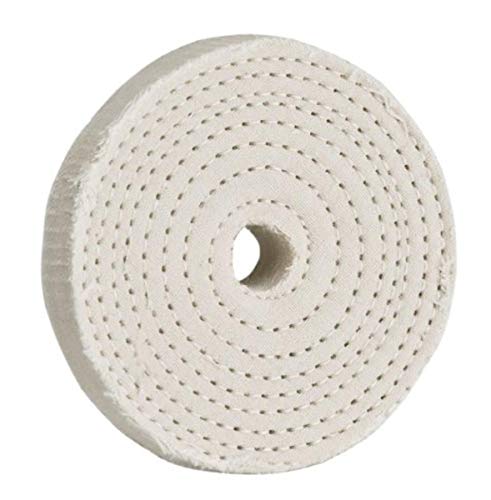
The D2499 is the small-wheel option, a 3 inch spiral sewn cotton buff for detail work that an 8 inch system wheel cannot reach. At 40 plies with a 1/2 inch arbor hole, it mounts on the same arbors and mandrels as larger wheels, but its small diameter suits pens, bottle stoppers, finials, and the inside rims of small boxes. Spiral sewing keeps the face firm for its size, so the wheel cuts predictably with Tripoli instead of folding away from the work.
It is also the natural replacement-wheel buy: a turner running a mandrel system can dedicate one of these to a single compound and save the big wheels for bowls. Small wheels grab small parts with real force, so a light touch and a firm grip on the workpiece matter more here than with any other pick.
Specs
- Diameter: 3 inches
- Construction: spiral sewn cotton, 40 ply
- Arbor hole: 1/2 inch
- Model: D2499
- Maker: Woodstock International
How to Choose Buffing Wheels for Woodturning
Decide between a system and loose wheels. A three-step system like the LBUFFSYS or the MD-01 puts all three stages on one mandrel, which is faster when you buff piece after piece on the lathe. Loose wheels cost less to start and let you mix diameters, but each stage change means swapping a wheel on the arbor.
Match the mount to your machine. The complete systems need a number 2 Morse taper headstock and tailstock support. Individual wheels need a 1/2 inch arbor, which bench grinders, buffing motors, and lathe mandrels all provide in some form. Confirm the fit before ordering, because a wheel that cannot mount securely is no bargain.
Size the wheel to the work. Eight inch wheels are the system standard and suit bowls and hollow forms. Six inch wheels are the bench-station standard. Three inch wheels trade coverage for access on pens and small parts. Bigger is not better by default: the wheel has to reach the surface cleanly.
Keep one wheel per compound. Tripoli, White Diamond, and carnauba wax each need a dedicated wheel, and the fabric should soften as the stages progress: linen or sewn cotton for Tripoli, a blend for White Diamond, and loose flannel or loose cotton for wax. A wheel loaded with the wrong compound contaminates the next stage.
Mind speed and pressure. Published instructions for lathe systems run from moderate speeds for wax up to about 3,000 RPM for the cutting stage, and every maker stresses a light touch. Heat dulls a wax finish, so if the surface feels hot, slow down and press less.
Who Should Skip These Picks
Turners who finish exclusively with film finishes such as lacquer or polyurethane, and who are happy with that look, do not need a buffing setup at all. Pen turners who polish CA glue finishes with micro-abrasive pads and plastic polish already own a complete workflow; a wheel system adds little. Anyone without a number 2 Morse taper lathe or a machine with a 1/2 inch arbor has nothing to mount these wheels on, so solve the machine question first. Finally, turners who mainly buff the inside of deep bowls should look at rounded ball-style buffs instead: flat wheels cannot follow a deep interior curve.
FAQ
What order do the three buffing steps go in?
Tripoli first, White Diamond second, carnauba wax last. Tripoli does the fine cutting that removes sanding haze, White Diamond refines the surface to a polish, and the wax wheel lays down the protective gloss coat. Each compound gets its own dedicated wheel, and skipping the middle step leaves the first step’s scratches visible under the wax.
Can I buff the inside of a bowl with a three-wheel lathe system?
Outside surfaces, yes, with care. Interiors are harder: the three wheels sit side by side on one mandrel, so a deep bowl wall can foul the neighboring wheel before the working wheel reaches the inside bottom. Shallow bowls are manageable. For deep interiors, a single wheel mounted alone, or a rounded buff, gives the clearance the three-wheel layout cannot.
What speed should buffing wheels run at?
Follow the maker’s guidance for your setup. Published instructions for the lathe systems in this roundup span roughly 1,400 to 3,000 RPM depending on the system and the stage, with the wax pass at the slower end. Bench motors built for buffing typically run near 1,725 RPM. Whatever the number, use a light touch, because pressure creates the heat that dulls a wax finish.
Do I need to apply a finish before buffing?
The system makers recommend it. Their instructions call for sanding to a high grit, then pre-treating the bare wood with an oil finish such as Danish oil and letting it dry before the wheels touch the piece. The buffing sequence then polishes that surface and adds the carnauba coat. Buffing raw, unoiled wood is possible on dense species, but the published method gives the deeper result.
Final Verdict
For a turner who wants the classic three-step result with the least fuss, the PSI Woodworking LBUFFSYS is the center of this roundup: proven layout, all three wheels on one mandrel, and replacement parts under published part numbers. The scottchen PRO MD-01 is the budget route into the same format. Turners who already own a grinder or buffer should start with the SCOTTCHEN 70 ply pair or the SALI set and dedicate one wheel to each compound, and anyone buffing pens and small parts should add the little Woodstock D2499 for the places big wheels cannot reach.
Product and ASIN Reference
| Product | ASIN |
|---|---|
| PSI Woodworking LBUFFSYS 3-Step Lathe Buffing System | B004CVJBYE |
| scottchen PRO 3-Step Lathe Buffing System MD-01 | B08MTDQ9NM |
| SCOTTCHEN Buffing Polishing Wheel 6 Inch 70 Ply 2-Pack | B07BGV23GK |
| SALI 4-Pack Polishing Wheel Set 6 Inch | B0BM6YWTS1 |
| Woodstock D2499 Spiral Sewn Buffing Wheel 3 Inch | B0000DD2AZ |
Related guides
More from Amazon
Programs that pair well with the guide above. Offers and eligibility are set by Amazon and may change.
A free business account with business pricing and bulk-buying tools for work, shop or home office.
Create a business accountFree shipping on eligible items, Prime Video and more. Eligible new members can start with a free trial.
Start a Prime free trialAudiobooks and podcasts to listen to on the go. Eligible new members can start with a free trial.
Try Audible freeAd-free music streaming. Eligible new subscribers can start with a free trial.
Try Music Unlimited freeAs an Amazon Associate we earn from qualifying purchases.