
Key takeaways
- Compare the best chop saws for metal cutting: DEWALT abrasive, Evolution dry-cut and cold-cut saws and compact options, with capacity and safety tips.
What's inside
As an Amazon Associate I earn from qualifying purchases. This post may contain affiliate links at no extra cost to you.
The Evolution S355CPSL is the best overall chop saw for most metal cutting in this group, because it pairs a 14-inch carbide-tipped blade with dry cutting, a 45-degree miter and enough capacity for common tube and angle stock without the sparks and wheel wear of an abrasive saw. A chop saw for metal is a pivoting-arm saw that drops a blade or wheel through steel held in a fixed vise, and the biggest choice is between abrasive wheels, which grind through metal, and carbide or cold-cut blades, which cut it cleanly. This guide covers six saws from a 14-inch DEWALT abrasive model to a compact 6-inch and a 7-1/4-inch cold-cut saw.
Quick List
- DEWALT D28730 14-inch Chop Saw – best for fast, rough cuts in structural steel with abrasive wheels
- Evolution S355CPSL 14-inch – best overall for clean, dry cuts in steel tube, angle and plate
- Evolution S14MCS 14-inch Mitering – best for shops that want a cold-cut saw with left-and-right miters and a light guide
- Evolution R355CPS 14-inch Multi-Material – best for mixed cutting of light steel, plastic and wood
- APLMAN 6-inch Cut-Off Saw – best for small jobs, rebar and angle iron in limited space
- VEVOR 7-1/4-inch Cold-Cut Saw – best for a compact, lightweight cold-cut saw for tube and flat stock
Which One Is Right for You?
| If you… | Choose |
|---|---|
| want a general metal-cutting saw that leaves a clean, cool cut | Evolution S355CPSL |
| cut a lot of thick structural steel and accept sparks and wheel changes | DEWALT D28730 |
| want miters in both directions and a shadow-line cut guide | Evolution S14MCS |
| mix metal, plastic and wood in a home shop and cut lighter stock | Evolution R355CPS |
| need a small, light saw for rebar, angle iron and small tube | APLMAN 6-inch |
| want a lightweight saw you can carry to a job site with a cold-cut blade | VEVOR 7-1/4-inch |
Choose the blade type first. Abrasive wheels are cheapest to start and plow through hardened steel, but they spray sparks, throw abrasive dust and shrink as they wear. Carbide-tipped and cold-cut saws cut slower in raw speed on some stock but leave a cleaner edge and need much less cleanup. Then match the capacity to your usual stock, using the 45-degree values rather than the 90-degree ones if you miter.
All 6 Picks in Detail
1. DEWALT D28730 14-inch Chop Saw – Best for Fast Abrasive Cuts in Structural Steel
As an Amazon Associate we earn from qualifying purchases at no extra cost to you.
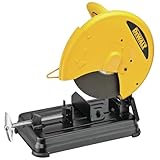
The DEWALT D28730 is a 14-inch abrasive chop saw. Distributor listings give it a 15-amp, 120-volt motor, a no-load speed of about 4,000 RPM (some listings say 3,800), a 5-inch round cutting capacity, a 0 to 45-degree miter fence, a Quick-Lock vise and a D-handle, with a weight near 35 pounds. It is the traditional contractor-style saw for cutting bar, tube, angle and pipe quickly and without fuss. The cost of that speed is sparks, wheel dust and the need to replace consumable wheels as they wear.
Wheel handling is part of owning this kind of saw. Store abrasive wheels flat and dry, check the maximum RPM printed on every wheel against the saw before mounting, and discard any wheel that has been dropped or shows a crack. Reinforced wheels shrink as they cut, so each new wheel cuts deeper than a worn one; if you notice the capacity falling short on thick stock, a fresh wheel is often the whole fix.
- Wheel: 14-inch abrasive wheel with a 1-inch arbor; confirm what is included on the listing
- Motor: 15 amp, 120 volt
- No-load speed: about 4,000 RPM; some listings show 3,800, so confirm
- Capacity: about 5 in round; mitering 0 to 45 degrees
- Weight: about 35 lb per distributor listings
Pros
- Fast cutting through thick steel and structural shapes
- Light for a 14-inch saw, with a quick-acting vise
Cons
- Heavy spark spray and abrasive dust
- Wheels wear and must be replaced; cut edge needs deburring
Choose it over the Evolution saws when raw speed and low up-front cost matter, and choose Evolution when cleanliness and fewer consumables matter.
2. Evolution S355CPSL 14-inch – Best Overall for Clean Dry Cuts
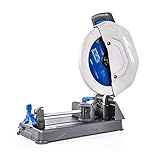
The S355CPSL is a heavy-duty 14-inch dry-cut chop saw with a carbide-tipped blade, 15-amp motor, miter up to 45 degrees and a cast steel vise. Retailer and distributor specifications list a no-load speed of about 1,450 RPM, a mild-steel-cutting blade with a 1-inch arbor, and capacities of roughly 5-1/8 inches in round tube and 4-3/4 inches in square tube at 90 degrees. Plate capacity is up to about 1/2 inch in mild steel. A carbide tooth cuts at far lower speed than an abrasive wheel, so chips are warm and the cut is cleaner, with little spark.
Technique matters with a slow carbide blade. Bring the blade down steadily rather than slamming it in, let the saw reach full speed before contact, and keep the vise tight so the stock cannot twist as the teeth bite. Chips will be hot, so wear gloves and glasses. Between jobs, brush the chip tray clean and check that the guard returns freely.
- Blade: 14-inch carbide-tipped, mild steel cutting, 1-inch arbor
- Motor: 15 amp, 120 volt, about 1,450 RPM no load per distributor listings
- Capacity at 90 degrees: about 5-1/8 in round, 4-3/4 in square tube
- Miter: left to 45 degrees per listings; confirm on product page
- Weight: about 60 lb per distributor listings
Pros
- Clean, relatively cool dry cuts with little burr and few sparks
- No abrasive wheel to replace; blades can be resharpened or swapped
Cons
- Heavier and more expensive to start than an abrasive saw
- Not suited to hardened or stainless steel without the right blade
It is the all-rounder next to the S14MCS, which adds right-hand miters and a light guide, and the DEWALT, which is quicker on raw structural cuts.
3. Evolution S14MCS 14-inch Mitering – Best for Left-and-Right Miters and a Cut Guide

The S14MCS is Evolution’s 14-inch mitering cold-cut saw built around the EVOMAX motor and blade system. Evolution’s pages list a 15-amp motor, an 80-tooth 14-inch blade, a no-load speed around 1,100 RPM, a shadow-line guide that shows where the blade will cut, an electric brake, dual sliding clamps and miters of roughly 45 degrees in both directions. Evolution quotes 3,500 or more cuts for the blade, which is a manufacturer figure. At around 72 pounds it is the heaviest saw in the group, which helps stability but makes it a bench or stand saw.
The shadow-line guide is the standout feature for repeat work: it shows the kerf line on the stock so you can set a mark to the blade without guessing at the offset. Combined with the electric brake and sliding clamps, it makes this the most production-friendly saw here for anyone cutting many pieces to a pencil mark. Given its weight, plan a rolling stand or a permanent bench position.
- Blade: 14-inch, 80-tooth cold-cut, 1-inch arbor
- Motor: 15 amp; no-load speed about 1,100 RPM per manufacturer
- Miter: both directions, about 45 degrees; confirm limits on listing
- Capacity at 90 degrees: about 4-3/4 in square tube; plate to about 1/2 in mild steel
- Extras: shadow-line cut guide, electric brake, weight about 72 lb
Pros
- Clean, burr-light cut and a light guide for accurate marks
- Miters in both directions
Cons
- Heavy and the most expensive to buy
- Slower blade speed means a deliberate cutting technique
Against the S355CPSL it gives more precision features and miter range, so choose the S355CPSL when you want less weight and a simpler saw.
4. Evolution R355CPS 14-inch Multi-Material – Best for Mixed Cutting of Lighter Stock
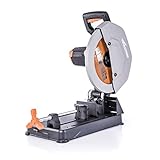
The R355CPS is a 14-inch multi-material chop saw that cuts light steel, plastic, wood and other materials with a carbide-tipped blade. Specifications from the manufacturer’s pages list a 15-amp motor at about 1,450 RPM, a 45-degree miter, capacity similar to the S355CPSL for tube at 90 degrees, but a lower limit on thick stock: mild steel plate up to about 1/4 inch and box section up to about 1/8-inch wall. It weighs around 47 pounds. A retailer calls it a light-duty saw for DIY or occasional use, which fits its limits.
If most of your work is light, such as angle iron brackets, thin-wall tube, aluminum extrusion and plastic trim, the lower limits will rarely matter and you gain versatility. If you expect to cut 3/8-inch plate or heavier box section regularly, treat the stated limits as a hard stop and look at the S355CPSL instead. Use the right blade for the material and do not cut wood and metal in the same session without cleaning chips from the base.
- Blade: 14-inch carbide-tipped multi-material, 1-inch bore; tooth count, confirm on listing
- Motor: 15 amp, 120 volt; about 1,450 RPM per manufacturer
- Miter: up to 45 degrees
- Limits: mild steel plate to about 1/4 in, box section to about 1/8 in wall
- Weight: about 47 lb per manufacturer
Pros
- Cuts metal, plastic and wood with one blade
- Lighter than the S355CPSL
Cons
- Lower thickness limits than the metal-only saws
- Not intended for heavy daily production cutting
It is the pick for a home shop; step up to the S355CPSL if you regularly cut thicker steel.
5. APLMAN 6-inch Cut-Off Saw – Best for Small Jobs, Rebar and Angle Iron

This compact 6-inch cut-off saw is listed for metal cutting with a 0 to 45-degree miter, and the description names angle iron, rebar, iron and plastic. The listing mentions a 60-tooth 6-inch blade, a 3-position fence, a spark deflector and a steel base, with a weight of about 10 pounds. The motor power figures on the listings do not agree with each other, so confirm amperage and speed on the product page. It suits a fence builder, a tinkerer or anyone who only needs small cuts and values portability over capacity.
Because documentation is inconsistent, plan to verify the blade specification and arbor size when the saw arrives, and look for a rating of the maximum safe speed on the blade itself. A small saw can still kick or bind, so clamp every piece, keep your free hand clear and let the blade stop completely before lifting the head. It is a handy second saw next to a bigger one rather than a main shop saw.
- Blade: 6 inches, 60 teeth per the listing
- Miter: 0 to 45 degrees
- Fence: three positions to suit stock size
- Motor power and speed: figures conflict across listings; confirm on listing
- Cutting capacity: not clearly stated; confirm on listing
Pros
- Light and easy to move or store
- Cuts rebar, angle and small stock
Cons
- Small capacity compared with the 14-inch saws
- Inconsistent specification data across listings
It is the smaller and lighter alternative to the VEVOR 7-1/4-inch, which states its capacity more clearly.
6. VEVOR 7-1/4-inch Cold-Cut Saw – Best for a Lightweight Cold-Cut Saw

The VEVOR chop saw uses a 7-1/4-inch stainless-steel-cutting cold-cut blade, a 1200-watt motor and a stated speed of 4,000 r/min, with a 0 to 45-degree cutting angle. Retailer pages add a maximum cutting width of roughly 2.76 inches and a thickness of about 2.56 inches, a weight near 14 pounds, a drop-down spark guard and a soft start. It is aimed at cutting metal tube, flat bar and I-shaped steel in a home or job-site setting. The 4,000 r/min speed is far higher than the Evolution saws, and cold-cut blades at that speed need to be used with care.
The capacity numbers mean you should measure before committing: a 2-inch square tube fits with room to spare, while a 3-inch tube does not. At roughly 14 pounds it is the one saw here that fits in a toolbox-sized space, which makes it useful for fence repair, trailer work and small fabrication, provided the stock is small. Read the manual, confirm the blade matches the arbor, and use the spark guard.
- Blade: 7-1/4 in cold-cut, ceramic alloy cutting heads per retailer pages
- Motor: 1200 W; 4,000 r/min no load
- Miter: 0 to 45 degrees
- Capacity: about 2.76 in wide by 2.56 in thick per retailer pages; confirm on listing
- Weight: about 14 lb per retailer pages
Pros
- Light and portable with clearly stated capacity
- Soft start and spark guard
Cons
- Limited capacity for thick or large stock
- Listing text contains inconsistencies, so double-check the blade size on arrival
Choose it over the APLMAN for clearer specifications, or over the 14-inch Evolution saws for portability.
Specs Compared
| Product | Blade or wheel | Cutting type | Miter | Motor and speed | Weight |
|---|---|---|---|---|---|
| DEWALT D28730 | 14 in abrasive wheel | Abrasive | 0 to 45 degrees | 15 A; about 4,000 RPM (some listings 3,800) | About 35 lb |
| Evolution S355CPSL | 14 in carbide-tipped | Dry cut | To 45 degrees | 15 A; about 1,450 RPM | About 60 lb |
| Evolution S14MCS | 14 in, 80-tooth cold cut | Cold cut | About 45 degrees both ways | 15 A; about 1,100 RPM | About 72 lb |
| Evolution R355CPS | 14 in carbide-tipped multi-material | Dry cut | To 45 degrees | 15 A; about 1,450 RPM | About 47 lb |
| APLMAN 6-inch | 6 in, 60-tooth | Cut-off, blade type: confirm on listing | 0 to 45 degrees | Confirm on listing | About 10 lb per listing |
| VEVOR 7-1/4-inch | 7-1/4 in cold cut | Cold cut | 0 to 45 degrees | 1200 W; 4,000 r/min | About 14 lb |
How We Chose These
This list is built from product titles, listing bullets and manufacturer or distributor specification pages. The criteria were blade type (abrasive, carbide or cold cut), blade diameter and cutting capacity, miter range, motor and speed data, weight and portability, and whether the listing clearly documents these values. We also looked at the safety features each product describes, such as a spark guard or an electric brake. This is a research-based roundup. When specifications differ between listings, we say so, and when a listing does not state a value we ask you to confirm it on the product page.
What to Look For
Abrasive Wheel Versus Carbide Versus Cold-Cut Blades
Abrasive wheels are bonded grit that grinds away steel. They are inexpensive and fast on thick, hard stock but shed dust, make showers of sparks, leave a hot burr and shrink as they wear, so the cut depth gets shallower with use. Carbide-tipped dry-cut blades use teeth that shear the metal at a much lower speed, around 1,100 to 1,500 RPM on the Evolution saws here, which makes a cleaner, cooler cut with little spark. Cold-cut blades, usually with cermet or carbide teeth, are similar in principle. The tradeoff is cost and the need to match the blade to the material, so stainless steel and hardened stock call for blades rated for them.
Capacity and the Miter Penalty
Capacity is listed at 90 degrees and at 45 degrees, and the 45-degree number is smaller. For example, the Evolution S355CPSL pages list square tube of about 4-3/4 inches at 90 degrees but about 3-1/2 inches at 45 degrees, and round tube drops from about 5-1/8 inches to about 4-1/8 inches. A good rule of thumb is to plan for roughly three-quarters of the straight-cut capacity when mitering, and to check the saw’s plate and wall-thickness limits as well as its width. A saw rated for 1/4-inch plate will not cut 1/2-inch plate cleanly or safely.
Motor Speed, Weight and Portability
A 14-inch saw with a 15-amp motor is a bench or stand tool at 35 to 72 pounds. Smaller 6 and 7-1/4-inch saws weigh 10 to 15 pounds and can be carried to a site. Speed matters for matching blades: an abrasive wheel must be rated for at least the saw’s no-load speed, and a cold-cut blade is made for a particular RPM range, so do not swap blades between saws without checking the arbor size, diameter and maximum speed printed on the blade.
Safety Gear and Setup
Metal cutting throws sparks, chips and noise. Wear safety glasses or a face shield, hearing protection and gloves suited to hot chips, and tie back loose hair and clothing. Clamp the work in the vise before you start, never hold it by hand, and let the blade reach full speed before it touches the metal. Move combustible materials away from the sparks of an abrasive saw, keep a fire extinguisher nearby, and let freshly cut metal cool before handling it. Unplug the saw to change a wheel or blade, and inspect abrasive wheels for cracks or chips before mounting.
Worked Example: Matching a Saw to a Job
Suppose you are building a steel workbench from 2-inch square tube with 1/8-inch walls and 2-inch angle. Any of the 14-inch saws handles that comfortably, and even the VEVOR 7-1/4-inch saw, with its stated 2.76-inch width, has just enough room at 90 degrees but little margin for miters. For forty repetitive cuts with clean ends ready to weld, a dry-cut Evolution saw saves a lot of grinding. For a few cuts of rebar for a concrete job, an abrasive saw or the compact 6-inch saw is more than enough.
Questions
Are chop saws for metal the same as miter saws for wood?
No. A wood miter saw runs at a much higher RPM with a toothed blade and is not made for steel. Metal chop saws use abrasive wheels or slow-speed carbide or cold-cut blades. Using a wood blade on metal is dangerous.
Can I use a carbide metal-cutting saw on stainless steel?
Only with a blade designed for stainless. Stainless work-hardens and can dull a mild-steel blade, so check the blade rating. Some saws, like the Evolution models, list lower plate limits for stainless than for mild steel.
Why do abrasive saws throw so many sparks?
The abrasive grains grind and heat the steel until tiny pieces glow and fly off. Carbide and cold-cut blades shear the metal into chips, so fewer sparks are produced, though the chips can still be hot.
Can these saws cut wood or plastic?
Multi-material models, such as the Evolution R355CPS, are meant to. Abrasive saws and cold-cut metal saws are not for wood. Always follow the manufacturer’s list of approved materials.
How should I support long stock?
Use roller stands or a support table at the same height as the saw table on both sides of the cut. Long stock hanging unsupported can bind the blade or shift when the cut finishes.
How long does a blade or wheel last?
It depends on the material, the thickness and your feed rate. Evolution quotes a figure of over 3,500 cuts for one blade, which is a manufacturer claim, and abrasive wheels are consumables that you replace as they wear. Replace any blade or wheel that is chipped, cracked or damaged.
Update History
- October 20, 2026 – Initial publication; product set drawn from current catalog listings.
- Check the product page for current specifications and availability before buying.
Sources
- Manufacturer and distributor specification pages for Evolution Power Tools, DEWALT and VEVOR
- Retailer listing titles and specification fields for each saw