
What's inside
- Quick picks by woodworking situation
- Choose the profile by cut type
- Solid carbide versus carbide-tipped
- Shank size, cutting diameter, and reach
- Feed rate and chip load: a practical setup
- Plywood, MDF, and hardwood differences
- Should you buy a CNC router bit set?
- What wears first and how to extend bit life
- What about CNC router bits for aluminum?
- Related Guides
As an Amazon Associate I earn from qualifying purchases. This post may contain affiliate links at no extra cost to you.
The best CNC router bits for woodworking are solid-carbide or carbide-tipped bits matched to the cut: a 1/4-inch compression bit for clean plywood and sheet goods, an upcut bit for chip removal and deep pockets, a downcut bit for a tidy top surface, and a two-flute upcut or compression bit for most hardwood work.
As an Amazon Associate we earn from qualifying purchases at no extra cost to you.
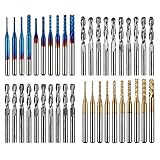


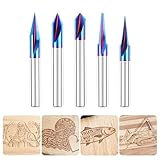
Quick picks by woodworking situation
| Situation | Recommended bit | Useful size | Starting feed rate | Why it fits |
|---|---|---|---|---|
| General plywood cutting | Two-flute compression spiral | 1/4 in shank, 1/4 in cutting diameter | 80–140 ipm at 18,000 rpm | Limits fuzzing on both the top and bottom faces |
| MDF pockets and profiles | Two-flute upcut spiral | 1/4 in or 1/8 in cutting diameter | 100–180 ipm at 18,000 rpm | Clears dusty chips efficiently and leaves a consistent wall |
| Hardwood joinery | Two-flute upcut, solid carbide | 1/4 in cutting diameter, 1/4 in shank | 60–120 ipm at 16,000–18,000 rpm | Strong edge, good chip evacuation, and predictable sizing |
| Clean top surface | Downcut spiral | 1/4 in cutting diameter | 60–110 ipm at 16,000–18,000 rpm | Pushes fibers down instead of lifting them |
| Small lettering or detail | Single-flute or two-flute upcut | 1/8 in cutting diameter | 40–90 ipm at 18,000–24,000 rpm | Fits tight corners; requires shallow passes |
| Edge shaping | Carbide profile bit with bearing | 1/4 in shank | 50–100 ipm | Produces a repeatable roundover, chamfer, or ogee |
These are starting ranges, not universal settings. Machine rigidity, bit geometry, material thickness, spindle speed, workholding, and dust extraction can move the correct feed rate substantially. Listen for a smooth cut and inspect the chips rather than treating a chart as a guarantee.
Choose the profile by cut type
Upcut spiral bits
An upcut bit pulls chips upward into the dust collector. It is the most useful general-purpose router CNC bit for slots, pockets, mortises, and through-cuts when the underside or pocket floor needs good chip evacuation. The trade-off is that it can lift fibers on the top face of plywood or tear the upper edge of veneered material.
Downcut spiral bits
A downcut bit presses fibers into the workpiece, which usually gives the cleanest top surface in plywood, MDF-faced panels, and shallow lettering. It is less suitable for deep pockets because chips are pushed downward and can recut in the kerf. Use shallow step-downs, effective dust extraction, and occasional retracts to clear the cut.
Compression bits
A compression bit combines a short upcut section near the tip with a downcut section higher on the cutter. Once the cut is deep enough for both geometries to engage, the opposing forces keep veneer fibers intact on both faces. For 3/4-inch plywood, a compression bit with roughly 1/8 to 1/4 inch of upcut geometry is a strong default. Cutting too shallowly can leave the upcut portion working alone and produce top-edge fuzzing.
O-flute and single-flute bits
O-flute bits have a polished flute that clears soft, gummy chips well. They are widely used in plastics and can work in MDF or plywood when a very open flute is helpful. Single-flute bits also make chip-load calculations simple and can run quickly on compact machines, but their finish depends heavily on correct feed rate and rigidity.
V-bits, engraving bits, and surfacing bits
Choose a 60-degree or 90-degree V-bit for signs, lettering, and decorative chamfers. A 30-degree V-bit reaches narrower details but has a fragile tip. For flattening a spoilboard or leveling a large panel, use a carbide insert surfacing cutter rather than a small end mill. Keep the surfacing cutter’s maximum diameter within your machine’s spindle and work-envelope limits.
Solid carbide versus carbide-tipped
Solid-carbide CNC router bits hold a sharp edge well and resist deflection, making them the preferred choice for small diameters, dense hardwood, and detailed work. They are also brittle: a plunge into a clamp, screw, or uneven workpiece can chip the cutting edge immediately.
Carbide-tipped bits use brazed carbide teeth on a steel body. They are often less expensive for larger profile cutters and can be durable in normal woodworking, but they generally have more mass and may not offer the same precision at tiny diameters. High-speed steel bits are inexpensive but lose their edge faster in abrasive MDF and plywood glue lines; they are rarely the best long-term choice for CNC work.
Shank size, cutting diameter, and reach
Match the shank to the collet, not merely to the bit diameter. A 1/4-inch shank is common on compact CNC routers and trim-router spindles, while 1/2-inch shanks are stiffer and better for large profile or surfacing cutters on stronger machines. Never install a 1/2-inch bit in a 1/4-inch collet with an adapter sleeve.
Shorter bits are usually safer and more accurate. Expose only enough cutter to reach the programmed depth, keeping the distance from the collet to the cutting edge as short as practical. Excessive stick-out increases vibration and can make a good bit appear dull. A 1/8-inch cutting diameter is useful for detail, but it deflects and breaks much more easily than a 1/4-inch bit.
Feed rate and chip load: a practical setup
The basic relationship is:
Chip load = feed rate ÷ (RPM × number of flutes)
For example, a two-flute bit at 18,000 rpm and 100 inches per minute gives a chip load of 0.0028 inch:
100 ÷ (18,000 × 2) = 0.0028 inch per tooth
If the edge is burning and the chips are powdery, the bit may be rubbing. Increase feed rate modestly, reduce spindle speed if your machine allows it, or use a larger step-down that still suits the machine. If the router chatters, leaves a rough scalloped wall, or breaks bits, reduce the radial engagement or feed rate and check workholding before making aggressive speed changes.
For a 3/4-inch panel, a conservative starting strategy is three passes at 1/4-inch depth, followed by a final full-depth pass if the edge matters. A full-depth cut in one pass may be faster on paper but can overload a small router, especially in hardwood or dense MDF.
Plywood, MDF, and hardwood differences
- Plywood: Glue lines and alternating grain can chip cutting edges. Compression bits are usually the best choice for through-cuts, while downcut bits work well for shallow top-face engraving.
- MDF: The material cuts consistently but produces fine abrasive dust. Use carbide, strong dust extraction, and regular collet and bearing cleaning. Avoid allowing dust to pack around the bit.
- Hardwood: Grain direction changes can cause tear-out. Use sharp solid-carbide bits, smaller step-downs around difficult grain, and climb-cutting only when you understand the associated loss-of-control risk.
Should you buy a CNC router bit set?
A CNC router bit set is worthwhile for a new machine only when it contains useful profiles and clearly states carbide grade, cutting diameter, shank size, and recommended speeds. A practical starter set might include a 1/4-inch compression bit, 1/4-inch upcut bit, 1/4-inch downcut bit, 1/8-inch upcut bit, 60-degree V-bit, and a small surfacing cutter.
A large inexpensive set can be poor value if half the bits are decorative profiles you will not use. For frequent production work, buy individual bits in duplicate instead. The cost of two dependable compression bits can be lower than the cost of replacing a panel ruined by a chipped or poorly balanced cutter. General market pricing is roughly $10–$30 for a basic carbide spiral bit, $25–$70 for a higher-quality compression bit, and $40–$150 or more for larger specialty or insert cutters.
What wears first and how to extend bit life
- Inspect the cutting edge under bright light; a reflecting line on the edge indicates wear.
- Clean resin and MDF dust with an appropriate bit cleaner and a soft brass or nylon brush. Do not scrape carbide with steel.
- Remove the collet periodically and clean the taper, nut, and collet slots. Contamination can create runout that looks like a bad bit.
- Never cut through hidden screws, nails, or brads. Scan reclaimed wood and secure stock above the spoilboard.
- Do not leave a bit clamped in a hot router. Heat, vibration, and dust accelerate wear in the collet and bearing.
- Replace a bit when it burns material despite sensible settings, needs much slower feeds, or produces a consistently rough edge.
What about CNC router bits for aluminum?
Woodworking bits are not automatically suitable for aluminum. For occasional aluminum work, use a sharp carbide single-flute or two-flute bit specifically designed for nonferrous metal, apply the manufacturer’s recommended lubrication or misting approach, and use conservative depths of cut. Aluminum chips can weld to an unsuitable flute, so a woodworking compression bit is the wrong choice. If your main work is wood, keep metal-cutting tools separate and reserve them for a rigid machine with secure workholding.
For most woodworkers, the best first purchase is a quality 1/4-inch solid-carbide compression bit, followed by separate upcut and downcut bits in the same shank size. That small group covers the majority of plywood, MDF, and hardwood jobs while making it easier to learn how profile, chip load, and cutting depth affect finish quality.