
What's inside
- Quick picks by garage situation
- How many pints does your garage need?
- Drainage matters more than an extra five pints
- Features that protect woodworking tools
- Compressor versus desiccant: which type belongs in a garage?
- Representative choices by budget and use
- Installation for reliable moisture control
- Ownership costs and maintenance
- Final buying recommendation
As an Amazon Associate I earn from qualifying purchases. This post may contain affiliate links at no extra cost to you.
The best dehumidifiers for garages are usually 35–50-pint compressor units with continuous-drain capability: choose about 20–30 pints for a small, mildly damp garage, 35–50 pints for a typical two-car garage, and a commercial or low-temperature unit for very cold, persistently wet spaces.
As an Amazon Associate we earn from qualifying purchases at no extra cost to you.
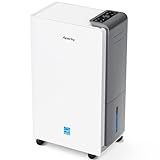


Quick picks by garage situation
| Garage condition | Approximate area | Recommended capacity | Best drainage choice | What to prioritize |
|---|---|---|---|---|
| Occasional condensation | Up to 400 sq. ft. | 20–30 pints/day | Bucket or gravity hose | Low purchase cost and adjustable humidistat |
| Typical attached garage | 400–700 sq. ft. | 35–50 pints/day | Gravity hose to a drain | Auto-defrost, washable filter, continuous operation |
| Large or very damp garage | 700–1,000 sq. ft. | 50–70 pints/day | Built-in pump or external condensate pump | Strong airflow, hose reliability, low-temperature performance |
| Unheated winter garage | Any size | Low-temperature-rated unit | Heated drain hose or pump if needed | Auto-defrost and operation below 60°F |
These capacities are practical starting points, not hard coverage limits. A garage with bare concrete, poor weather sealing, wet vehicles, or groundwater intrusion may need the next size up. A dry, insulated garage may need less.
How many pints does your garage need?
Manufacturers commonly advertise dehumidifier capacity in pints collected per day. The rating is measured under test conditions and does not mean the machine will remove that amount every day in a cool garage. Lower temperatures reduce compressor performance, while a frequently opened garage door introduces new humid air.
Use this sizing method:
- Calculate floor area by multiplying garage length by width. A 20-by-22-foot two-car garage is 440 square feet.
- Start with 20–30 pints for up to 400 square feet when humidity is only occasional.
- Choose 35–50 pints for 400–700 square feet with regular condensation or a target relative humidity around 45–55%.
- Move to 50–70 pints, or use a commercial unit, when the garage is larger, visibly damp, or affected by wet vehicles and masonry.
- Add capacity for unusually high moisture rather than relying on a small unit running continuously.
A worked sizing example
Suppose a 22-by-24-foot garage measures 528 square feet. It is attached to the house, has a concrete floor, and develops condensation after rain but has no standing water. A 35-pint unit could control it, but a 50-pint model gives more reserve for wet vehicles and door openings. Set the humidistat to 50% relative humidity, then check the actual reading after several days. If the unit runs nearly nonstop and the humidity remains above 60%, investigate leaks or move up to a larger or low-temperature-rated model.
Do not use a dehumidifier to compensate for active water entry. Repair roof, wall, slab, or plumbing problems first. Otherwise the machine may run continuously, consume more electricity, and wear out its compressor without protecting tools effectively.
Drainage matters more than an extra five pints
A bucket is acceptable for a workshop visited every day, but it is a poor choice for a garage left unattended. A full tank normally stops the compressor, allowing humidity to rise again. For tool protection, continuous drainage is usually the better feature.
Gravity hose
A gravity drain is the simplest option. Place the dehumidifier higher than a nearby floor drain, utility sink, or suitable condensate line, then attach the supplied hose or a correctly sized hose adapter. The hose must slope downward for its entire run. Avoid loops, kinks, and submerged ends, which can stop flow and cause overflow.
Internal pump
A pump allows water to travel upward or across the garage to a drain. This is useful when the only drain is above the machine or on the opposite side of the room. Pump systems add a wear item: the pump, check valve, and narrow discharge tubing can clog with dust or biological buildup. If a model has no built-in pump, an external condensate pump can provide the same flexibility.
Bucket operation
Bucket-only operation makes sense when the garage is used frequently and you want the lowest initial cost. Look for an automatic shutoff, a full-tank indicator, and a tank handle that is easy to remove without spilling water near electrical equipment.
Features that protect woodworking tools
- Adjustable humidistat: Choose a model that lets you set a target rather than simply selecting “continuous.” A 45–55% relative-humidity range is a practical target for many metal tools and stored lumber.
- Auto-defrost: Cold garages can cause frost on the evaporator coil. Defrost controls prevent the unit from operating inefficiently or shutting down prematurely.
- Washable air filter: Garages contain sawdust, sanding dust, and vehicle debris. A removable filter is easier to maintain than a disposable filter that is expensive or difficult to find.
- Restart memory: After a power interruption, the unit should resume its previous settings. This matters when the garage is not checked daily.
- Low-temperature specifications: Verify the manufacturer’s operating range. A standard basement model may perform poorly in an unheated garage during winter.
- Continuous-duty design: Compressor units intended for long operating periods generally suit damp garages better than small thermoelectric units.
- Accessible controls: A clear display showing relative humidity and a simple timer or target setting are more useful than excessive app features.
Compressor versus desiccant: which type belongs in a garage?
Most garages should use a compressor dehumidifier. It removes more water efficiently in moderate and warm conditions and is available in the 35–50-pint sizes commonly required for garages.
Desiccant dehumidifiers use a moisture-absorbing wheel rather than a compressor. They can perform better in colder spaces, but they typically use more electricity for a comparable high-moisture load and may produce more heat. They are worth considering for a small, unheated garage where a compressor repeatedly freezes or spends much of its time defrosting.
Small thermoelectric units are quiet and inexpensive, but they generally remove too little water for a full-size garage. They are better suited to a cabinet, enclosed tool locker, or very small storage area.
Representative choices by budget and use
| Choice | Typical market range | Suitable garage | Advantages | Limitations |
|---|---|---|---|---|
| Basic 20–30-pint compressor | About $150–$250 | Small, mildly damp space | Lower cost, simpler controls | Small bucket and limited moisture reserve |
| Standard 35–50-pint compressor | About $200–$350 | Most one- and two-car garages | Good capacity, humidistat, hose drainage | May struggle below roughly 60°F |
| Pump-equipped 35–50-pint model | About $250–$450 | Garages without a low nearby drain | Automatic removal over distance or height | More parts to clean and eventually replace |
| Commercial or low-temperature unit | About $500–$1,500+ | Large, cold, or persistently wet garages | Stronger construction and cold-weather capability | Higher purchase price, noise, and power use |
Common consumer brands such as Frigidaire, Midea, GE Appliances, Honeywell, and hOmeLabs offer models in the standard residential range, but model specifications change. Compare the current data sheet for pint rating, minimum operating temperature, hose connection, pump availability, noise, and warranty rather than choosing by brand name alone.
Installation for reliable moisture control
- Place the unit on a level, solid surface with clearance around the air intake and exhaust. Keep it away from sawdust-producing operations and direct spray.
- Close the garage door and nearby windows as much as practical. Dehumidifying an open garage wastes energy.
- Connect the drain hose with a continuous downward slope, or route the pump discharge according to the manual.
- Set the target humidity to 50% and let the unit operate for 24–48 hours before judging performance.
- Use a separate hygrometer near the tool storage area. The number on the dehumidifier may not represent humidity at the opposite end of the garage.
- Inspect metal tools for existing rust and apply appropriate protective oil or wax. Dehumidification slows new corrosion but does not remove existing rust.
Ownership costs and maintenance
The filter is usually the first routine item to load with dust. Inspect it weekly in an active woodworking garage and wash or vacuum it according to the instructions. A clogged filter reduces airflow, increases runtime, and can encourage coil icing.
Clean the bucket, drain pan, hose inlet, and pump screen periodically. Dust the coil and exterior without forcing debris into the fan. Keep the unit upright during storage and follow the manufacturer’s instructions after moving it; compressor oil may need time to settle before operation.
Electricity cost depends on wattage and runtime. For example, a 500-watt unit running 10 hours per day uses about 5 kilowatt-hours daily. At an electricity rate of $0.18 per kWh, that is approximately $0.90 per day or $27 over 30 days. A properly sealed garage and a realistic humidity setting can reduce runtime more effectively than buying a marginally larger machine.
Final buying recommendation
For most woodworking garages, choose a 35–50-pint compressor dehumidifier with an adjustable humidistat, auto-defrost, washable filter, automatic restart, and continuous-drain connection. Select a pump-equipped version when gravity drainage is impossible. If the garage stays cold for long periods, prioritize a low-temperature-rated or commercial unit over a larger ordinary basement model. Correct sizing, dependable drainage, and regular filter cleaning will do more to prevent tool rust than a high pint rating alone.