
What's inside
- Best desktop 5-axis CNC machines at a glance
- Why the Pocket NC V2-50 is the strongest all-round choice
- When the V2-10 is the better desktop 5-axis CNC machine
- 5-axis desktop CNC versus 4-axis desktop CNC
- How to calculate whether the machine fits your part
- Ownership realities buyers often miss
- Bottom line
- Related Guides
As an Amazon Associate I earn from qualifying purchases. This post may contain affiliate links at no extra cost to you.
The best desktop 5-axis CNC for 2026 buyers is the Pocket NC V2-50 for aluminum and hardwood work, while the smaller Pocket NC V2-10 makes more sense for miniature parts, wax, plastics, and limited bench space; a 4-axis desktop CNC machine is usually the better value if you do not need simultaneous 5-axis cutting.
“5-axis” does not automatically mean industrial cutting capacity. Some machines tilt and rotate a small workpiece but still have a tiny tool envelope, low spindle power, or poor chip clearance. The useful buying questions are how much material fits between the tool and the rotary table, whether the spindle can maintain cutting speed in aluminum, and whether the machine can live on your bench without becoming a permanent obstruction.
As an Amazon Associate we earn from qualifying purchases at no extra cost to you.

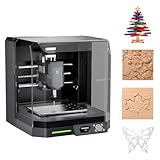
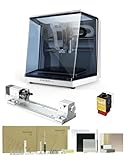

Best desktop 5-axis CNC machines at a glance
| Machine or category | Practical work envelope | Spindle and materials | Approximate bench footprint | Best use |
|---|---|---|---|---|
| Pocket NC V2-50 | About 5 x 4 x 3 in.; rotary axes for indexed or simultaneous work | 10,000-rpm class spindle; aluminum, brass, plastics, wax, and hardwood with conservative tooling | About 18 x 18 in.; roughly 24 in. tall | Small metal parts, fixtures, molds, and serious desktop 5-axis work |
| Pocket NC V2-10 | About 1.8 x 1.8 x 1.8 in. | High-speed small-tool spindle; wax, plastic, graphite, and very small aluminum parts | About 16 x 16 in.; roughly 16 in. tall | Jewelry-scale work, medical-model-style geometry, and compact benches |
| Typical 4-axis desktop CNC with rotary attachment | Approximately 8 x 8 x 3 in., depending on the base machine and rotary fixture | Usually 15,000–24,000 rpm router spindle; wood, plastics, wax, and light aluminum | Approximately 24 x 24 in. plus cable and dust-clearance space | Wrapped carving, guitar parts, signs, and lower-cost experimentation |
| Small industrial benchtop 5-axis mill | Approximately 8–16 in. per linear axis | 12,000–24,000 rpm, commonly 1–5 hp; aluminum, steel, and production tooling | Often 36 x 36 in. or larger; commonly several hundred pounds | Frequent metal production where “desktop” is used loosely |
Envelope figures are useful working approximations rather than interchangeable manufacturer specifications. Rotary fixtures, tool holders, vise jaws, and tilted-axis clearance can reduce the usable volume substantially. Always check the current machine drawing before ordering a stand or planning a part.
Why the Pocket NC V2-50 is the strongest all-round choice
The V2-50 is the most convincing choice when “desktop 5 axis cnc” means a genuine small machining center rather than a 3-axis router with a fourth-axis accessory. Its roughly 5-inch-scale work envelope is large enough for brackets, impellers, small molds, watch components, and aluminum prototypes, yet the machine remains suitable for a reinforced bench rather than a factory floor.
Its limitation is not the number of axes; it is cutting capacity. A 10,000-rpm spindle and compact frame are appropriate for small cutters and light passes, not aggressive production milling. Aluminum is realistic when the work is rigidly clamped, the tool is sharp, coolant or suitable lubrication is managed carefully, and radial engagement remains modest. Hardwood is also practical, although a dust shoe and extraction arrangement may be more important than maximum spindle speed.
Choose this machine if you need indexed or simultaneous 5-axis toolpaths, regularly make metal parts smaller than a fist, and can accept slower material removal than a full-size VMC. General market pricing for a machine in this class is commonly in the low five-figure range before tooling, shipping, workholding, and software.
When the V2-10 is the better desktop 5-axis CNC machine
The V2-10 is a specialist choice. Its approximately 1.8-inch cube envelope rules out many brackets and woodworking projects, but that small volume is an advantage for tiny parts: wax patterns, miniature molds, jewelry components, dental-style models, small plastic mechanisms, and delicate multi-sided prototypes.
Do not buy it because the machine is cheaper or occupies less space if your parts are routinely larger than 2 inches. A part that fits the linear envelope can still fail when the vise, fixture, tool holder, and tilted rotary axes are included. The V2-10 is best understood as a precision miniature 5-axis desktop CNC, not a scaled-down replacement for a general-purpose mill.
5-axis desktop CNC versus 4-axis desktop CNC
A desktop 4-axis CNC adds rotation around one axis, commonly allowing a cylindrical part to be machined from several indexed positions. It is excellent for chair spindles, relief carving around a dowel, guitar-neck details, and parts that need machining on four sides. A 4 axis desktop CNC machine also tends to be less expensive and easier to program.
Five axes become valuable when the cutter must maintain a better angle against sloped surfaces, reach deep pockets with a shorter tool, or machine multiple faces without repeatedly removing and re-indicating the part. That capability costs more in post-processing, fixturing, collision checking, and setup time. If your work is mostly flat panels, joinery, signs, or straightforward turned reliefs, a desktop 4-axis CNC is usually the more productive purchase.
| Your situation | Best fit | Reason |
|---|---|---|
| Budget below roughly $5,000 | 3-axis router or 4-axis conversion | Reserve money for tooling, dust extraction, workholding, and CAM software. |
| Small aluminum parts every week | Pocket NC V2-50 or a heavier benchtop mill | Rigidity and enclosed chip control matter more than a large advertised axis count. |
| Wax, foam, jewelry, and tiny prototypes | Pocket NC V2-10 | The small envelope matches miniature work and reduces wasted bench space. |
| Hardwood components and carved furniture details | 4-axis router or large 3-axis router | Wood parts generally need more XY reach than most compact 5-axis mills provide. |
| First CNC and occasional use | 4-axis desktop machine | Simpler CAM and workholding produce a shorter learning curve. |
| Frequent complex prototypes | V2-50 or industrial benchtop 5-axis mill | Automatic reorientation reduces repeated setups and alignment errors. |
How to calculate whether the machine fits your part
Start with the finished part, not the stock size. Add at least 0.25 inch of stock on each side for roughing, then reserve space for the fixture. For example, a 3.5 x 2.5 x 1.5-inch aluminum part may require a 4 x 3 x 2-inch billet. A vise and jaw set can consume another inch or more around the part, while a tilted toolpath needs clearance above corners. A nominal 5 x 4 x 3-inch envelope may therefore be comfortable for that part but unsuitable for a 4.8-inch-wide part mounted in a bulky fixture.
For rotary work, inspect the swept diameter at the most extreme tilt. A cylindrical blank that fits when the rotary axis is level can strike the enclosure or spindle when tilted. Simulate the complete setup in CAM before purchasing material or tooling.
Ownership realities buyers often miss
- Tooling costs accumulate quickly. Small carbide end mills, collets, holders, probing equipment, vises, soft jaws, and workholding can add 15–30 percent to the initial machine budget.
- Small cutters break first. Excessive stick-out, clogged flutes, poor chip evacuation, and plunging at the wrong feed rate are common causes of failure.
- Dust and chips are different problems. Hardwood needs extraction and enclosure protection; aluminum needs chips cleared from the cut and careful lubrication. Do not assume a woodworking dust shoe is suitable for metal machining.
- Five-axis calibration matters. Rotary-axis centerline error becomes visible as misaligned features on opposite faces. Use a repeatable fixture and verify rotary-axis offsets after moving the machine.
- Software is part of the machine. A desktop cnc 5-axis setup needs a postprocessor that matches its rotary conventions, limits, and collision behavior. Generic 3-axis CAM output is not enough.
Bottom line
For a real 5-axis desktop CNC machine that can tackle small aluminum and hardwood work, choose the Pocket NC V2-50 and plan for light, controlled cuts. Choose the V2-10 only when your parts genuinely fit its miniature envelope. If your projects are mainly wood, foam, wax, or wrapped carving, a larger and simpler 4-axis desktop CNC machine will often deliver more usable capacity for less money. The decisive specification is not “five axes”; it is the combination of clear work envelope, rigid fixturing, spindle capability, chip management, and the bench space required to use all of them safely.