
What's inside
- Quick comparison
- Best overall for effortless family sharing: Aura Carver
- Best for a narrow shelf or portrait collection: Aura Mason
- Best for a simple touchscreen appliance: Skylight Frame
- Best for multiple albums and local file flexibility: Pix-Star
- Decision matrix by room and family habits
- How much resolution do you actually need?
- Storage: cloud convenience versus local control
- Setup that prevents common problems
- Durability and ownership details
- Bottom line
As an Amazon Associate I earn from qualifying purchases. This post may contain affiliate links at no extra cost to you.
The best digital picture frames for most families are the Aura Carver for simple app sharing, the Aura Mason for a more discreet portrait-oriented display, and a 15-inch Pix-Star frame when viewing distance or a large photo library matters more than furniture-friendly size.
The right choice depends on three measurements: the wall or shelf space available, the resolution needed at that distance, and how much effort relatives should spend sending photos. A compact frame with excellent sharing can be a better family purchase than a larger screen with a complicated setup.
As an Amazon Associate we earn from qualifying purchases at no extra cost to you.

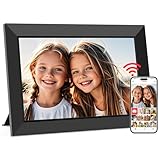


Quick comparison
| Frame | Screen and resolution | Storage and sharing | Approx. market range | Best fit |
|---|---|---|---|---|
| Aura Carver | 10.1-inch landscape LCD, 1600 × 1200 | Cloud-based photo storage; app sharing and invitations | $150–$200 | Families who want the easiest sharing experience |
| Aura Mason | 9-inch portrait-oriented LCD, 1600 × 1200 | Cloud-based storage; app uploads and shared access | $150–$200 | Small shelves, bedside tables, and portrait photos |
| Skylight Frame 10 | 10-inch touchscreen, approximately 1280 × 800 | Cloud photo delivery through an app or email-style sharing; paid features may apply | $130–$180 | Users who prefer a simple, appliance-like interface |
| Nixplay 10.1-inch frame | 10.1-inch LCD, commonly 1280 × 800 | App, playlists, and cloud account features; capacity varies by plan and model | $150–$250 | Several households managing separate albums |
| Pix-Star 15-inch frame | 15-inch LCD, commonly 1024 × 768 | Internal storage, memory-card support, email, and online photo services | $180–$250 | Large rooms and extensive local photo collections |
Specifications can vary between generations and regional versions, so check the exact model number before ordering. Resolution is not the only measure of image quality: viewing angle, brightness, automatic dimming, and how well the frame crops portrait images can matter just as much.
Best overall for effortless family sharing: Aura Carver
The Aura Carver is the strongest choice when several people will add photos from their phones. Its 1600 × 1200 panel is unusually sharp for a 10.1-inch frame, and the landscape format suits group pictures, holiday scenes, and most phone photos after cropping.
Its main advantage is the sharing workflow. An owner can invite family members to a private frame, and contributors can add images through the Aura app without handling a memory card or visiting the frame. This is useful for grandparents or relatives who want new pictures but should not have to manage Wi-Fi settings.
The limitation is physical format. The Carver is wider than it is tall, so it works best on a console, mantel, or a wall section with roughly 12 inches of horizontal room. It is less suitable if the available space is a narrow vertical opening or if the collection is dominated by portrait-oriented phone photos.
Best for a narrow shelf or portrait collection: Aura Mason
The Aura Mason uses a smaller, portrait-oriented design and is easier to place beside books, a lamp, or a small woodworking project. It is a good match for family portraits, school photos, and images taken vertically on a phone. The 1600 × 1200 resolution keeps faces and fine details clear at normal tabletop distance.
Choose it over the Carver when the frame itself should occupy less visual space. Choose the Carver instead when several viewers will stand farther away or when landscape family scenes dominate the library. Neither model is the ideal choice for displaying a large offline archive, since their cloud-centered design favors convenient sharing over removable-storage flexibility.
Best for a simple touchscreen appliance: Skylight Frame
Skylight Frame is appealing to households that want a straightforward dedicated device rather than a feature-heavy photo system. Photos can be sent through the associated sharing process, and the touchscreen makes basic navigation accessible to people who prefer not to use a phone app for every action.
Its typical 1280 × 800 resolution is adequate for a 10-inch display, although it gives up some pixel density compared with Aura’s 1600 × 1200 screen. That difference is most visible when the frame is close to eye level or when displaying detailed images such as scanned photographs. Review the current subscription terms before buying: some cloud features and expanded functions may depend on a paid plan.
Best for multiple albums and local file flexibility: Pix-Star
A 15-inch Pix-Star frame makes more sense in a living room, hallway, or workshop than on a crowded end table. Its larger image area remains easy to see from across a room, and its support for local storage and memory cards is useful when the photo library is already organized on a computer.
The trade-off is pixel density. A 1024 × 768 image spread across 15 inches is less sharp than a 1600 × 1200 image on a 10-inch frame. At six feet, the larger size usually wins; at two feet, the smaller high-resolution panel can look more refined. Pix-Star also exposes more settings, which is helpful for an organizer but less ideal for a relative who wants the fewest possible controls.
Decision matrix by room and family habits
| Your situation | Recommended type | Why |
|---|---|---|
| One person curates photos for several relatives | Aura Carver | Invitations and app sharing reduce maintenance across households |
| Narrow shelf, bedside table, or mostly portrait images | Aura Mason | Compact portrait format uses less horizontal space |
| Recipient dislikes apps and prefers touching the screen | Skylight Frame | Simple touchscreen interaction is easier to understand |
| Multiple contributors need separate playlists | Nixplay | Playlist-oriented controls suit several groups or rooms |
| Large room, long viewing distance, or offline archive | 15-inch Pix-Star | Large screen and local-storage options reduce dependence on phone uploads |
| Lowest upfront budget | Basic 10-inch Wi-Fi or microSD frame | Often costs $60–$120, but app quality and support vary widely |
How much resolution do you actually need?
For a 10-inch frame viewed from a desk or shelf, 1280 × 800 is generally sufficient. A 1600 × 1200 panel is preferable when the frame is close to the viewer, when scanned prints contain fine detail, or when the frame will double as a small art display.
For a 15-inch frame viewed across a room, size and brightness can be more valuable than extra pixels. Before mounting it, mark the frame’s approximate outer dimensions on the wall with painter’s tape. A 15-inch class frame is commonly around 15 to 16 inches wide and 11 to 13 inches tall, while a 10-inch frame is often about 10 to 12 inches wide and 7 to 9 inches tall. Confirm the manufacturer’s dimensions because bezels and stands differ.
Storage: cloud convenience versus local control
Cloud-first frames are easiest for ongoing family sharing. They avoid manually resizing photos and allow contributors in different locations to add pictures. They also depend on the maker’s account system, servers, and subscription policy. If service access changes, the frame may lose some sharing functions even though its screen still works.
Local-storage frames are better for a large, stable archive. A 32 GB card can hold roughly 8,000 four-megapixel JPEGs at an average file size of 4 MB, although modern phone images may be much larger. For a rotating collection of 1,000 photos, even 8 GB is usually ample. Check whether the frame copies images internally or reads the card continuously; that affects how easy it is to update the collection.
Setup that prevents common problems
- Prepare the library. Remove duplicates, rotate sideways images, and export edited photos as JPEGs or supported formats. This prevents a family frame from repeatedly showing near-identical pictures.
- Choose the crop before uploading. A 4:3 frame crops a 16:9 phone image differently from a 16:10 frame. Keep important faces away from the edges.
- Connect it near the router. Complete updates and initial synchronization before moving the frame to its final wall or shelf position.
- Set brightness and sleep hours. Automatic dimming reduces glare at night and avoids wasting power when nobody is viewing it.
- Invite contributors selectively. Use a small group of trusted family members or a single curator. Uncontrolled sharing can fill the frame with screenshots, duplicates, and low-resolution social-media downloads.
Durability and ownership details
The screen is usually not the first part to fail. Power adapters, USB connectors, stands, and wall-mount hardware receive more physical stress. Leave a little slack in the power cable, avoid hanging the frame where the cable is pulled sideways, and use the supplied adapter unless its electrical specifications match exactly.
Clean the display with a dry microfiber cloth or one lightly dampened with water. Do not spray cleaner directly onto the panel, press hard on the LCD, or use paper towels that can scratch glossy surfaces. Keep the frame away from direct sunlight and heat sources; prolonged heat can shorten the life of the display and discolor surrounding materials.
For a woodworking-built surround, leave ventilation space around the frame and make the inner opening slightly larger than the visible screen rather than forcing the bezel into a tight fit. Design the back panel to remain removable so the power connector, reset button, and ventilation openings are accessible.
Bottom line
Buy the Aura Carver when easy, multi-person sharing is the priority. Pick the Aura Mason for a smaller portrait-oriented location. Choose Skylight when a simple touchscreen experience matters most, Nixplay when playlists and multiple groups are important, and a 15-inch Pix-Star when the frame must be visible across a room or manage a substantial local archive. Measure the wall first, count the likely photo contributors, and then decide whether cloud convenience or removable storage better matches the way your family actually handles pictures.