
What's inside
As an Amazon Associate I earn from qualifying purchases. This post may contain affiliate links at no extra cost to you.
The best dog agility training equipment for most backyards in 2026 is a modular kit built around a PVC or coated-steel frame, a fold-flat tunnel, and adjustable-height jumps — the Better Sporting Dogs and PawHut home kits cover this well in the $150–$400 range, while serious handlers should look at competition-grade weaves and a low-profile contact obstacle. Below we break down material durability, the actual square footage each obstacle needs, and how much garage space everything swallows when you’re done for the season.
As an Amazon Associate we earn from qualifying purchases at no extra cost to you.
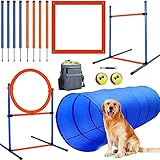
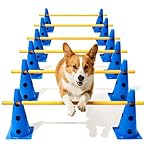


What Makes Backyard Agility Equipment Different from Competition Gear
Competition obstacles are built to regulation specs and weigh accordingly — a USDAA-standard A-frame tips past 200 lbs. Backyard equipment trades some rigidity for portability: PVC instead of aluminum, sandbag-anchored tunnels instead of staked ones, and jump standards you can move with one hand. That’s the right trade for home use, but it means material quality matters more, not less. Cheap PVC cracks in UV within a season; look for furniture-grade or UV-stabilized pipe, and powder-coated steel over painted mild steel for anything with a base.
The three things that actually determine whether a kit works in your yard:
- Frame material. Furniture-grade PVC and powder-coated steel survive 3–5 seasons outdoors; thin-walled white plumbing PVC becomes brittle in sun in 12–18 months.
- Anchoring. Grass stakes beat sandbags on any soft surface. If your yard is turf or gravel, you need weighted bases — plan for it.
- Storage footprint. A full six-obstacle course should fold into under 8 cubic feet if it uses collapsible tunnels and flat-pack standards. Fixed obstacle owners need roughly triple that.
Space Math: How Much Yard Does Each Obstacle Need?
Manufacturers list obstacle dimensions, not the course footprint — and that’s where people get surprised. A tunnel is 10–24 ft long, but a safe run line also needs approach and exit lanes. Here’s the real footprint per obstacle, including run-off:
| Obstacle | Obstacle Size | Min. Safe Footprint (with approach/exit) | Stored Size | Setup Time |
|---|---|---|---|---|
| Collapsible chute/tunnel (15 ft) | 15 × 2 ft | ~30 × 10 ft | Folds to ~24″ disc, 2″ thick | 2 min |
| Bar jump (adjustable) | ~4 ft wide, up to 36″ tall | ~20 × 12 ft | Two standards + bar, flat-pack ~4 ft | 3 min |
| Weave poles (set of 12) | 12 ft line, 24″ spacing | ~25 × 8 ft | Channel-style base folds in half, ~6 ft | 5 min |
| Tire jump | ~4 × 5 ft frame | ~20 × 12 ft | Breaks down to hoop + 2 standards | 4 min |
| Pause table | 36 × 36 in, 8–12″ tall | ~12 × 12 ft | Fixed; ~4 cu ft | 1 min |
| Teeter (backyard size) | ~8 ft board | ~20 × 12 ft | Board + base, ~10 cu ft | 10 min |
Rule of thumb: a flowing 5-obstacle course needs a clear run of about 30 × 60 ft — roughly 1,800 sq ft. You can compress to ~25 × 40 ft with a tighter layout and smaller dog, but below that you’re training individual skills, not courses. If your yard is under 1,000 sq ft, prioritize a tunnel, two jumps, and weave poles with a channel base you can open for teaching.
The Picks by Situation
Best complete starter kit: PawHut agility starter sets or Trixie Dog Activity kits
Both brands sell bundled sets (typically two jumps, a tunnel, weave poles, and a pause box or hoop) in the $100–$200 range. PawHut’s tunnels use spiral steel frames in 190T polyester — durable enough for weekly use, though the fabric will fade by year two. Trixie’s jump cups are plastic rather than metal; fine for training, but replaceable if you run a heavy dog through the bar repeatedly. These kits are the right call if you’re not sure your dog will love the sport — the sunk cost is low and everything stores in a closet corner.
Best for committed hobbyists: Better Sporting Dogs agility line
Better Sporting Dogs sells individual obstacles and bundles aimed at serious home trainers — adjustable bar jumps with competition-style cups, channel weaves, and a regulation-feel tunnel. Expect $300–$600 for a meaningful course. The step up buys you metal jump cups, UV-stabilized components, and obstacle heights that translate directly to trial conditions, so skills learned at home transfer.
Best for small yards and apartments: tunnel + 2-jump combo
Skip the bundles. A single 15-ft collapsible tunnel ($30–$60) plus two adjustable jumps teaches drive, handling front/rear crosses, and jump commitment — the majority of agility skills — in under 800 sq ft. Add a travel plank or wobble board later for contact confidence without a full teeter.
Best for large/high-energy dogs: anchored equipment only
Dogs over ~50 lbs knock over lightweight standards and drag sandbag tunnels. Prioritize jump standards with wide steel bases, tunnels with stake loops at both ends, and a tire jump with a breakaway hoop — a hard-plastic hoop hit at speed is how shoulders get bruised.
Decision Matrix
| Your Situation | Recommended Setup | Budget Range | Yard Needed |
|---|---|---|---|
| First-time owner, unsure of dog’s interest | Bundled starter kit (PawHut/Trixie type) | $100–$200 | ~1,200 sq ft |
| Small yard or patio training | Tunnel + 2 jumps bought separately | $60–$120 | ~800 sq ft |
| Preparing for trials | Competition-spec individual obstacles | $400–$800 | ~1,800 sq ft |
| Multiple dogs / daily use | Metal-cup jumps, channel weaves, staked tunnel | $350–$600 | ~1,500 sq ft |
| Large breed, high speed | Weighted-base everything, breakaway tire | $300–$500 | ~1,800 sq ft |
Durability and Ownership Realities Listings Don’t Mention
- Tunnel fabric fails first. The 190T polyester on budget tunnels UV-degrades in 2–3 seasons if left out. Store tunnels indoors — folded, they take less room than a laundry basket, so there’s no excuse.
- Jump bars are consumables. A 4-ft PVC jump bar costs a few dollars to replace and should be treated as disposable. Dogs learning jump height will break or bow bars; that’s the system working.
- Weave pole bases rust and warp. Steel channel bases rust at the weld points if stored damp; flat PVC bases warp if leaned against a wall in a hot garage. Store them flat or hung.
- Stakes beat bags long-term. Sandbag anchors degrade in sun and split seams; 12-inch spiral ground stakes hold better and cost under $15 for a set — buy them even if the kit includes bags.
- Common setup mistake: spacing obstacles too close to “fit the yard.” Dogs need 10–15 ft to commit to a jump approach. A stretched-out 3-obstacle line trains more than a cramped 6-obstacle knot.
FAQ
Can I leave agility equipment outside year-round?
Only the steel-framed pieces survive it gracefully. Tunnels, PVC jump bars, and pause table surfaces all degrade under UV and freeze-thaw cycles. A folded tunnel and flat standards store in under 8 cubic feet — garage shelving handles it.
How high should I set jumps for a beginner dog?
Start with the bar on the ground or at wrist height for your dog — roughly 4–8 inches for medium breeds. Dogs learn obstacle commitment first, height later. Raising the bar before the dog drives through the obstacle creates stutter-stepping habits that are hard to undo.
Is a backyard course enough for trial preparation?
For obstacle skills, yes — backyard-sized teeters and channel weaves teach the mechanics. What you can’t replicate at home is ring pressure and full-course spacing, so occasional access to a club field still matters for sequencing.
Start small, buy for durability over obstacle count, and measure your yard against the real footprints above before committing to a full kit.