
What's inside
As an Amazon Associate I earn from qualifying purchases. This post may contain affiliate links at no extra cost to you.
The best hand planer for woodworking is a No. 4 smoothing plane for general furniture work, but a No. 5 jack plane is the better first purchase if you need to flatten boards, while a low-angle block plane is the most useful compact option for end grain, chamfers, and small adjustments.
Choosing among hand planers for woodworking is less about finding one “best” model and more about matching the plane’s sole length, blade width, cutting angle, weight, and adjustment system to the job. A short plane follows curves and local high spots; a long plane bridges hollows; a wider blade removes more material but demands more sharpening effort.
As an Amazon Associate we earn from qualifying purchases at no extra cost to you.


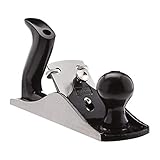

Quick recommendations by situation
| Situation | Best plane type | Useful specification | Why it fits |
|---|---|---|---|
| One plane for a broad range of furniture work | No. 5 jack plane | 350–380 mm sole, 50–51 mm blade, about 1.8–2.5 kg | Long enough for jointing and short enough for general stock preparation |
| Final smoothing before finish | No. 4 smoothing plane | 240–250 mm sole, 50–51 mm blade, about 1.7–2.2 kg | Easy to control and capable of fine shavings on prepared surfaces |
| Flattening long boards or shooting a joint | No. 7 jointer plane | 560–610 mm sole, 60–62 mm blade, about 3.5–4.5 kg | Bridges dips and produces a straight reference edge |
| End grain, trimming, and small parts | Low-angle block plane | 150–180 mm sole, 40–45 mm blade, about 0.7–1.0 kg | Compact, maneuverable, and effective on end grain |
| Heavy stock removal | No. 5½ or No. 6 fore plane | 400–460 mm sole, 55–60 mm blade, about 2.5–3.5 kg | More stable than a jack plane without the bulk of a jointer |
The best hand planer for woodworking at each skill level
Best first plane: a No. 5 jack plane
A traditional No. 5 jack plane is the most adaptable woodworking hand planer for a beginner who wants to prepare rough lumber, true edges, level glued panels, and refine parts. Its roughly 350–380 mm sole is long enough to reveal and reduce moderate hollows, while its manageable size does not make short workpieces awkward.
Choose a model with a 50–51 mm blade and a reliable depth-adjustment mechanism. A cambered blade, with the corners relieved slightly, is appropriate for removing material. For general work, a cutting depth of approximately 0.05–0.15 mm produces controllable shavings; deeper cuts are possible, but they increase effort and the risk of tear-out.
The Stanley No. 5 is a widely available vintage and current-pattern option, while the Lie-Nielsen No. 5 and Veritas No. 5½ offer heavier construction and more refined adjustment. Typical market ranges run from roughly $50–$150 for a usable economical or restored plane, and about $250–$450 for premium modern versions.
Best for finishing: a No. 4 smoothing plane
A No. 4 is the right choice when boards are already reasonably flat and the goal is a clean, attractive surface. Its shorter sole follows small changes in the wood instead of bridging them, and its blade is normally sharpened with little or no camber for a narrow, even shaving.
Use it after a jack or fore plane, not as a substitute for flattening badly twisted stock. A finely set No. 4 can take shavings around 0.02–0.05 mm thick. The Lie-Nielsen No. 4 and Veritas bevel-up smoother are premium examples; a well-tuned Stanley No. 4 can perform the same class of work at a much lower cost.
Best for joinery: a low-angle block plane
For trimming tenon cheeks, easing sharp edges, fitting drawer parts, and shooting small end-grain surfaces, a low-angle block plane is usually more useful than a full-size plane. Its blade commonly sits at about 12 degrees, producing a low combined cutting angle that slices end grain effectively when the blade is sharp.
A low-angle block plane is also a practical hand planer for woodworking in a small shop because it needs little storage space and can be used one-handed. The trade-off is its short sole: it cannot reliably flatten a long edge or broad panel.
Best for long edges: a No. 7 jointer plane
When the task is preparing a long edge for a tabletop glue-up or checking a board for straightness, a No. 7 jointer plane earns its weight. Its 560–610 mm sole spans local hollows, and its broad blade removes enough material to make progress without repeated passes.
It is not automatically better for every user. A long plane can be tiring, particularly on dense hardwood, and it requires a sufficiently long, flat workbench. If your projects are mostly small boxes, instruments, or short furniture components, a No. 5 may be more useful.
How the important specifications affect the choice
Blade width and sharpening
Wider blades cover more surface per pass but require more force and more time at the sharpening station. A 50 mm blade is a sensible general-purpose size; blades around 60 mm suit larger planes and heavy stock removal. Narrower blades can be easier for smaller hands and are adequate for narrow components.
Steel type matters less than edge geometry and maintenance. A plane that uses a replaceable or easily removed blade may be more convenient for a beginner, while a thick blade with a substantial cap iron can resist chatter in difficult grain. Keep a primary bevel around 25–30 degrees unless the manufacturer specifies otherwise, then hone a small secondary bevel around 30–35 degrees.
Sole length
Think of the sole as a reference bridge. A 150–180 mm block-plane sole is excellent for local corrections but cannot establish a straight edge. A 350–380 mm jack-plane sole balances correction and maneuverability. A 560 mm or longer jointer sole is valuable only when the workpiece and bench are long enough to benefit from it.
Adjustment systems
Most metal bench planes use either a traditional frog-and-yoke depth adjustment or a bevel-up system. Traditional designs offer a familiar, stable arrangement and can be adjusted while the blade is installed. Bevel-up planes often make blade removal and sharpening quicker, and their effective cutting angle can be changed by installing a blade with a different bevel.
Lateral adjustment is important because it lets you align the blade edge with the sole. Look for a mechanism with little backlash. A plane that shifts unpredictably during adjustment will waste more time than a less expensive plane with a simple but precise mechanism.
Weight and balance
Extra weight can help a plane carry momentum through difficult grain, but it does not replace a sharp edge or correct technique. For repeated flattening, a 2–3 kg jack plane may feel efficient. For delicate work, a lighter plane gives better feedback and reduces fatigue. Choose a handle and tote that allow your wrist to remain reasonably straight; comfort affects accuracy over a full work session.
A practical buying decision
- Limited budget: Buy a sound used No. 4 or No. 5 and reserve part of the budget for sharpening equipment. A $75 plane with a properly flattened sole and sharp blade can outperform a $200 plane that is poorly set up.
- Beginner with mixed projects: Start with a No. 5 jack plane, then add a low-angle block plane. This combination covers stock preparation, edge work, chamfers, and many fitting tasks.
- Mostly small projects: Choose a block plane or No. 4 before considering a jointer plane. A long, heavy plane will occupy space without providing much advantage.
- Frequent furniture making: Add a No. 4 for finishing and a No. 7 for long joinery after the jack plane is tuned.
- Low tolerance for maintenance: Favor a plane with easy blade removal and a readily available replacement blade, but remember that every quality hand plane still needs sharpening.
Setup and ownership: what actually determines performance
Before judging any woodworking hand planer, inspect the sole for burrs, verify that the blade seats firmly, and make sure the mouth is not obstructed by chips. Flattening an entire sole is rarely necessary; remove only high spots that prevent stable contact. Set the cap iron, if fitted, close to the cutting edge for tear-out-prone wood, but leave enough clearance for shavings to pass.
- Flatten the back of a new blade or remove only the factory burr if it is already close.
- Hone a consistent bevel and raise a small secondary bevel.
- Install the blade so its edge is parallel to the sole.
- Set the mouth opening conservatively for fine work and wider for heavier shavings.
- Take a test cut across scrap from the same board, then adjust depth and lateral alignment.
In ordinary use, the cutting edge is usually the first part to wear, followed by sole rust, a damaged mouth, loose adjustment hardware, or a cracked tote on older planes. Wipe the plane after use, store it dry, retract the blade slightly, and apply a thin rust-preventive film to bare steel. Avoid leaving a plane on a damp bench or resting it on its blade.
For most people asking which hand planer for woodworking to buy, the clearest path is a No. 5 jack plane first, a low-angle block plane for detail work, and a No. 4 smoothing plane when surface quality becomes the priority. Add a No. 7 only when long edges or broad boards make its extra length and weight genuinely useful.