
What's inside
- Best Handheld Wood Planers of 2026
- Quick picks by woodworking situation
- 2-3/8 inches versus 3-1/4 inches
- Head-to-head comparison
- Depth per pass: speed versus control
- Corded versus 18V cordless runtime
- Which model fits your situation?
- Ownership costs and durability
- How to use a handheld wood planer without creating a dip
- Final recommendation
As an Amazon Associate I earn from qualifying purchases. This post may contain affiliate links at no extra cost to you.
Best Handheld Wood Planers of 2026
For door-edge trimming, choose a lightweight 2-3/8-inch handheld wood planer or a 3-1/4-inch model used with shallow passes; for flattening rough boards, a corded 3-1/4-inch planer usually removes material faster and avoids battery-runtime limits.
The most useful buying decision is not maximum depth. It is matching the planer’s cutting width, control, and power source to the work. A 2-3/8-inch cut is easier to start and stop on narrow edges, while the common 3-1/4-inch format covers more surface per pass and is better suited to doors, tabletops, and wide stock.
As an Amazon Associate we earn from qualifying purchases at no extra cost to you.

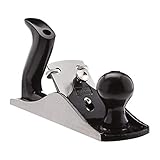


Quick picks by woodworking situation
- Best for frequent rough-board work: a corded 3-1/4-inch planer such as the Bosch PL2632K or Makita KP0800.
- Best cordless choice: the DeWalt DCP580 20V MAX, whose 3-1/4-inch width and brushless motor suit job-site trimming.
- Best budget corded option: the WEN 6530, a 3-1/4-inch model for occasional repairs and general DIY work.
- Best for narrow door edges and light work: a compact 2-3/8-inch planer, where available, or a 3-1/4-inch planer operated at a shallow depth with a side fence.
- Best for a workshop with reliable power: a corded planer, because it can make continuous passes without waiting for batteries.
2-3/8 inches versus 3-1/4 inches
Cutting width determines how much material the tool removes laterally in one pass. A 3-1/4-inch planer covers approximately 37% more width than a 2-3/8-inch model:
(3.25 – 2.375) ÷ 2.375 = 0.368, or about 37% more coverage per pass.
That advantage matters when flattening a board or trimming the bottom of a wide door. It does not automatically make the wider planer better for every job. On a narrow door edge, a 3-1/4-inch tool extends beyond the workpiece, making it easier to tip the tool and create a hollow or rounded edge at the beginning or end of a pass.
A 2-3/8-inch handheld electric wood planer is generally easier to control on small stock, but compact models are less common in the current market. Before buying one, confirm that replacement blades and a compatible fence are readily available. The more widely supported 3-1/4-inch format often has better blade availability and resale value.
Head-to-head comparison
| Planer type or example | Cutting width | Maximum depth per pass | Power source | Approximate weight | Best use |
|---|---|---|---|---|---|
| Compact handheld planer | 2-3/8 in. | About 1/16 in. | Corded or compact cordless, depending on model | 5-6 lb. | Narrow door edges, trim, small repairs |
| Bosch PL2632K | 3-1/4 in. | 3/32 in. | 6.5-amp corded | About 6.3 lb. | Controlled general-purpose workshop use |
| Makita KP0800 | 3-1/4 in. | About 1/8 in. | 6.5-amp corded | About 5.7 lb. | Repeated trimming and stock removal |
| DeWalt DCP580 | 3-1/4 in. | 1/16 in. | 18V/20V MAX cordless | About 6.8 lb. without battery | Job-site work and mobile door fitting |
| WEN 6530 | 3-1/4 in. | 1/8 in. | 6-amp corded | About 6.5 lb. | Infrequent DIY work and budget repairs |
Published dimensions and weights can vary slightly by included accessories and regional packaging. More important than a small weight difference is how evenly the front shoe moves and how securely the depth knob holds its setting.
Depth per pass: speed versus control
A planer rated for 1/8 inch per pass can remove material quickly, but that setting is not automatically the best one. Deep cuts increase motor load, create larger chips, and make it easier to gouge the workpiece when the front shoe is lifted or the rear shoe leaves the board.
- 1/64 inch: final fitting, paint removal, and correcting a slightly proud door edge.
- 1/32 inch: general door trimming and smoothing uneven boards.
- 1/16 inch: efficient stock removal on straight, firmly supported workpieces.
- 1/8 inch: aggressive roughing only when the grain, motor, and workholding allow it.
For example, removing 1/8 inch from a 30-inch-wide door would require roughly ten full-width passes with a 3-1/4-inch planer, ignoring overlap. At 1/16 inch, the same job needs approximately twice as many passes but gives better control near the hinges and latch-side corners. A door edge is usually a fitting task, not a race, so shallow cuts are safer.
Corded versus 18V cordless runtime
A corded planer is the better choice when the work is near an outlet and involves many continuous passes. It delivers consistent power until the job ends, and a typical 6- to 6.5-amp model costs less to operate than buying multiple batteries.
An 18V cordless wood planer handheld is more convenient on renovation sites, roofs, decks, and unfinished buildings. The trade-off is runtime. Actual battery life depends on cut depth, wood species, feed speed, and battery capacity, but these are useful planning estimates for a brushless 3-1/4-inch planer:
| 18V battery | Typical light trimming | Typical moderate planing | Practical interpretation |
|---|---|---|---|
| 2.0 Ah | About 20-30 minutes of intermittent trigger time | About 10-15 minutes | Several door adjustments, but limited for board flattening |
| 4.0 Ah | About 40-60 minutes | About 20-30 minutes | Good general-purpose balance |
| 5.0 Ah | About 50-75 minutes | About 25-35 minutes | Better for repeated stock removal |
These figures describe motor-on time rather than an hour of nonstop planing. Users normally stop to reposition clamps, inspect the surface, clear chips, and measure the work. A 4.0Ah battery may therefore cover a surprisingly productive session, but a corded machine remains preferable for long flattening work.
Which model fits your situation?
| Your situation | Best match | Why |
|---|---|---|
| One or two door repairs per year | Budget 3-1/4-inch corded planer | Low purchase cost and no battery ecosystem required |
| Frequent mobile installation work | 18V cordless 3-1/4-inch planer | No extension cord and quick setup between rooms |
| Flattening rough boards in a workshop | 6- to 6.5-amp corded model | Continuous power and better value for many passes |
| Small shop with limited storage | Compact planer with a dust bag or short chip chute | Easier to store and control on narrow work |
| New user worried about gouges | Lightweight 3-1/4-inch model with a stable shoe and shallow depth adjustment | Offers manageable control without sacrificing blade availability |
Ownership costs and durability
Planer blades are the first consumable to wear. Reversible carbide blades usually provide two usable edges, but a nail, screw, embedded grit, or hidden staple can damage both edges immediately. Keep spare blades with the tool and replace them as a matched pair. Mixing a new blade with a damaged or differently positioned blade can produce ridges across the work.
Chip evacuation is the next ownership issue. Packed chips increase heat and can obstruct the cutter area. Unplug a corded planer or remove the battery before clearing it, then use a brush or compressed air around the vents and depth mechanism. Do not force a jammed depth knob; compacted chips can prevent the shoe from sitting flat.
Inspect the front and rear shoes periodically. A nick or resin buildup can tilt the tool and create an uneven pass. Clean pitch from the shoe with an appropriate non-abrasive cleaner, and store the planer with the blade area protected. On cordless models, keep batteries away from excessive heat and use the manufacturer’s charger rather than mixing incompatible battery systems.
How to use a handheld wood planer without creating a dip
- Mark the removal area. Use a pencil or marking gauge so you can see whether each pass is actually reducing the high spot.
- Clamp the work securely. Movement is a common cause of chatter and uneven cuts.
- Set a shallow first cut. Start around 1/32 inch for a door or finished surface.
- Place the front shoe flat before starting the motor. This prevents the cutter from striking at an angle.
- Feed at a steady pace. Pushing too quickly overloads the motor; pausing in one place creates a hollow.
- Keep pressure over the front shoe at the beginning and the rear shoe at the end. This prevents the tool from rocking down into the work.
- Measure after every few passes. Stop when the door closes cleanly rather than continuing to remove material.
Final recommendation
For most buyers, a 3-1/4-inch planer is the best all-round size because it offers broad coverage, common replacement blades, and enough capacity for both door fitting and rough stock. Choose the Bosch PL2632K, Makita KP0800, or a similar corded model for sustained workshop use; choose the DeWalt DCP580 or another 18V cordless equivalent when portability matters more than unlimited runtime. Select a compact 2-3/8-inch tool only when narrow-edge control and low weight clearly outweigh the wider model’s faster coverage.