
What's inside
As an Amazon Associate I earn from qualifying purchases. This post may contain affiliate links at no extra cost to you.
The best marine binoculars for most boaters are waterproof 7×50 models with a wide field of view, nitrogen-filled optics, and a reliable compass or rangefinder only if you will actually use it.
A 7×50 configuration offers a useful balance: seven-power magnification is steady enough on a moving deck, while 50 mm objective lenses gather more light than compact binoculars. For casual harbor trips, a 7×35 or 8×42 can be lighter; for night navigation and extended offshore use, a rugged 7×50 is usually the safer choice.
As an Amazon Associate we earn from qualifying purchases at no extra cost to you.
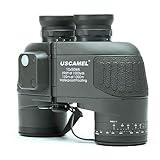
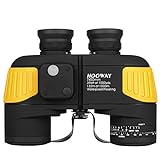


Best marine binoculars by boating situation
| Boating situation | Best configuration | What to prioritize | Typical market range in 2026 |
|---|---|---|---|
| Day trips, kayaks, and small open boats | 7×35 or 8×32 | Low weight, floating strap, waterproof construction | $80–$250 |
| General coastal cruising | 7×50 | Wide field of view, fog resistance, easy focus | $120–$450 |
| Offshore cruising and frequent use | 7×50 with compass | Illuminated compass, range scale, strong armor, serviceable seals | $250–$700 |
| Low-light observation from a fixed position | 7×50 with high-transmission coatings | Optical clarity, edge sharpness, tripod compatibility | $200–$800+ |
Top marine binocular choices
Steiner Navigator Pro 7×50: best all-round marine binocular
The Steiner Navigator Pro 7×50 is a strong choice for boaters who want a purpose-built marine instrument without moving into the price of Steiner’s Commander line. Its 7x magnification is manageable while underway, and the 50 mm objectives provide a 7.1 mm exit pupil, which can make the view appear bright in dim conditions.
Its waterproof, nitrogen-filled construction is designed to resist internal fogging and splashes. The Sports-Auto-Focus system is particularly useful at sea because it reduces repeated refocusing on distant buoys, shorelines, and vessels. The trade-off is size: a 7×50 binocular generally weighs around 1.0–1.2 kg, so it is more noticeable around the neck than a compact hiking model.
Choose this model when you want a dependable 7×50 for coastal cruising, navigation checks, and regular dockside use. It is less attractive if storage space or weight matters more than low-light performance.
Fujinon Mariner 7×50: best for a wide, traditional marine view
The Fujinon Mariner 7×50 is aimed at users who prefer a conventional marine binocular with a broad view and large objectives. A typical field of view in this class is about 7 to 7.5 degrees, equivalent to roughly 367–394 feet at 1,000 yards. That width helps keep a moving boat, buoy, or bird in view while scanning.
Fujinon’s marine optics are known for robust construction and clear glass, but buyers should check the exact version carefully because Fujinon has sold multiple Mariner configurations over time. Some are more basic than compass-equipped models, and availability can vary by region.
This is a sensible pick for a sailor who values a wide viewing window and a traditional focus arrangement. For night navigation, confirm whether the particular model includes a compass and whether its illumination is practical in a dark cockpit.
Steiner Commander 7×50: best premium option for frequent offshore use
The Steiner Commander 7×50 is designed for demanding marine use and typically adds features such as a stabilized or damped compass system, rangefinding reticle, higher-grade coatings, and more substantial mechanical protection, depending on the specific version.
Its main advantage is not simply magnification. Premium marine binoculars are easier to use repeatedly because the compass is more readable, the controls are better protected, and the optics tend to maintain contrast near the edges of the image. Those improvements matter when you are identifying navigation marks in glare, haze, or fading daylight.
The cost can rise well above $500, and the extra features add weight. It makes financial sense for professional mariners, offshore cruisers, guides, and owners who use binoculars every trip. It is excessive for occasional sightseeing in calm weather.
Bushnell Marine 7×50: best value for occasional coastal use
The Bushnell Marine 7×50 is a practical lower-cost route into the classic marine format. Models in this category commonly offer waterproof and fogproof construction, rubber armor, and a wide field of view at a price often below premium European alternatives.
The compromises are usually found in edge sharpness, focus feel, sealing details, and low-light contrast rather than in the headline 7×50 specification. A value model can still be entirely appropriate for weekend boating, provided it is rinsed after saltwater exposure and stored dry.
Pick it when your budget is roughly $100–$200 and you need a backup or occasional-use binocular. If the instrument will be exposed to heavy spray every week, spending more on sealing and service support is likely worthwhile.
How the specifications affect real coastal viewing
Waterproof rating
“Waterproof” is not a single performance level. Look for an IP rating or a clearly stated immersion standard. IPX7 indicates protection during temporary immersion up to 1 metre for up to 30 minutes under the test conditions. IPX8 indicates a manufacturer-defined deeper or longer immersion test, so the precise conditions should be stated.
Many marine binoculars instead describe their construction as waterproof and nitrogen-filled without publishing an IP code. That can still be useful, but it makes direct comparison harder. Nitrogen filling primarily prevents internal condensation; it does not make a binocular immune to saltwater damage. External hinges, focus mechanisms, battery contacts, and lens coatings can still deteriorate.
Magnification and field of view
Higher magnification is not automatically better on a boat. At 10x, hand movement is magnified by the same factor as the target, making it harder to hold a small buoy steady. Seven-power binoculars are easier to stabilize and generally provide a wider field.
For scale, a 7-degree field shows approximately 367 feet at 1,000 yards. An 8-degree field shows about 419 feet at the same distance. That extra width can make it easier to reacquire a moving vessel, but a wide field is only helpful if the image remains reasonably sharp toward the edges.
Low-light clarity
A 7×50 binocular has a theoretical exit pupil of 50 ÷ 7 = 7.1 mm. That is a generous amount of light for dawn, dusk, and overcast conditions. However, the exit pupil is only the potential light beam. Optical transmission, lens coatings, internal baffling, haze, and your eyes determine how much useful detail you actually see.
For example, a well-coated 7×42 can look clearer than a poorly coated 7×50 despite its smaller objective lenses. Prioritize fully multi-coated optics, good contrast, and a clean image over the largest possible objective diameter.
Features worth paying for—and features to question
- Worth paying for: true waterproof construction, nitrogen filling, grippy rubber armor, a broad diopter adjustment, replaceable objective covers, and a secure neck strap.
- Worth paying for frequent offshore use: an illuminated compass, rangefinding reticle, higher-grade coatings, and manufacturer repair support.
- Useful but not essential: floating construction, tripod mounting, and a center-focus system that can be operated with cold or wet hands.
- Question carefully: vague “water-resistant” wording, unspecified immersion depth, permanently attached caps that obstruct the view, and electronic features with no published battery life.
Marine binocular ownership: the maintenance that matters
Salt crystals are usually a greater long-term threat than ordinary rain. After use near spray, rinse the exterior with fresh water while the objective and eyepiece covers are closed. Do not use a high-pressure hose. Pat the housing dry, then open the covers and allow the binocular to air-dry before storing it in a case.
Remove loose grit with a blower before touching the lenses. A soft lens brush can remove remaining particles, followed by a clean microfiber cloth or lens tissue. Rubbing a dry, salt-coated lens can create fine scratches. Avoid household glass cleaner, paper towels, and alcohol products unless the manufacturer specifically permits them.
The parts most likely to wear first are neck straps, lens-cover hinges, rubber eyecups, focus mechanisms, and battery contacts on illuminated compasses. Keep batteries out during long-term storage, and inspect the O-rings or seals if the binocular has been dropped. A waterproof rating applies to an intact instrument; a cracked housing or distorted hinge can compromise it.
A simple buying decision
Choose a 7×50 if you regularly boat at dawn, dusk, or offshore and can accept roughly 1 kg of equipment. Choose a lighter 7×35 or 8×32 if you mostly cruise in daylight, carry the binocular while paddling, or have limited cockpit storage. Select a compass model only when you understand how you will use the heading and range scale; otherwise, the extra cost buys complexity rather than useful information.
For most coastal owners, the best balance is a waterproof, nitrogen-filled 7×50 with a field of view near 7 degrees, fully multi-coated optics, and a focus system that can be operated without removing gloves. Spend more for a premium compass-equipped model when the binocular is navigation equipment rather than occasional viewing gear.