Key takeaways
- New to hand saws? Compare three beginner-friendly panel saws for plywood and boards, with tooth counts, blade lengths and the specs that matter most.
What's inside
As an Amazon Associate I earn from qualifying purchases. This post may contain affiliate links at no extra cost to you.
Breaking down a plywood sheet with the wrong hand saw is where most beginners lose their first cut: the blade wanders off the line, the veneer face chips along the edge, and the panel needs so much cleanup that it no longer fits the project. The real decision is not which brand name to trust, but which tooth count and blade length match the sheets and boards you plan to cut, because a coarse, fast blade and a fine, controlled blade solve opposite problems for a first-time user working without power tools.
This roundup is written for first-time buyers cutting plywood for shop furniture, homeowners trimming boards in a garage or apartment, and anyone putting together a first hand-tool kit. Every pick is a fixed-blade panel saw sized for sheet goods and boards rather than fine joinery. The selections and specifications come from the product names and specification fields published on the Amazon product pages, so you can compare tooth counts, blade lengths, blade thicknesses, and handle designs side by side before choosing the saw that fits your first projects.
Quick Picks
As an Amazon Associate we earn from qualifying purchases.
| Product | Best for | Key spec from title |
|---|---|---|
| Fiskars 15-Inch PowerTooth D-Handle Hand Saw | Beginners who want a secure, closed grip for long cuts | 15-inch blade |
| HAUTMEC Pro 14-Inch Hand Saw | Cleaner edges on plywood faces | 12 TPI fine tooth |
| QYQRQF 14-Inch Hand Saw | A first saw for mixed boards and panels | 11 TPI |
How to Choose
Tooth count decides how the edge looks
Teeth per inch, usually shortened to TPI, is the first number to check on any panel saw listing. A coarse blade around 7 to 9 TPI removes material quickly but leaves a rougher edge and more tear-out on the face veneer of plywood. A finer blade around 11 to 12 TPI cuts more slowly, yet the smaller teeth shear fibers more cleanly and leave an edge that needs less sanding. For a beginner whose first projects are plywood shelves, shop cabinets, and storage boxes, the finer end of that range is usually the safer starting point, because fixing a chipped edge is harder than making a few extra strokes.
Blade length decides how much stroke you get
Panel saws for sheet goods are commonly sold in lengths from about 14 inches up to 26 inches. A longer blade lets you take long, steady strokes that keep the cut moving and reduce the sawing effort per cut, which helps when breaking down a full plywood sheet. A shorter blade is easier to control, fits inside a toolbox, and is less likely to flex or wander in the hands of someone still learning the stroke. Beginners often do better starting at the shorter end of the range, because control matters more than speed while the basic push-stroke technique is still becoming habit.
Blade thickness decides how straight the blade tracks
Blade thickness is easy to overlook, yet it shapes how a saw behaves mid-cut. A thicker blade, around 1.0 millimeter, resists bending and tends to hold a straight line through a long plywood cut, at the cost of a slightly wider kerf and a little more effort per stroke. A thinner blade, around 0.9 millimeter, cuts with less resistance and feels lighter, but it can flex if you push too hard or twist the handle. For a beginner, a mid-to-thicker blade is forgiving: it stays on the line even when your stroke is not yet perfectly straight.
Handle shape decides how long you can cut comfortably
You will hold the handle for every stroke, so its shape matters as much as the blade. A closed D-handle lets your whole hand wrap inside the grip, which feels secure during long breakdown cuts and helps if your hands tire quickly. An open pistol-style grip with a soft rubber overmold gives a more traditional feel and can be easier to steer on shorter cuts. Check the listing for handle material and grip descriptions, and think about whether you will wear gloves, cut for long sessions, or work in a warm shop where a smooth plastic grip may become slippery.
The 3 Best Options
Fiskars 15-Inch PowerTooth D-Handle Hand Saw

This Fiskars saw suits beginners who want the confidence of a closed D-handle while learning to break down plywood and boards. The 15-inch blade is long enough for steady strokes across a sheet yet short enough to stay manageable in a small shop or garage. Its triple-ground PowerTooth teeth are designed to cut on both the push and pull portions of the stroke, which helps new users keep the cut moving without forcing the blade. The SoftGrip touchpoints on the handle add comfort during longer sessions, and the fully hardened steel blade is built to hold its edge through regular use.
Specs
- Blade length: 15 inches
- Blade material: fully hardened steel
- Teeth: triple-ground PowerTooth
- Teeth per inch: 9
- Handle: D-handle with SoftGrip touchpoints
- Weight: not stated
Best for: beginners who want a secure closed grip for breaking down plywood sheets and boards.
Watch out for: Fiskars sells PowerTooth saws in more than one blade shape, so check the listing photos and confirm you are ordering the straight fixed-blade hand saw rather than a curved pruning variant.
ASIN: B0DQ66LLST
HAUTMEC Pro 14-Inch Hand Saw
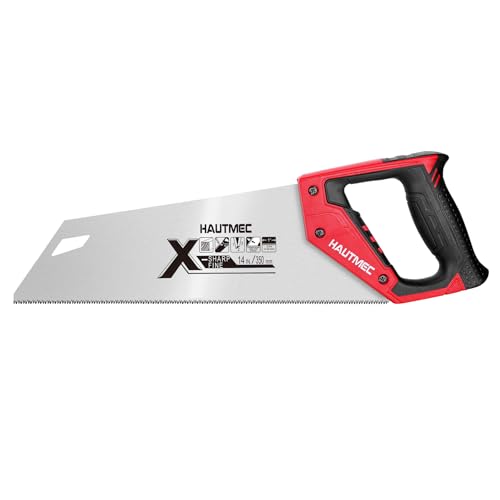
The HAUTMEC Pro is the fine-cut option in this group, and it fits beginners whose first projects show the cut edge, such as plywood shelving, drawer boxes, and small cabinets. The 12 TPI tooth count is the finest here, which trades some cutting speed for a cleaner edge on veneer faces. Its blade is a full 1.0 millimeter thick, and that stiffness helps the saw track straight through long cuts instead of drifting. The wide blade profile adds stability on deep cuts through thick boards, while the induction-hardened, triple-ground teeth are made to stay sharp through repeated use in lumber and sheet goods.
Specs
- Blade length: 14 inches
- Blade material: 65Mn high-carbon steel
- Blade thickness: 1.0 mm
- Teeth per inch: 12
- Teeth: induction-hardened, triple-ground
- Handle: ABS with soft TPR rubber grip
- Weight: not stated
Best for: beginners who want the cleanest possible edge on plywood faces and visible project parts.
Watch out for: this brand sells several similar hand saws with different tooth counts, so confirm the listing is the 12 TPI fine-tooth Pro version before ordering.
ASIN: B0BYJNWJVT
QYQRQF 14-Inch Hand Saw

The QYQRQF saw is a middle path for a first-time buyer who wants one general saw for boards, panels, and odd jobs around the shop. Its 11 TPI triple-ground teeth sit between the coarse and fine ends of this roundup, cutting reasonably fast while still leaving a tidy edge on plywood and laminate-faced boards. The 14-inch blade keeps the tool compact and easy to steer while you learn, and the soft TPR handle is shaped to suit a wide range of hand sizes. At 0.9 millimeter, the blade is the thinnest here, so it rewards a light, even stroke rather than downward force.
Specs
- Blade length: 14 inches
- Blade material: 65Mn steel
- Blade thickness: 0.9 mm
- Teeth per inch: 11
- Teeth: triple-ground
- Handle: TPR soft grip
- Weight: not stated
Best for: first-time buyers who want one affordable-tier saw for mixed boards, panels, and PVC.
Watch out for: the thinner blade can flex if you bear down on the stroke, so check that the listing matches the 14-inch, 11 TPI version and plan to let the teeth do the work.
ASIN: B0BZYWGZM7
Which One Fits Your Situation
Breaking down a first plywood sheet for a shop project
If your first job is cutting a full plywood sheet into cabinet or shelving parts, edge quality on the veneer face matters most, because that edge will show. The HAUTMEC Pro, with its 12 TPI fine teeth and stiff blade, is the pick here: it tracks straight on long cuts and leaves the cleanest edge of the three. Support the sheet fully so the offcut does not drop and tear the last fibers.
Cutting boards in an apartment or small garage
When space is tight and the saw has to live in a toolbox or a closet, a shorter blade and a secure grip beat raw cutting speed. The Fiskars 15-inch saw fits this situation well: the closed D-handle feels controlled in a short stroke, the blade length stays manageable around benches and doorways, and the saw handles both sheet goods and solid boards without needing a dedicated cutting station or a power outlet.
Putting together a first hand-tool kit
If this saw is one piece of a first kit that also needs squares, clamps, and measuring tools, spreading the budget across the kit matters. The QYQRQF 14-inch saw covers the everyday cutting in that situation: boards for jigs, panels for storage boxes, and PVC pipe for shop plumbing jobs. Its 11 TPI teeth are a sensible all-round compromise, so you can learn on one saw before deciding whether a coarser or finer specialist is worth adding later.
Trimming panels to fit after a rough first cut
Sometimes the job is not the first cut but the second one: shaving a panel edge so a shelf fits its opening, or trimming a board that was cut slightly long. Short, controlled strokes matter here, and any of these three saws can do it, but the HAUTMEC Pro and the QYQRQF, with their finer teeth, leave the least cleanup. Mark the line with a knife rather than a pencil so the teeth start in a defined groove.
Common Mistakes
- Choosing the coarsest blade for plywood, then fighting chipped veneer edges that no amount of sanding fully hides.
- Forcing the saw with downward pressure instead of letting the teeth cut, which bends thin blades and makes the cut wander.
- Starting the cut with short, choppy strokes at full force, tearing the first fibers instead of drawing a shallow starter groove.
- Letting the offcut hang unsupported at the end of a long cut, so its weight snaps the last section and tears the face.
- Storing the saw loose in a toolbox where other tools dull the teeth; keep the blade covered or hung on the wall.
Frequently Asked Questions
What size panel saw should a beginner start with?
A blade between 14 and 20 inches is the practical starting range for sheet goods and boards. Shorter blades are easier to control and store, while longer blades give smoother, faster strokes on full sheets. Most beginners learn faster on a mid-length saw, because it forgives an uneven stroke while still covering the cuts a small shop actually makes.
How many teeth per inch are best for cutting plywood?
For plywood, a finer tooth count around 11 to 12 TPI is usually the better choice, because the smaller teeth shear the face veneer more cleanly and reduce chipping along the cut line. Coarser blades around 7 to 9 TPI cut faster in solid boards but leave a rougher edge in sheet goods. If you cut mostly plywood, start fine and accept a slightly slower pace.
Can one panel saw handle both plywood and solid boards?
Yes, a general-purpose panel saw in the 9 to 12 TPI range can cut both materials, and that is exactly the role of the saws in this roundup. Expect a compromise: the saw will not be the fastest choice for thick framing lumber or the cleanest choice for fine joinery, but for shop projects, shelving, and general repairs, one mid-range saw covers the work comfortably.
How do I keep a hand saw cut from wandering off the line?
Start with a few light pull strokes to establish a shallow groove on the line, keep your forearm, elbow, and shoulder aligned behind the blade, and use long, even strokes without pressing down. A stiffer blade helps, as does marking the line with a knife. If the cut drifts, stop, back out, and restart the groove rather than trying to steer the blade mid-cut.
Related guides
More from Amazon
Programs that pair well with the guide above. Offers and eligibility are set by Amazon and may change.
A free business account with business pricing and bulk-buying tools for work, shop or home office.
Create a business accountFree shipping on eligible items, Prime Video and more. Eligible new members can start with a free trial.
Start a Prime free trialAudiobooks and podcasts to listen to on the go. Eligible new members can start with a free trial.
Try Audible freeAd-free music streaming. Eligible new subscribers can start with a free trial.
Try Music Unlimited freeAs an Amazon Associate we earn from qualifying purchases.