Key takeaways
- Quiet workshop air compressors for pneumatic tool stations compared on decibel ratings, per-station airflow and tank size for noise-sensitive shops.
What's inside
As an Amazon Associate I earn from qualifying purchases. This post may contain affiliate links at no extra cost to you.
A pneumatic tool station changes the noise equation. A big stationary compressor hides in another room and nobody minds its roar, but a station compressor sits within arm’s reach of the person pulling the trigger, cycling all day in the same airspace as conversation and customers. That is why the quiet-station strategy inverts the usual advice: instead of one loud machine feeding every bench, place a small low-decibel unit at the station it serves, sized honestly for that bench’s tools.
The quietest verified option is our top pick, the Makita MAC100Q, published at 58 dB. The runner-up is the California Air Tools 8010 at 60 dBA, carrying the largest tank of the three for a busier station. These machines fit the finish bench where a nailer fires all day, the small shop sharing walls with a home or storefront, and the teaching workspace where noise rules are real. Every model below comes from its Amazon listing, and each carries a decibel figure published by its maker, since a quiet claim without a number is only a mood. None of them feeds a sander for long, and the guidance below keeps that limit in view.
Quick Picks
As an Amazon Associate we earn from qualifying purchases.
| Product | Best for | Key spec |
|---|---|---|
| Makita MAC100Q | Quietest station air | 58 dB published rating, 1 gallon tank – ASIN: B084GY6DXV – https://www.amazon.com/dp/B084GY6DXV |
| California Air Tools 8010 | Busiest single station | 60 dBA, 8 gallon tank, 2.2 CFM at 90 PSI – ASIN: B00WM1VPKE – https://www.amazon.com/dp/B00WM1VPKE |
| Rolair JC10 Plus | Fastest recovery at a trim station | 60 dBA, 2.4 CFM delivered at 90 PSI – ASIN: B0058NRVMO – https://www.amazon.com/dp/B0058NRVMO |
How to Choose
Demand a decibel figure, then compare it fairly
Every pick here publishes a number, and that number is the only honest starting point: 58 dB for the Makita, 60 dBA for the other two. Treat figures as maker-stated values measured under each brand’s own conditions, and use them for ranking rather than as a promise about your room.
Size the station before the compressor
A station is one bench and its tools, not the whole shop. A pin nailer and a blow gun ask almost nothing; a station that also runs a stapler and an inflator asks a little more. Match the unit to that local list, because oversizing buys tank you will never drain.
Recovery matters more than capacity at a nailer station
Fastening work fires in bursts, so the seconds a pump needs to restore pressure shape the working rhythm more than gallon count does. Published pump-up and recovery times, where the maker gives them, deserve as much attention as the tank size on the box.
Placement still buys quiet for free
Even a 58 dB machine sounds louder bouncing off bare concrete in a corner. A rubber mat under the unit, a few feet of distance, and a hose long enough to keep the compressor off the bench all lower the noise the operator actually hears.
The 3 Best Options
Makita MAC100Q — OUR TOP PICK

Makita’s Quiet Series entry is built around a half-horsepower induction motor turning just 1,750 RPM, a slow pace that produces the published 58 dB operating level. The oil-free dual-piston pump fills the 1 gallon tank to its 135 PSI maximum in about 90 seconds and delivers 0.7 CFM at 90 PSI, with a gentle 2.8 amp draw that behaves on shared workshop circuits. A full roll cage wraps the works, the whole unit weighs 27.6 pounds, and Makita positions it for indoor finish work during case, base, and trim installation.
Specs
- Noise: 58 dB published
- Motor: 0.5 HP induction, 1,750 RPM
- Tank: 1 gallon
- Air delivery: 0.7 CFM at 90 PSI; 1.2 CFM at 40 PSI
- Maximum pressure: 135 PSI
- Draw and weight: 2.8 amps; 27.6 pounds
Best for: A finish or assembly station inside a home, storefront, or occupied building where noise discipline is strict.
Watch out for: The 0.7 CFM delivery is the lowest here, so the station’s tool list must stay genuinely small.
California Air Tools 8010

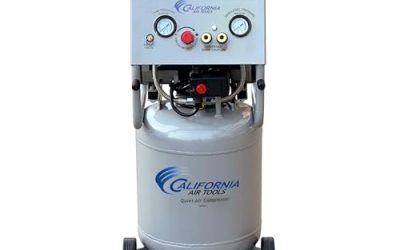
The 8010 scales the quiet formula up for a harder-working station: a 1.0 HP oil-free dual-piston pump on an 8 gallon steel tank, published at 60 dBA. It delivers 2.2 CFM at 90 PSI and 3.1 CFM at 40 PSI against a 120 PSI ceiling, fills from empty in about 165 seconds, and recovers from 90 to 120 PSI in roughly 60 seconds per the maker. Wheels and a 48 pound weight keep it repositionable, and the maker describes a 70/30 duty cycle, suiting stations whose tools fire steadily.
Specs
- Noise: 60 dBA published
- Motor: 1.0 HP, oil-free dual-piston pump
- Tank: 8 gallon steel, wheeled
- Air delivery: 2.2 CFM at 90 PSI; 3.1 CFM at 40 PSI
- Maximum pressure: 120 PSI
- Duty cycle: 70/30 per maker
Best for: The busiest single station in a small shop, where an 8 gallon reserve smooths a full day of fastening.
Watch out for: Its 120 PSI ceiling is the lowest of the three, slightly shortening each tankful’s useful band.
Rolair JC10 Plus
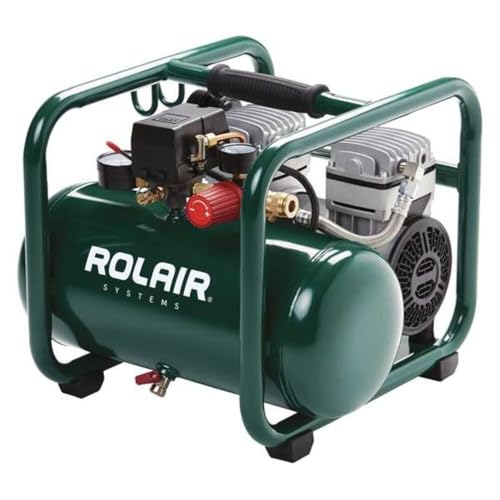
Rolair publishes 60 dBA for the JC10 Plus and backs the quiet claim with pace: 2.4 CFM delivered at 90 PSI from a 1 HP oil-free motor turning 1,725 RPM. The 2.5 gallon tank refills from empty to 125 PSI in about 55 seconds and recovers from its 95 PSI cut-in in roughly 14 seconds, the briskest cycle figures in this group. Factory pressure settings run 95 to 125 PSI, the draw is 7.5 amps, and automatic thermal protection guards the motor during long assembly sessions.
Specs
- Noise: 60 dBA published
- Motor: 1 HP oil-free, 1,725 RPM
- Tank: 2.5 gallon
- Air delivery: 2.4 CFM at 90 PSI; 3.8 CFM at 40 PSI
- Pressure band: 95 to 125 PSI factory settings
- Recovery: about 14 seconds from cut-in
Best for: A trim and fastening station where the operator fires in rapid sequences and hates waiting on recovery.
Watch out for: At roughly 43 to 45 pounds it is the heaviest carry here, despite the compact tank.
Which One Fits Your Situation
- A station inside a finished, occupied space: the Makita MAC100Q, the quietest published figure of the three at 58 dB.
- One hard-working bench that fires fasteners all day: the California Air Tools 8010, whose 8 gallon tank stretches every cycle.
- Rapid-fire trim work at a dedicated station: the Rolair JC10 Plus, with the strongest delivered CFM and fastest recovery.
- Several benches needing air at once: place one quiet unit per station rather than stretching one small pump across all of them.
Common Mistakes
- Trusting the word quiet in a product name without finding the published decibel figure.
- Asking a 1 gallon station unit to feed a second bench through a long hose, then blaming the pump.
- Setting the compressor directly on the bench, where the surface amplifies vibration into the work area.
- Forgetting that blow guns drain small tanks quickly, turning cleanup into stop-and-wait work.
Frequently Asked Questions
How quiet is quiet enough for a station beside the operator?
Published figures in the high fifties to about 60 dBA sit near normal conversation level, which most people can work beside for hours. Every additional few decibels is plainly audible, so the gap between 58 dB and a standard jobsite unit is dramatic in practice.
Can one quiet compressor serve two stations?
Only if both stations run light fastening tools and rarely fire together. Delivered CFM on these small pumps is modest by design, and sharing halves an already small budget, so the per-station layout in this guide exists for a reason.
Why do these quiet models cost airflow compared with standard units?
Low noise comes from slow-turning motors and pumps, and slower machinery moves less air per minute. The trade is deliberate: peak delivery exchanged for a sound level occupied spaces can tolerate.
Do oil-free quiet pumps still need maintenance?
There is no oil service, but tanks still gather condensate and need draining, and intake filters still clog with shop dust. A quiet pump neglected on draining will rust its tank just as surely as a loud one.
The Bottom Line
Station air should be sized to the bench and silenced for the room. The Makita MAC100Q is the quietest verified choice at 58 dB, the California Air Tools 8010 brings an 8 gallon reserve to the busiest bench at 60 dBA, and the Rolair JC10 Plus matches that level with the fastest recovery here. Pick by the tools at your station, and the compressor becomes background instead of interruption.
Related guides
- 3 Best Vertical Tank Air Compressors for Woodworking Shops (November 2026)
- 3 Best Two-Stage Shop Air Compressors for Woodworking Shops (November 2026)
- 3 Best Two-Stage Shop Air Compressors for Pneumatic Tool Stations (November 2026)
- 3 Best Phenolic Top Router Tables for Garage Workshops (November 2026)
More from Amazon
Programs that pair well with the guide above. Offers and eligibility are set by Amazon and may change.
A free business account with business pricing and bulk-buying tools for work, shop or home office.
Create a business accountFree shipping on eligible items, Prime Video and more. Eligible new members can start with a free trial.
Start a Prime free trialAudiobooks and podcasts to listen to on the go. Eligible new members can start with a free trial.
Try Audible freeAd-free music streaming. Eligible new subscribers can start with a free trial.
Try Music Unlimited freeAs an Amazon Associate we earn from qualifying purchases.