
What's inside
- What matters most when choosing a spindle sander
- Common spindle sander configurations compared
- Best spindle sander picks by shop situation
- How spindle size changes the result
- Oscillation: useful feature, not a substitute for technique
- Footprint and dust collection calculations
- Setup and maintenance that affect accuracy
- Decision matrix
- Final buying recommendation
As an Amazon Associate I earn from qualifying purchases. This post may contain affiliate links at no extra cost to you.
The best spindle sander for most shops is a corded oscillating model with at least six sleeve sizes, roughly 1/2 to 3 inches of coverage, and a footprint you can leave assembled rather than a more powerful machine that remains stored in a box.
As an Amazon Associate we earn from qualifying purchases at no extra cost to you.
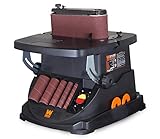

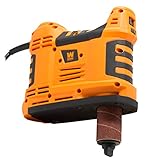
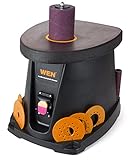
What matters most when choosing a spindle sander
A spindle sander turns a straight sanding sleeve around a vertical drum while moving that drum up and down. The rotation removes material; the oscillation spreads wear over more of the abrasive and reduces the chance of creating deep grooves in curved work.
For curved edges and inside profiles, evaluate four things in this order:
- Spindle and sleeve range: Small drums reach tight curves; large drums sand broad concave edges more smoothly.
- Oscillation: More useful than speed alone because it distributes heat and abrasive wear.
- Table and dust collection: A rigid, flat table and usable dust port affect accuracy and cleanup.
- Footprint and storage: A machine that is difficult to access will be used less often, regardless of its motor rating.
Common spindle sander configurations compared
| Configuration | Typical sleeve sizes | Typical oscillation | Typical footprint | Best fit |
|---|---|---|---|---|
| Compact benchtop | 1/2, 3/4, 1, 1-1/2, 2, 3 in. | About 58–72 strokes/min | Approximately 15 x 15 in. | Small shops, occasional curve sanding |
| Mid-size benchtop | 1/2 to 3 in.; sometimes 1/4 or 3-1/2 in. | About 58–72 strokes/min | Approximately 18 x 18 in. | Frequent hobby and furniture work |
| Floor-standing spindle sander | 1/2 to 4 in. or more | About 50–72 strokes/min | Approximately 20 x 20 in. or larger | Production work and large curved parts |
| Combination spindle/belt sander | Commonly 1/2 to 3 in. | Often about 58 strokes/min | Approximately 20 x 20 in. | Shops wanting one machine for edges and profiles |
These are useful buying ranges rather than a substitute for the manual. Manufacturers may publish oscillation as strokes per minute, while others emphasize revolutions per minute. Compare like with like: a spindle’s rotation speed does not describe how quickly it travels vertically.
Best spindle sander picks by shop situation
Best value for occasional users: a compact 1/2-horsepower benchtop model
A machine such as the WEN 6524-style benchtop spindle sander is a practical starting point when the work consists of cabinet parts, templates, small furniture components, and occasional inside cutouts. Models in this class commonly include six rubber drums and sleeves from 1/2 through 3 inches, a cast-iron or heavy metal table, and a 1-1/2-inch dust port.
The main advantage is not maximum power; it is coverage. A six-sleeve kit lets you match the drum to the radius instead of forcing every curve onto one medium-size sleeve. Expect a general market range of roughly $120 to $220, depending on the included accessories and regional pricing.
Best compact upgrade: Triton TSPS450
The Triton TSPS450 is a well-known 450-watt oscillating spindle sander aimed at benchtop users. Its accessory set typically covers six spindle diameters, including small drums for tighter profiles and a 3-inch drum for broader curves. Its relatively compact format suits a shop where the machine must be lifted onto a bench and stored afterward.
Choose this type when you value a complete sleeve assortment and portability more than a large permanent table. Check the exact regional package before buying, since voltage, plug, and accessory details can vary. A typical market range is about $180 to $300.
Best for frequent furniture work: a heavier 1/2-horsepower benchtop machine
A heavier machine, such as the Shop Fox W1831 class, is preferable when the sander will be used weekly rather than a few times each month. The benefit is usually a more substantial table and base, not a dramatic increase in sanding speed. Less movement under pressure makes it easier to keep a workpiece square while refining an inside profile.
These machines commonly provide six sleeve sizes, oscillation near 58 strokes per minute, and a 1-1/2-inch dust outlet. Plan on approximately $250 to $400. Before purchase, measure the stored height as well as the table footprint; the spindle and dust hood can make the machine taller than expected.
Best when edge sanding also matters: a combination spindle/belt sander
A combination machine adds a sanding belt position to the oscillating spindle. It makes sense if you regularly flatten edges, smooth tapers, and sand curves. It is less compelling if inside profiles are the only requirement, because the belt mechanism adds cost, height, setup time, and more parts to maintain.
Combination models generally occupy about 20 by 20 inches or more and may weigh 60 pounds or above. They often cost roughly $300 to $600. Select one only if the second sanding function will replace another tool or save meaningful setup time.
How spindle size changes the result
Use the smallest drum that fits the concave radius without binding. A small drum contacts less surface area, so it can remove material quickly from a tight curve, but it also makes it easier to create a hollow or faceted-looking transition if you linger in one spot.
Use a larger drum for broad arcs. It bridges small irregularities and leaves a more consistent curve, although it cannot enter a tight inside corner. For example, a 3-inch drum is useful on a broad furniture arm profile, while a 1/2-inch drum is better for a narrow template opening.
Do not confuse sleeve diameter with the minimum possible inside radius. The abrasive has thickness, the workpiece must clear the table opening, and the operator needs enough room to control the part. Make a test cut in scrap before committing to an expensive component.
Oscillation: useful feature, not a substitute for technique
Oscillation helps because each section of sleeve moves across the wood instead of sanding one horizontal band continuously. This reduces localized heat and extends abrasive life. Fixed oscillation is adequate for most woodworking; variable speed or variable oscillation can be helpful when working delicate veneer, resin-heavy material, or soft woods.
Keep the work moving at a controlled rate. Pressing hard does not make the machine more accurate. It can slow the spindle, overload the motor, flatten the abrasive, and leave a visible dip at the end of the pass.
Footprint and dust collection calculations
Allow more than the advertised base dimensions. If a machine has an 18-by-18-inch base, the base occupies 324 square inches, or 2.25 square feet. Add at least 6 inches of clearance on the front and both sides for hand control and workpiece movement: the practical operating zone becomes roughly 30 by 30 inches, or 6.25 square feet.
That calculation often changes the buying decision. A larger floor-standing machine may use less bench space but still consume a dedicated 20-by-20-inch area. If your available workspace is a 24-inch-deep bench, a compact benchtop model is likely the better fit, provided you can safely clamp or bolt it down.
Connect the dust port to a collector rather than relying only on a small shop vacuum. Fine abrasive dust can collect beneath the table and around the oscillating mechanism. A reducer may be necessary, but avoid a sharply kinked hose that restricts airflow.
Setup and maintenance that affect accuracy
- Install the correct table insert. Use the opening that closely matches the drum without rubbing. A large gap allows a narrow workpiece to drop into the mechanism.
- Fit the rubber drum and sleeve securely. The sleeve should be tight enough that it cannot spin independently of the drum. Never use a torn or stretched sleeve.
- Place the correct washer and nut in the manufacturer’s order. Over-tightening can distort the rubber drum; under-tightening can allow vibration.
- Check the table. Remove pitch and dust, then verify that the table is square to the spindle before precision work.
- Sand in shallow passes. Leave the blade or router marks visible until the curve is consistent, then remove the remaining marks with the spindle.
- Clean after use. Brush dust from the table and vents, vacuum beneath the insert, and inspect the oscillation mechanism periodically.
The sleeve usually wears first, especially when sanding resinous wood or pressing in one location. A sleeve that feels glazed, has torn edges, or no longer cuts with light pressure should be replaced rather than forced. Keep replacement sleeves organized by diameter; a machine is much more useful when the commonly used sizes are immediately available.
Decision matrix
| Your situation | Recommended specification | Why |
|---|---|---|
| Budget under about $200; occasional use | 1/2 HP benchtop, six sleeves, 1/2–3 in. range | Provides the essential diameters without paying for a floor base |
| Beginner learning templates and curves | Heavy table, fixed oscillation, 1-1/2 in. dust port | Simple controls and a stable work surface reduce setup errors |
| Very limited storage | Compact unit under roughly 18 x 18 in., with carry handles | More likely to be put away safely after use |
| Weekly furniture production | Heavier benchtop or floor model, six or more sleeves | Improves stability and reduces repeated setup and cleanup |
| Frequent broad curves | At least a 3 in. drum, rigid table, effective dust port | Large profiles are smoother and faster on a broad sleeve |
| Curves plus straight edge sanding | Combination spindle/belt model | One machine covers two jobs, if its larger footprint is acceptable |
Final buying recommendation
For most home woodworking shops, choose a corded benchtop spindle sander with six sleeve diameters from about 1/2 to 3 inches, fixed oscillation near 60 strokes per minute, a rigid table, and a standard dust port. Spend more for a heavier base when you sand curves every week; spend more for a combination machine only when belt sanding is also part of your normal workflow. The best spindle sander is the one whose smallest drum fits your tightest profile, whose largest drum handles your broadest curve, and whose footprint still leaves enough room to control the work safely.