
What's inside
- Start with the Type of Mortiser
- Compare the Specifications That Affect Real Work
- Choose Motor Power for the Chisel, Not the Label
- Understand Chisel Capacity and Sizing
- Check Plunge Depth and Table Travel
- Evaluate the Fence and Workholding
- Compact or Heavy-Duty: A Decision Matrix
- Set Up the Machine for Accuracy
- Ownership Costs and Common Wear
- Final Buying Recommendation
As an Amazon Associate I earn from qualifying purchases. This post may contain affiliate links at no extra cost to you.
To choose a mortiser, match the machine’s mortise capacity, plunge depth, table travel, and motor power to the size and frequency of your joinery—not simply to the largest number in its specification sheet.
As an Amazon Associate we earn from qualifying purchases at no extra cost to you.

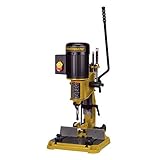


Start with the Type of Mortiser
Mortisers fall into three practical categories: benchtop hollow-chisel mortisers, floor-standing machines, and drill-press-style or portable alternatives. Each suits a different workshop.
Benchtop Hollow-Chisel Mortiser
A benchtop machine is usually the best choice for a home woodworker making furniture, doors, small frames, and occasional timber joints. It uses a square chisel surrounding a rotating auger bit. The auger clears waste while the chisel cuts the four sides of the mortise.
Typical benchtop specifications include a 1/2- to 1-1/2-horsepower motor, mortise capacities from 1/4 to 3/4 inch, a 4- to 6-inch quill stroke, and a machine weight of roughly 60 to 130 pounds. These machines are compact enough for a garage shop but heavy enough to resist movement when cutting hardwood.
Floor-Standing Mortiser
A floor-standing mortiser is intended for repeated work, larger stock, and longer production sessions. Its heavier column, larger table, stronger clamping arrangement, and greater leverage make it easier to cut deep mortises in oak, maple, ash, and other dense species.
Expect approximately 1-1/2 to 3 horsepower, mortise capacities up to 1-1/2 inches or more, 6- to 12-inch plunge depth, and weights ranging from about 200 to 500 pounds. The trade-off is cost, floor space, assembly time, and the need for a stable installation.
Drill Press or Portable Option
A drill press fitted with a hollow-chisel attachment can be economical if you already own a rigid drill press with adequate quill travel. It is less convenient to adjust, and its table, column, and quill may not be designed for the sideways forces created by square chisels.
Portable mortising attachments are useful for repairs or workpieces that cannot be brought to a stationary machine. They are generally slower and provide less consistent depth control. For regular furniture production, a dedicated mortiser is usually easier to set up accurately.
Compare the Specifications That Affect Real Work
| Specification | Compact benchtop | Heavy-duty floor-standing | Why it matters |
|---|---|---|---|
| Motor power | 0.75–1.5 hp | 1.5–3 hp | Higher power helps maintain speed in wide or deep hardwood mortises. |
| Typical mortise capacity | 1/4–3/4 in. | 1/4–1-1/2 in. | Determines the largest chisel and mortise width the machine can handle. |
| Plunge depth | 4–6 in. | 6–12 in. | Allows deeper joints or multiple mortises without resetting the work. |
| Table size | 8 × 10 to 12 × 15 in. | 12 × 15 to 20 × 24 in. | A larger table supports wide rails, legs, and door components. |
| Typical machine weight | 60–130 lb | 200–500 lb | Weight improves stability but reduces portability. |
| General market price | About $350–$1,000 | About $1,000–$3,000+ | Budget for chisels, sharpening equipment, clamps, and dust removal too. |
These are useful buying ranges rather than guarantees. Individual machines vary, and a well-supported 1-horsepower mortiser can outperform a poorly adjusted machine with a larger advertised motor.
Choose Motor Power for the Chisel, Not the Label
Motor power matters most when the chisel is wide, the mortise is deep, the timber is hard, or the machine will run frequently. A 1/4-inch chisel removes relatively little material and places modest demand on the motor. A 3/4-inch or 1-inch chisel creates much more resistance, especially if the auger is dull or the chisel clearance is incorrect.
For occasional work in pine, poplar, and other softwoods, 3/4 to 1 horsepower is often sufficient. For mixed hardwood furniture, look for roughly 1 to 1-1/2 horsepower. For production work, large door joints, or continuous use, 1-1/2 horsepower and above provides greater reserve.
Do not use horsepower as a substitute for rigidity. A machine that flexes under load can produce tapered mortises, burn marks, and broken chisels regardless of motor size.
Understand Chisel Capacity and Sizing
Hollow-chisel mortisers are commonly sold with a capacity range such as 1/4 to 3/4 inch. Check whether that figure describes the largest chisel the machine accepts or the manufacturer’s recommended working range. The arbor, collar, and quill opening must all accommodate the intended chisel set.
Mortise width is normally selected in relation to the stock thickness. A useful starting point is a mortise about one-third of the workpiece thickness. For a 1-1/2-inch-thick leg, that suggests a mortise near 1/2 inch. A 1/2-inch tenon cheek on each side leaves enough surrounding wood for strength, although the best proportion depends on the joint design and species.
Buy compatible chisel-and-bit sets rather than assuming every brand uses identical dimensions. Imperial and metric sizes are not interchangeable, and replacement augers may need to match the chisel’s internal clearance.
Check Plunge Depth and Table Travel
Plunge depth is the maximum distance the head can move downward. It is not always the same as the usable mortise depth: the workpiece, hold-down, chisel length, and table position reduce the practical amount.
For common chair, cabinet, and table work, a 4- to 6-inch plunge is usually adequate. Choose more travel if you make thick doors, architectural joinery, or deep leg mortises. A depth stop should lock securely and repeat accurately; a stop that slips can make matching parts inconsistent.
Table travel is equally important. Some machines allow the table to move left, right, forward, and backward, while others rely on repositioning the workpiece. A table with approximately 4 to 6 inches of side-to-side travel makes it easier to cut a series of mortises without disturbing the fence. Front-to-back travel is valuable when cutting wide joints or aligning multiple faces of a leg.
Evaluate the Fence and Workholding
A rigid, square fence is one of the most important parts of a mortiser. Look for a fence that locks at both ends, has a clear reference face, and can be adjusted without excessive play. A short or flexible fence may be acceptable for narrow rails but becomes frustrating on long legs.
Useful features include an adjustable stop for repeated parts, a hold-down that keeps stock against the table, and enough clearance to clamp irregular workpieces. Threaded holes or slots for auxiliary fences are valuable because a sacrificial wooden fence can support small parts and prevent tear-out.
Test the controls before buying when possible. The table should move smoothly but remain tight when locked. The head should descend without side-to-side wobble, and the depth stop should return to the same position after repeated plunges.
Compact or Heavy-Duty: A Decision Matrix
| Your situation | Better choice | Reason |
|---|---|---|
| Budget under about $600 and fewer than 50 mortises per month | Compact benchtop | Lower entry cost and adequate capacity for cabinets, tables, and small frames. |
| Limited workshop or shared garage | Benchtop, ideally under 100 lb | Can be stored on a mobile stand and removed when floor space is needed. |
| Beginner learning traditional joinery | Benchtop with 1/4- to 3/4-inch capacity | Simpler setup, lower accessory cost, and enough range for common projects. |
| Several matching mortises every week | Heavy benchtop or floor-standing | Better repeatability, larger table, and less time spent repositioning stock. |
| Doors, thick legs, or hardwood production | Floor-standing, 1-1/2 hp or more | Greater rigidity, deeper plunge, larger chisels, and improved heat management. |
| Machine must be moved frequently | Compact model with a mobile stand | Portability is more useful than capacity that rarely gets used. |
Set Up the Machine for Accuracy
- Secure the machine to a stable bench or stand. Movement during a plunge changes both alignment and depth.
- Install the auger first, leaving enough clearance between its tip and the bottom of the chisel. Follow the machine’s specified clearance rather than forcing the components together.
- Align the chisel with the fence and set its flat face in the intended cutting direction. Incorrect orientation can increase resistance and produce uneven walls.
- Set the depth stop using a test piece of the same species and thickness as the project stock.
- Make a shallow first plunge, then deepen the mortise in stages. This gives chips a path to escape and reduces heat and load.
- Use a sharp chisel and auger. If the machine requires excessive pressure, stop and inspect sharpness, alignment, and chip clearance.
For a 3-inch-deep mortise, for example, a first plunge of about 1 inch followed by two additional plunges can be easier on the machine than forcing the full depth in one pass. The exact number depends on timber, chisel width, and chip evacuation.
Ownership Costs and Common Wear
The first consumables to wear are usually auger cutting edges, chisel corners, belts, and depth-stop or table-lock components. Replacement chisel-and-bit sets commonly cost about $25 to $100 per size, while sharpening equipment or professional sharpening adds to the long-term budget.
Clean packed chips from inside the chisel, around the quill, and beneath the table after each session. Lubricate sliding columns and table mechanisms according to the manual, but keep oil away from surfaces that must grip the workpiece. Inspect belts for cracking and verify that mounting bolts remain tight.
Common mistakes include plunging too quickly, using a chisel without adequate auger clearance, cutting with a dull bit, relying on a weak fence, and failing to support long stock. These problems often look like inadequate motor power when the real issue is setup.
Final Buying Recommendation
Choose a compact mortiser if you have limited space, make furniture in small batches, and mainly need mortises from 1/4 to 3/4 inch. Choose a floor-standing machine when repeatability, deep joints, large stock, and daily hardwood work justify its cost and footprint. In either case, prioritize a rigid head, accurate depth stop, square adjustable fence, useful table travel, and readily available replacement chisels over a high horsepower figure alone.