
What's inside
As an Amazon Associate I earn from qualifying purchases. This post may contain affiliate links at no extra cost to you.
Jet Jointer JJ-6CSX Review: Is It Worth Buying?
The Jet Jointer JJ-6CSX is worth considering if you need a traditional 6-inch jointer with a long bed and a cast-iron fence, but it is a poor fit if you need a compact machine, frequent wide-board capacity, or modern helical-cutterhead performance. Its value depends less on the headline width than on whether its footprint, setup work, and straight-knife maintenance suit your shop.
The JJ-6CSX is a floor-standing, single-phase jointer built around a 6-inch cutting width and a three-knife cutterhead. It is a conventional machine rather than a high-capacity or premium-finish solution. For a small-to-medium workshop that mainly flattens and edges boards for furniture, cabinetry, and general woodworking, that can be a sensible balance.
As an Amazon Associate we earn from qualifying purchases at no extra cost to you.


What the JJ-6CSX offers
Jet has sold versions of the JJ-6CSX with specifications that can vary by production run and market. The figures below describe the commonly listed configuration; check the machine’s manual or current manufacturer documentation before buying, especially when comparing used listings.
| Item | Common JJ-6CSX specification | Why it matters |
|---|---|---|
| Cutting width | 6 inches | Suitable for many furniture parts, but does not flatten boards wider than the knives. |
| Bed length | Approximately 56 inches | More support for longer stock than a compact benchtop jointer, though technique still matters. |
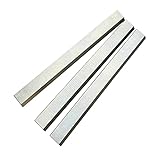
| Cutterhead | Three straight knives | Knives are resharpenable or replaceable, but their height and condition affect cut quality. |
| Fence | Cast iron, about 4 by 38 inches | A long reference surface helps with edge jointing; squareness and secure locking are essential. |
| Motor | Commonly listed at 1 HP, 115/230 V, single phase | Confirm the motor plate and wiring on the specific machine; voltage options may differ by version. |
| Weight | Roughly 250–270 lb | Mass helps the machine stay planted, but delivery, positioning, and leveling take planning. |
How it performs on the things that matter
Flatness and bed support
The long cast-iron tables are the JJ-6CSX’s main practical advantage over small benchtop jointers. They support longer boards and make it easier to establish a straight reference face when you use a consistent feed and keep pressure over the outfeed table after the cut begins. The machine’s nominal capacity does not guarantee flat results, however: tables must be aligned, knives set evenly, and the board’s defects assessed before you start.
On a used machine, inspect the table surfaces for deep gouges, rust pitting, and evidence of impact. Check that the infeed table moves smoothly and locks without shifting. A jointer with misaligned tables or uneven knives can leave a taper or a slight step even when the operator’s technique is sound.
Fence adjustment
The long fence gives useful support for edge jointing, and its tilting adjustment allows bevels. The key buying question is not simply whether the fence moves, but whether it returns to square and stays there when locked. Check the fence at 90 degrees with a reliable square, then apply moderate hand pressure and confirm it does not creep. Also inspect the locking hardware and the fence’s travel for play.
For repeated bevel work, expect to verify the angle rather than rely only on the scale. For everyday edge jointing, a stable, repeatable 90-degree setting matters more than quick angle changes.
Cutterhead quality and maintenance
The three-knife straight cutterhead is serviceable and familiar, but it is less forgiving of damaged or poorly adjusted knives than a segmented insert-style head. Dull knives, nicks, or uneven knife height can produce tear-out, ridges, or a rough surface that needs more sanding. Difficult grain can tear out even with sharp knives, so take light cuts and orient the board to reduce against-the-grain cutting where possible.
Knife changes and alignment are the main recurring maintenance task. The exact procedure depends on the machine’s knife and adjustment system, so follow the JJ-6CSX manual rather than improvising. Keep the tables clean and protected from rust, clear chips from the cutterhead area with the machine unplugged, and inspect dust collection regularly. Straight knives can be sharpened or replaced, but sharpening and accurate setting take time; factor that into ownership cost.
Space, setup, and value
Although the JJ-6CSX is a 6-inch machine, it is not a small-shop benchtop tool. Its long beds need clear infeed and outfeed paths, and its weight makes placement a real setup task. Measure the machine’s footprint and the longest stock you expect to joint, then add working clearance at both ends. A footprint that fits on paper may still be awkward if it blocks a workbench, lumber rack, or walkway.
Setup is more involved than plugging in a portable tool. Plan for safe unloading, a stable floor, leveling, electrical compatibility, dust collection, and verification of table alignment, fence squareness, and knife condition. A new machine may need inspection and adjustment after assembly or transport; a used one may need more. Budget time for calibration before judging the finish it produces.
| Your situation | JJ-6CSX fit | What to consider |
|---|---|---|
| Beginner with a permanent workshop | Reasonable, if you are ready to learn setup and safe feeding | Buy a sound, aligned machine and learn to check fence square and knife condition. |
| Experienced hobbyist jointing furniture stock weekly | Good match for typical narrow and medium-width parts | Its bed length and cast-iron construction are useful; straight knives require upkeep. |
| Very limited floor space or mobile work | Usually a poor match | Look at a smaller jointer or another workflow; this machine is heavy and needs clearance. |
| Regularly flattening boards wider than 6 inches | Insufficient capacity | Consider a wider jointer or a different flattening method for wide panels. |
| High-volume work or tear-out-prone figured stock | Capable, but not the easiest option | A jointer with a segmented cutterhead may reduce tear-out and knife-change effort, at higher cost. |
Pricing varies with condition, accessories, and local supply. As a broad market guide, a used JJ-6CSX may fall in the several-hundred-dollar range, while a new comparable floor-standing 6-inch jointer can cost from around a thousand dollars to several thousand, depending on features and cutterhead. Treat unusually cheap used machines cautiously: missing guards, damaged tables, a weak motor, or difficult-to-source parts can erase the savings.
When to buy—and when to pass
Choose the Jet JJ-6CSX if you have a permanent shop, mostly work with stock within its 6-inch capacity, and want a substantial conventional jointer without paying for a wider machine or more elaborate cutterhead. It can be a practical workhorse when the tables are true, the fence locks securely, and the knives are maintained.
Pass if floor space is tight, you need to move the machine often, or your projects routinely involve wide boards. Also be cautious with a used JJ-6CSX whose seller cannot demonstrate smooth table adjustment, a stable fence, and a clean cut. The jj 6csx jet jointer is best judged as a complete machine—not just by its motor or cutting width.
For shoppers searching for a “jet 6 jointer jj 6csx,” the central decision is simple: it offers a useful combination of bed length, cast-iron construction, and familiar straight-knife serviceability, but demands room and periodic calibration. If those ownership realities fit your workshop, it is worth buying at a fair price. If not, a smaller machine or a wider-capacity alternative will be a better long-term choice.