
What's inside
As an Amazon Associate I earn from qualifying purchases. This post may contain affiliate links at no extra cost to you.
Makita Planer Reviews: KP0810, KP312, and Cordless DKP180 Compared
For everyday trim carpentry, choose the 18V LXT DKP180 for portability, the corded KP0810 for frequent deeper cuts and adjustable control, and the KP312 when you need to flatten wide beams or large timber efficiently. Their key difference is width: the DKP180 and KP0810 plane 82 mm (3¼ in.) per pass, while the KP312 covers 312 mm (12¼ in.). The KP0810 also offers finer depth increments than the DKP180; battery runtime on the cordless model depends heavily on cut depth, timber, blade condition, and battery capacity.
At a glance: three Makita planers
| Model | Power | Planing width | Maximum depth per pass | Depth adjustment | Approx. weight |
|---|---|---|---|---|---|
| KP0810 | Corded, 850 W | 82 mm (3¼ in.) | 4 mm (5/32 in.) | 0.1 mm increments | About 3.4 kg (7.5 lb.) |
| KP312 | Corded, 2,200 W | 312 mm (12¼ in.) | 3.5 mm (9/64 in.) | 0.1 mm increments | About 18.4 kg (40.6 lb.) |
| DKP180 | 18V LXT battery | 82 mm (3¼ in.) | 2 mm (5/64 in.) | 0.1 mm increments | About 3.4 kg (7.5 lb.) with battery |
Specifications can vary by market and configuration. Check the manual for the exact model sold in your region, particularly for weight, included accessories, and compatible batteries. The KP0810 and DKP180 use a conventional narrow planer format; the KP312 is a specialist wide planer, not simply a more powerful substitute.
As an Amazon Associate we earn from qualifying purchases at no extra cost to you.
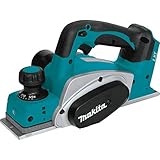


KP0810 vs. DKP180: corded control or cordless convenience?
Choose the KP0810 for regular shop or site work
The KP0810 is a practical all-rounder if you routinely trim doors, adjust timber edges, or remove material from boards. Its 82 mm cutting width suits typical carpentry stock, and its maximum 4 mm cut gives more headroom for substantial stock removal than the DKP180’s 2 mm maximum. In practice, heavy cuts are best made in multiple passes: that reduces strain, makes the tool easier to control, and helps avoid tear-out.
Its 0.1 mm depth steps are useful when a door or fitting needs a careful final adjustment. A corded supply also means no battery pauses during a long job. The trade-off is managing the lead around the workpiece and finding a suitable outlet, which can be awkward on ladders or in unfinished buildings.
Choose the DKP180 when access matters more than continuous runtime
The DKP180 is the more convenient Makita wood planer for short, mobile jobs: trimming a door at its hinges, easing an edge on site, or making occasional adjustments away from a power outlet. It shares the KP0810’s 82 mm width and 0.1 mm adjustment increments, but its 2 mm maximum cut makes it less suited to rapid, heavy stock removal.
Battery life per charge cannot be expressed reliably as a fixed number of minutes or boards. A light chamfer or a few shallow passes uses far less energy than repeated full-width cuts in hard timber. Battery capacity matters too: a higher-capacity compatible 18V LXT pack generally provides more work between charges, but adds weight. If you plan to plane many boards, keep a charged spare or use a corded model.
A useful planning method is to estimate the work in passes rather than assume a runtime figure. For example, a 1 mm reduction across an 82 mm-wide board requires at least one pass at the DKP180’s full depth, while a deeper reduction requires multiple passes. Knots, hard grain, a dull blade, and uneven stock can increase the load and reduce the amount completed per charge.
Why the KP312 is a different buying decision
The KP312’s 312 mm width lets it cover nearly four times the width of an 82 mm planer in one pass. That makes a major difference when flattening broad beams, large timber faces, or other wide work where overlapping narrow passes would be slow and could leave ridges. Its 2,200 W motor is built for demanding, continuous corded work.
That capacity comes with substantial weight and bulk: at roughly 18.4 kg, it is intended for large workpieces and controlled handling, not quick overhead trimming or routine door fitting. Make sure the timber is adequately supported and plan the direction and sequence of passes before starting. If the stock is narrow, a KP312 is usually unnecessary; its width and weight do not improve a small trim job.
Pick by the work you actually do
| Your situation | Best fit | Why |
|---|---|---|
| Occasional door fitting; no convenient outlet | DKP180 | Portable, battery-powered, and fine 0.1 mm depth adjustments |
| Frequent trim work or deeper reductions | KP0810 | 82 mm width, corded runtime, and up to 4 mm depth per pass |
| Wide beams or broad timber faces | KP312 | 312 mm cutting width reduces the number of side-by-side passes |
| Limited storage and mixed, light jobs | DKP180 | No cord to store or route; most practical when already using LXT batteries |
| Large, repetitive work in a fixed work area | KP312 | Wide coverage and corded power suit demanding beam work |
Budget for the whole setup, not just the tool. A cordless planer may be less appealing if you also need to buy batteries and a charger; if you already own compatible LXT batteries, that cost may already be covered. A wide planer can also require more room to store and maneuver. Prices vary by region and whether a tool is sold bare or in a kit, so compare the configuration and included equipment rather than relying on a single headline price.
Ownership details that affect the finish
- Keep blades sharp and aligned. Dull or unevenly set blades can leave a rough finish, increase effort, and make the planer pull unevenly. Replace or rotate blades according to the model’s instructions.
- Clear chips regularly. Planing creates a lot of shavings. A blocked chip outlet can disrupt cutting and make the tool harder to control. Disconnect a corded tool or remove the battery before clearing it.
- Use a shallow finishing pass. Maximum cut depth is a capacity limit, not a recommended setting for every job. Shallow passes improve control, especially near the end of a cut or across changing grain.
- Support the work and the tool. Secure the timber, keep the base flat at the start and finish, and avoid tipping the planer as it leaves the edge. This helps prevent unwanted dips.
- Check consumables and compatibility. Blade type, reversible edges, and replacement availability depend on the specific model and market. Confirm the correct part before ordering.
Bottom line
For most trim carpenters, the decision is between the KP0810’s corded power and deeper cutting capacity and the DKP180’s freedom from a cord. Choose the cordless model for portable, intermittent work and the KP0810 for longer sessions or more substantial removal. Buy the KP312 only when its unusually wide cut solves a real beam-flattening or broad-surface problem. For a makita planer machine that will handle ordinary boards and door adjustments, the 82 mm models are the sensible starting point; for wide-beam work, width—not portability—is the deciding feature.