
What's inside
As an Amazon Associate I earn from qualifying purchases. This post may contain affiliate links at no extra cost to you.
Planer Tool Buying Guide: Which Type of Planer Do You Actually Need?
Choose a hand planer for small, precise adjustments; an electric hand planer for quick on-site stock removal; a thickness planer to make boards a consistent thickness; and a jointer-planer when you need to flatten and square rough lumber in a compact shop. The right planer tool depends less on its advertised power than on the board dimensions you handle, the surfaces you need to produce, and the space you can give the machine.
Start with the job, not the machine
“Planer” can mean several tools that remove wood in very different ways. A traditional hand plane and an electric hand planer work on a board’s surface, but don’t reliably make its opposite faces parallel. A thickness planer does that job once one face is already flat. A jointer-planer combination pairs a jointer, which flattens a face and straightens an edge, with a thickness planer.
As an Amazon Associate we earn from qualifying purchases at no extra cost to you.


That distinction matters when buying a planer wood tool. Feeding a bowed board straight into a thickness planer usually produces a board that is the same thickness but still bowed. If you regularly mill rough or reclaimed lumber, you’ll need a way to flatten one face first—either a separate jointer, a suitable flattening sled, or a jointer-planer.
Compare the four types
These figures are common planning ranges, not guarantees: check the specifications of the particular machine before buying. Benchtop planer capacity is usually listed by maximum board width and thickness; jointer capacity is commonly listed by cutterhead width.
| Type | Typical working capacity | Typical weight | Space and best use |
|---|---|---|---|
| Hand plane | Board width limited mainly by the plane and your reach; no fixed thickness capacity | About 1.5–10 lb, depending on style | Small storage footprint; fine fitting, smoothing, and controlled edge work |
| Electric hand planer | Usually about 3–3¼ in. cutting width; roughly 1/16–⅛ in. maximum cut per pass on many models | About 5–10 lb | Portable; doors, framing, and localized stock removal |
| Benchtop thickness planer | Commonly 12–13 in. wide and 6 in. thick; some models accept wider stock | About 60–100 lb | Needs a sturdy bench or stand and infeed/outfeed clearance; consistent thickness for boards |
| Jointer-planer combination | Commonly 10–12 in. cutterhead width; thickness capacity varies by model | Often 400–900 lb for stationary machines | Permanent shop footprint and board-handling room; flattening and thicknessing rough lumber |
Which planer fits your situation?
Choose a hand plane for fitting and fine adjustment
A hand plane is the most sensible choice if you only need to trim a door edge, ease a sharp corner, flatten a small glue-up, or refine a surface after machining. It stores easily and doesn’t require dust collection or power. A low-angle block plane suits end grain and small parts; a longer bench plane bridges hollows more effectively on wider surfaces.
The trade-off is skill and setup. A dull iron tears fibers instead of shaving them, while a blade set too deeply can dig in. You’ll need to learn blade sharpening and adjustment, but there are few motors or consumables to maintain. For occasional touch-ups, that can be a better investment than a large machine.
Choose an electric hand planer for portable, rough work
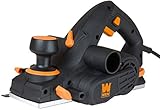
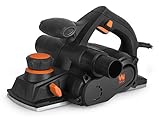
Pick an electric hand planer when the workpiece is already installed or too awkward to bring to a stationary machine—such as trimming a sticking door, leveling framing, or quickly removing material from a long edge. Its narrow cutter makes it handy in the field, but it isn’t a substitute for a jointer or thickness planer when you need accurate, parallel faces.
It’s easy to remove too much material, especially at the ends of a board, where the tool can leave a dip or step. Take shallow passes, support the work securely, and check the result with a straightedge. Budget for replacement or sharpenable blades, and keep the sole clean: pitch and dust can interfere with smooth travel.
Choose a thickness planer for repeatable board thickness
A benchtop thickness planer is usually the best first machine for a furniture hobbyist buying surfaced lumber or working with boards that already have one flat face. It brings the opposite face parallel to the reference face and makes batches of boards consistent in thickness—useful for tabletops, shelves, cabinet parts, and glue-ups.
It does not flatten a twisted or bowed board by itself. A planer presses the board against its bed as it cuts, so the board can spring back to its original curve afterward. Flatten one face first, then feed that face down. If you don’t own a jointer, a properly secured planer sled can support stock that needs flattening, though it adds setup time and limits how conveniently you can process long boards.
Plan for more than the machine’s footprint. Long boards need support on both sides, and the cutterhead produces substantial chips. Check whether your shop can accommodate a suitable dust collector or chip extractor, and whether the planer can be moved or stored safely; a 70-pound machine is portable in theory but awkward to lift repeatedly.
Choose a jointer-planer for rough lumber and limited floor space
A combination machine makes sense when you regularly buy rough-sawn lumber and want to flatten faces, square edges, and thickness boards without purchasing two full-size machines. It can also save floor space compared with separate stationary jointer and planer machines.
“Combination” doesn’t mean compact or effortless. Many models are heavy, need a stable permanent position, and require reconfiguring tables or guards when switching functions. Check the conversion process, the maximum width in both modes, and the length of stock you can realistically handle. If you mostly buy pre-milled boards and only need occasional thickness adjustments, the cost and setup are unlikely to pay off.
A quick decision matrix
| Your situation | Best starting choice | Why |
|---|---|---|
| Small budget, occasional fitting, little storage | Hand plane | Low space demand; handles small corrections without a machine setup |
| On-site work or trimming installed material | Electric hand planer | Portable and quick for localized removal |
| Beginner making furniture from surfaced boards | 12–13 in. benchtop thickness planer | Useful capacity for common project parts; manageable compared with stationary equipment |
| Frequent rough-lumber milling, with a dedicated shop area | Jointer-planer combination | Handles flattening and thicknessing in one machine |
| Very little floor space but frequent thicknessing | Benchtop thickness planer, stored on a mobile stand | Smaller than a stationary combination machine, though stock still needs clearance |
Check ownership costs before you buy
The purchase price is only part of the cost. Hand planes may need sharpening stones or a honing guide. Electric hand planers use cutter blades that eventually need replacement or sharpening. Thickness planers and jointer-planers require sharp knives or cutter inserts, chip management, and occasional table or fence adjustments.
Knives are often the first performance-related wear item: dull edges can leave a rough surface, increase tear-out, and encourage users to take heavier cuts. On machines with disposable knives, confirm the replacement price and availability before choosing a model. Helical or insert-style cutterheads can offer convenient edge changes, but their initial cost and replacement inserts differ from straight-knife systems.
To estimate whether a machine is worth owning, divide its total ownership cost by the number of projects you expect to use it for. For example, a hypothetical $600 planer used on 30 projects over five years costs $20 per project before blades, electricity, and dust collection. If you’ll use it on only three projects, borrowing, renting, or buying surfaced stock may make more sense. These are general market examples, not quotes; prices vary by capacity and cutterhead type.
Bottom line
For small corrections, buy a hand plane. For portable rough removal, choose an electric hand planer. For consistent thickness on boards with a flat reference face, a benchtop thickness planer is the practical choice. If you regularly start with rough lumber and have room for heavy stationary equipment, consider a jointer-planer combination. Match the tool to your stock and milling process—not just to the word “planer” on the label.