What's inside
As an Amazon Associate I earn from qualifying purchases. This post may contain affiliate links at no extra cost to you.
Why thick benches are picky about holdfasts
A holdfast that works perfectly in a 2-1/2″ thick top can be useless in a 4″ Roubo slab. The problem is geometry. A holdfast holds by wedging its shaft against the walls of the dog hole at two points. If the shaft is too short, too smooth, or too small in diameter for the hole, it cannot create enough bite and it pops out under pressure or bounces instead of setting.
Most traditional benches are 3″ to 4-1/2″ thick. Once you are over 3-1/2″, you need to be deliberate about holdfast length, shaft diameter, and the hole you drill. Getting this wrong means you will be hammering twice as hard for half the holding power, and you will oval out your dog holes over time.
As an Amazon Associate we earn from qualifying purchases at no extra cost to you.


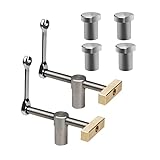
How a holdfast actually grips
When you tap the top of a holdfast, the shaft cants slightly inside the hole. The toe of the pad presses down on the work and the shaft binds against the front and back of the hole. The rougher and springier the shaft is, the better it bites without needing a massive strike.
Two things kill holding power: a shaft that is too polished or chrome-plated, and a hole that is too large for the shaft. A 3/4″ shaft in a 1″ hole has to deflect much farther before it wedges, which means it often slips before it locks. A 3/4″ shaft in a 3/4″ or 25/32″ hole locks with a light to medium tap and releases with a sharp tap on the back of the shaft.
Bench thickness matters because the shaft needs enough depth to develop that wedge. On a thin bench (under 2-3/4″), almost any holdfast will stick. On a thick bench, you need a shaft that goes at least 1-1/2″ to 2″ below the bottom of the top when seated, or the leverage works against you.
The two numbers that matter: shaft diameter and usable length
Ignore marketing and look at these specs:
1. Shaft diameter vs. your dog hole. The workhorse standard is 3/4″ (19mm). Most benches are drilled for 3/4″ dogs and holdfasts, and that system works well up to about 3-3/4″ thick. If you are building a new thick bench, 1″ (25mm) holdfasts are more forgiving. They give you more contact area and resist bending, but you will need to drill 1″ holes and buy 1″ accessories to match.
2. Usable shaft length. Measure from the underside of the pad’s arm to the end of the shaft. For a 3″ bench, you need at least 6″ of shaft below the arm. For a 3-1/2″ to 4″ bench, look for 7-1/2″ to 9″ of usable shaft. For a 4″ to 4-1/2″ bench like a laminated maple or beech Roubo, you want 9″ to 11″ overall length with at least 8″ of straight shaft.
Reach matters too. A 6″ reach (from shaft center to pad tip) is too short for wide boards. 7″ to 8-1/2″ is better for a thick bench where you will be clamping across wider panels. Too much reach makes the holdfast flex and lose downforce, so do not chase an 10″ arm unless you buy a heavy forged shaft to match.
Forged vs. cast vs. bent steel
There are three basic types on the market, and they behave very differently in thick tops.
Traditional forged holdfasts are made from mild steel, hammered to shape. The shaft has texture and slight taper, and the steel has spring. They set with one firm tap and pop free with a tap on the back. They are the most reliable in thick benches because they flex rather than slip. The well-known Gramercy holdfasts are the benchmark here, but any competently forged 3/4″ holdfast from a small blacksmith will act similarly. Expect to pay $35 to $65 per pair.
Cast iron holdfasts are cheap and widely available. They are stiff and brittle, with a sand-cast texture. They can work in benches up to about 3″ thick, but in a thick top they are the most likely to fail. Failure mode is either they will not bite at all and skate up the hole, or they crack at the bend if you over-strike them. They also mar work more because the pad is often small and hard. They are fine for light holding if your bench is on the thinner side and you do not want to spend much.
Bent steel bar holdfasts are made from cold-bent round bar. They are stronger than cast iron and cheaper than forged. The downside is the shaft is often perfectly smooth and dead straight, so it needs a tighter hole and a harder hit to set in a thick bench. Some woodworkers scuff the shaft with 80-grit or add a slight flat with a file to improve bite. If you go this route, buy forged holdfasts sized for 3/4 inch holes only if they list usable shaft length for 4-inch tops, otherwise you will be short.
Comparison for thick tops
| Type | Shaft Dia. | Typical Usable Length | Works in 3.5″+ Top? | Common Failure Mode |
|---|---|---|---|---|
| Gramercy / Small Forge Forged | 3/4″ (19mm) | 7.5″ – 9″ | Yes, reliable to 4″ | Pad dents soft wood if over-struck |
| Heavy Blacksmith Forged (1″ shank) | 1″ (25mm) | 9″ – 11″ | Yes, best for 4″ – 4.5″ | Heavy, needs 1″ holes |
| Bent Steel Bar | 3/4″ | 6″ – 7.5″ | Marginal, needs tight hole | Slips, needs hard strike |
| Budget Cast Iron | 3/4″ | 5.5″ – 6.5″ | No, slips or cracks | Won’t wedging, breaks at elbow |
Drilling and fitting for maximum hold
Your holdfast is only as good as the hole. For a 3/4″ holdfast, drill 3/4″ holes with a sharp auger or Forstner bit, not a spade bit. Drill perpendicular to the top, but a 2 to 3 degree lean toward the vise is fine and can even help bite. For a thick top, drill straight through if you can; a blind hole that is only 3″ deep in a 4″ top reduces wedge depth.
Test fit before you commit to a pattern. Drill one hole near the leg, tap the holdfast in with a 16 oz mallet, and try to pull it by hand. It should set in one or two moderate blows and release with one sharp blow to the back of the bend. If it takes a sledgehammer to set, your hole is too tight or the shaft is too smooth. If it lifts with hand pressure, the hole is too big or the shaft is too short.
If you already have a thick bench and budget cast iron holdfasts that will not hold, you have two fixes. First, try roughing the shaft with 60-grit sandpaper for 2″ above and below the contact zone. Second, add a collar. A 3/4″ thick hardwood offcut with a 3/4″ hole slipped over the shaft and sitting on the benchtop effectively reduces the bench thickness. Some makers sell steel collars for this purpose. It is not elegant, but it works.
What to buy based on bench thickness
If your bench is 2-3/4″ to 3-1/2″ thick: A pair of 3/4″ forged holdfasts will handle 90% of tasks. You do not need 1″ shanks. Spend the money on forged steel and you will not think about holdfasts again.
If your bench is 3-1/2″ to 4-1/4″ thick: This is the zone where length is critical. Buy forged 3/4″ holdfasts that specifically state they are made for thick benches, with at least 8″ of shaft. If the vendor does not list shaft length, assume they are short. For new builds in this range, consider drilling 1″ holes and buying 1″ forged holdfasts. They cost more and the accessories are less common, but they hold with less fuss.
If your bench is over 4-1/4″ thick or has a double layer: Do not buy short holdfasts hoping they will work. You need extra-long forged holdfasts, often sold as “Roubo” or “extra deep” models, with 10″ to 12″ overall length. Alternatively, counterbore the underside of the dog holes. A 1-1/2″ Forstner bit drilled 1″ deep on the bottom reduces the effective thickness without weakening the top much if you stay away from the edge.
Avoid holdfasts with chrome or powder coat on the shaft if you have a thick top. The coating reduces friction exactly where you need it. Bare steel with a light oil film holds better and can be renewed with a quick scuff every year.
Using them without damaging work
Always use a scrap pad between the holdfast and your workpiece if the piece is finished. The pad of a forged holdfast can leave a crescent dent in pine or even cherry with a hard strike. A 1/8″ leather or cork pad glued to the foot helps, but check that it does not make the holdfast need an even harder hit.
Set the holdfast close to the work before striking. If there is a 1/4″ gap between pad and board when you start hammering, you are bending the arm instead of wedging the shaft and you will weaken it over time. Drop it, let it touch, then give it a firm tap straight down. To release, hit the back of the curve, not the pad. Hitting the pad to release just drives it tighter.