
What's inside
As an Amazon Associate I earn from qualifying purchases. This post may contain affiliate links at no extra cost to you.
A pneumatic nail gun solves a specific problem: driving fasteners quickly and at a consistent depth without the wrist strain and variability of a hammer. For trim carpenters, deck builders, and weekend renovators alike, the tool converts a slow, error-prone task into a single-press operation that leaves the workpiece clean. The right unit for your compressor and your typical fastener type can cut project time in half compared to hand-nailing, while the wrong one creates jams, blowouts, and frustration that make you wonder why you did not just use a hammer.
What separates a worthwhile pneumatic nail gun from a mediocre one comes down to four things that owner feedback consistently highlights: depth-control precision, jam frequency under load, overall weight during extended use, and whether the fastener range actually matches the work you do. A tool rated for 2-inch brad nails means nothing if you are framing walls with 3-1/2-inch collated nails, and a framing nailer means nothing for attaching shoe molding. The 2026 market offers clear options at every tier, and below we compare them on published specifications, real owner reports, and pricing.
As an Amazon Associate we earn from qualifying purchases at no extra cost to you.

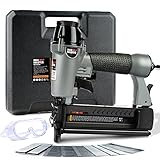


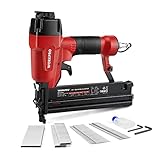


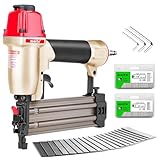
Quick Picks
| Product | Best for | Price |
|---|---|---|
| DEWALT DWFP12231 | General finish and trim work | $102.35 |
| NEU Master 2-in-1 | Tight budgets needing brads and staples | $39.99 |
| Metabo HPT NR90AES1 | Framing and structural work | $159 |
| Metabo HPT NT50AE2 | Precision trim with adjustable depth | $69 |
| WORKPRO 2-in-1 | Homeowners wanting versatility | $39.55 |
| Metabo HPT NT65M2S | Finish carpentry, lightweight use | $129 |
| DOTOOL 2-in-1 | Light DIY projects on a budget | $35.99 |
| meite F50C | Beginners who want nails included | $43.98 |
How We Picked
We compared each tool on four criteria that matter most in this category. First, fastener compatibility: the gauge and length range must match the type of work the tool claims to serve. Second, depth control: whether the adjustment mechanism is tool-free, how fine-grained the settings are, and whether owners report drift during use. Third, reported reliability: jam frequency, misfire rate, and build-quality concerns pulled from long-term owner feedback. Fourth, value relative to the stated price, including whether accessories like included fasteners or a carrying case offset the cost.
The 8 Best Pneumatic Nail Gun in 2026
DEWALT Brad Nailer Kit, 18GA, DWFP12231
A dependable mid-range choice for finish carpenters and serious DIYers who need one tool to cover trim, molding, and paneling. The 5/8-inch to 2-inch fastener range handles everything from thin quarter-round to thicker baseboard stock, and the kit format means you are ready to work out of the box.
- Wide fastener range covers most finish applications in a single tool
- Kit includes accessories that eliminate the need for a separate purchase
- At $102.35 it costs more than most competitors in the same gauge class
Skip it if you primarily need staples for upholstery or light fencing; a dedicated dual-function tool at a lower price covers that use case better.
NEU Master Nail Gun, 2 in 1 Pneumatic Brad Nailer/Staple Gun
For homeowners tackling upholstery, light fencing, or small trim projects who do not want to maintain two separate tools. The dual-function design is its main appeal, and the price is among the lowest for a pneumatic option that actually drives both fastener types.
- Two functions in one tool saves money and bench space
- Hard to beat for a pneumatic brad-and-staple combination at $39.99
- Owner feedback points to inconsistent depth control on the staple setting
Skip it if you do precision trim work regularly; the depth adjustment lacks the fine-grained control that dedicated brad nailers offer.
Metabo HPT Framing Nailer, 21°, NR90AES1
Built for framers and deck builders who drive long collated nails daily and need a tool rated for sustained structural work. The 21-degree plastic collation angle is specifically designed to clear tight corners and angled framing members without interference.
- The 2- to 3.5-inch nail range handles most rough framing and subfloor applications
- Plastic collation at 21 degrees improves clearance in confined joints
- Heavier and bulkier than finish tools, making it tiring for overhead work
Skip it if your projects are trim-only; a framing nailer is overkill and uncomfortable for delicate molding work.
Metabo HPT Brad Nailer, 18 Gauge, NT50AE2
A strong choice for woodworkers who need precise, repeatable depth control on trim and molding without paying a premium price. The tool-free depth adjustment lets you switch between soft pine and dense oak without reaching for a screwdriver, which owners cite as a workflow improvement.
- Tool-free depth adjustment reduces setup time between different materials
- At $69 it sits in a sweet spot between budget and professional pricing
- The exhaust pattern directs air toward the workpiece, blowing sawdust onto fresh glue joints
Skip it if you also need staples; this is a dedicated brad nailer with no dual-function capability.
WORKPRO 2-in-1 Pneumatic Brad Nailer/Staple Gun, 18 GA
Targeted at first-time pneumatic tool buyers who want to test the format before committing to a premium brand. The magazine capacity reduces reload frequency during long runs of identical fastening, which helps on repetitive jobs like subfloor paneling.
- Under $40 with both brad nails and staple capability
- Larger magazine capacity means fewer interruptions during extended runs
- The sequential trigger mode requires more force than expected, adding fatigue over a full session
Skip it if you need the tool daily on a job site; the build quality is adequate for weekend use but not for sustained professional pace.
Metabo HPT 16 Gauge Finish Nailer, NT65M2S
For finish carpenters who need the extra holding power of 16-gauge nails for larger trim, cabinets, and door jambs while keeping weight manageable. Owner feedback confirms the “lightweight” designation is substantive, not marketing language.
- Noticeably easier to hold overhead for extended periods than comparable 16-gauge tools
- The 1- to 2.5-inch range covers the most common finish nail lengths
- At $129 it is the priciest finish tool in this roundup, and 16-gauge nail holes are harder to hide than 18-gauge brads
Skip it if your work is primarily thin molding or crafts where the larger head hole of a 16-gauge nail would be visible after filling.
DOTOOL Pneumatic Brad Nailer, 18 Gauge, 2 in 1
The absolute lowest entry price for a functional air-powered nail and staple driver. For budget-conscious DIYers who want to get off the ground without spending much, it delivers on that single promise.
- Cheapest option in this list at $35.99
- Included accessories make it immediately usable without extra purchases
- Plastic components in the nosepiece and trigger assembly show wear faster than metal counterparts
Skip it if you drive fasteners into hardwood or pressure-treated lumber; owners report the mechanism struggles beyond softwood and thin paneling.
meite F50C Pneumatic Brad Nailer with 2000pcs Nails
Best suited for beginners who want a complete starter package in one purchase. The 2,000 included nails cover a substantial amount of trim work before you need to restock, and the 5/8-inch to 2-inch range gives flexibility for most household tasks.
- The included nail supply means you can start work immediately
- The 5/8- to 2-inch range covers most common household trim fastener sizes
- Some owners report jamming after a few hundred cycles on thicker stock
Skip it if you already own an air compressor and nails; the value proposition here is the bundle, not the hardware itself.
Buying Guide
Gauge and Fastener Length
Gauge determines the diameter of the nail and the size of the hole it leaves. Eighteen-gauge brad nailers are the most versatile for finish work, producing small holes that hide easily under wood filler. Sixteen-gauge finish nailers drive thicker nails with greater pull-out resistance, making them better for cabinets, baseboard in high-traffic areas, and door casings. Framing nailers drive collated nails up to 3-1/2 inches for structural joints. Matching the gauge to the work is the single most important purchasing decision; no depth adjustment or comfort feature compensates for the wrong fastener type.
Depth Control and Trigger Mode
Tool-free depth adjustment lets you fine-tune how far a nail sits below the surface, which matters when switching between materials of different densities during a single project. A fixed-depth tool requires trial-and-error with pressure or a separate adjustment step. Trigger mode matters too: bump-fire (contact trip) lets you drive nails quickly by holding the trigger and pressing the nose against the work, ideal for framing and repetitive nailing. Sequential trigger requires you to press the nose first, then pull the trigger, which improves accuracy for trim but slows the pace.
Weight and Magazine Capacity
Weight affects how long you can work overhead or at arm’s length before fatigue sets in. Owner feedback on this factor is more predictive of real-world satisfaction than any spec-sheet number. Magazine capacity determines how often you reload; a full magazine might hold 100 brad nails, while a framing nailer might hold only 30. If you work on large, repetitive jobs like subflooring, a larger magazine saves significant time. For detail trim where each nail is placed individually, capacity matters less.
Our Verdict
Top pick: the DEWALT DWFP12231 kit offers the best balance of fastener range, included accessories, and reliable depth control for general finish work. Budget pick: the DOTOOL at $35.99 is the lowest-cost way to get a functional pneumatic brad and staple driver, provided your work stays within softwood and thin paneling. If you need 16-gauge holding power for cabinets or large trim and still want a tool you can use overhead without fatigue, the Metabo HPT NT65M2S at $129 is the clear choice over everything else in this group.
FAQ
What CFM does my compressor need for a pneumatic nail gun?
Most 18-gauge brad nailers draw between 2 and 3 CFM at typical operating pressures, which a small 2-gallon compressor can handle. Framing nailers demand more air volume and benefit from a larger tank and higher CFM rating. Match your compressor to the tool’s stated consumption, not the other way around.
Do I need to oil a pneumatic nail gun?
Yes. Daily application of a few drops of pneumatic tool oil into the air inlet keeps the internal seals and driver blade lubricated. Many modern models are marketed as oil-free, but owners who add oil still report longer service intervals and fewer dry-fire jams.
What is the difference between bump-fire and sequential trigger modes?
Bump-fire lets you drive nails by holding the trigger and pressing the nose against the surface in rapid succession, which is faster but less precise. Sequential trigger requires the nose to contact the workpiece before the trigger will fire, which reduces the risk of accidental double-nails and improves accuracy on finish work.
Can a pneumatic nail gun be used indoors safely?
Yes, provided you wear hearing protection and safety glasses. The main indoor concern is air pressure and exhaust noise, not fumes. A pneumatic nail gun produces no combustion gases, so ventilation is not required beyond normal room airflow.