
What's inside
- Quick comparison: which CNC wood bit fits your job?
- Upcut bits: the best all-purpose starting point
- Downcut bits: cleaner tops for plywood and MDF
- Compression bits: the cleanest answer for sheet goods
- V-bits for detailed engraving and lettering
- Spoilboard cutters: fast flattening, not general profiling
- Decision matrix by material and experience
- How to choose size, shank, and flute count
- Feeds, speeds, and ownership realities
- Bottom line
- Related Guides
As an Amazon Associate I earn from qualifying purchases. This post may contain affiliate links at no extra cost to you.
The best CNC bits for wood are an upcut spiral for general hardwood and softwood cutting, a downcut spiral for clean top surfaces in plywood and MDF, a compression bit for sheet goods with two clean faces, a V-bit for lettering and engraving, and a spoilboard cutter for flattening wasteboard surfaces.
The right choice depends less on the router brand than on four variables: the material, the required edge quality, the depth of cut, and whether your machine can maintain the feed rate needed by the bit. A premium cutter used with the wrong settings will leave a worse finish than a modest cutter matched to the job.
As an Amazon Associate we earn from qualifying purchases at no extra cost to you.
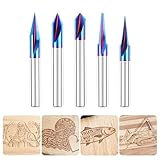


Quick comparison: which CNC wood bit fits your job?
| Bit type | Best material or task | Typical diameter | Typical flute length | Main advantage | Main drawback |
|---|---|---|---|---|---|
| Upcut spiral | Hardwood, softwood, pockets, through-cuts | 1/8–1/2 in | 1/2–1-1/4 in | Excellent chip removal | Can lift veneer or splinter the top face |
| Downcut spiral | Plywood, MDF, shallow pockets, laminated panels | 1/8–1/2 in | 1/2–1-1/4 in | Clean top surface and restrained chips | Needs good dust extraction and chip clearance |
| Compression spiral | Through-cut plywood and veneered sheet goods | 1/4–1/2 in | 3/4–1-1/4 in | Clean top and bottom faces | Must be cut deep enough for its upcut section to engage |
| V-bit | Signs, lettering, chamfers, detailed engraving | 30°, 60°, or 90° | 6–20 mm | Sharp detail and variable line width | Small depth errors change the appearance significantly |
| Spoilboard cutter | Flattening MDF or surfaced wasteboards | 1–1-1/4 in | 1/4–1/2 in | Covers a broad area quickly | Not intended for detailed profiling |
Upcut bits: the best all-purpose starting point
An upcut spiral pulls chips upward and away from the cutting zone. That makes it the most forgiving choice for pockets, slots, and through-cuts in solid wood, especially when your dust collection is modest. It also helps prevent chips from being repeatedly recut inside a deep pocket.
Choose a two-flute carbide upcut bit for most hardwood and softwood work. A 1/4-inch diameter cutter is a useful general-purpose size because it is stiff enough for ordinary cabinet parts and small furniture components while still reaching into moderately tight corners. A 1/8-inch bit gives finer inside radii, but it is easier to break and removes material more slowly.
The trade-off is edge quality. Because the cutting action lifts material, an upcut may pull fibers from the top face of plywood or tear out at the upper edge of a soft board. Use a finishing pass, masking tape, a sacrificial top layer, or a downcut bit when the visible top surface matters most.
Downcut bits: cleaner tops for plywood and MDF
A downcut spiral pushes chips and fibers downward. This usually produces a cleaner top edge on plywood, veneered panels, and painted MDF, and it keeps thin parts pressed against the spoilboard. These cnc wood bits are particularly useful for shallow pockets, lettering, and profiles where the top face is the presentation surface.
Downcut geometry is not automatically better for deep cutting. Its downward action can compress chips into a pocket, causing heat, burn marks, and premature dulling. Make shallower passes, use effective dust extraction, and avoid letting the cutter rub at the bottom of a narrow slot. For a through-cut in thick plywood, a compression bit is normally the better choice.
Compression bits: the cleanest answer for sheet goods
A compression cutter combines a short upcut section near the tip with a longer downcut section above it. When the cutting depth is set correctly, the two geometries shear fibers toward the middle of the panel, leaving both the top and bottom faces cleaner than a conventional upcut.
Compression bits are ideal for cabinet parts, plywood furniture, melamine-faced panels, and veneered boards. They are less useful for very shallow engraving or a pocket that never reaches the transition between the upcut and downcut sections. Follow the manufacturer’s minimum cutting depth; on many common 1/4-inch compression cutters, the first pass must be deep enough for the downcut portion to engage the lower edge.
For a 3/4-inch plywood panel, a practical approach is to leave a thin onion skin on the first passes, then make a final full-depth pass. This improves holding security and gives the compression geometry a better chance to clean both faces.
V-bits for detailed engraving and lettering
V-bits are the right choice when the design depends on crisp lines rather than rapid material removal. A 60-degree V-bit is a versatile middle ground for signs and moderately detailed text. A 30-degree bit produces narrower, deeper-looking lettering and can resolve smaller details, but it is more vulnerable to breakage. A 90-degree bit creates broad engraving and is useful for chamfers and decorative edge work.
V-bit line width changes with depth. For a 60-degree cutter, increasing the depth by only 1 mm can noticeably widen a groove. This is why a flat, accurately surfaced workpiece and a carefully set Z-zero matter more for engraving than a small difference in spindle speed.
Use a sharp solid-carbide V-bit for hardwood signs and a smaller diameter only when the design requires it. For fine detail, reduce the feed rate conservatively, secure the work firmly, and inspect the tip under magnification if the letters begin to look fuzzy.
Spoilboard cutters: fast flattening, not general profiling
Spoilboard cutters, also called surfacing or fly cutters, remove a wide strip of material in each pass. Common diameters range from 1 inch to 1-1/4 inches, making them much faster than a 1/4-inch end mill for flattening an MDF wasteboard or truing a workholding surface.
A useful coverage calculation shows why diameter matters. If a 1-1/4-inch cutter is programmed with a 75% stepover, each pass overlaps the previous path by 25%, so the effective new width is about 0.94 inches. Flattening a 24-inch-wide spoilboard therefore requires roughly 26 adjacent passes before accounting for machine margins. With a 1/4-inch cutter at the same stepover, the theoretical count rises to about 129 passes.
Use a surfacing cutter only when the machine has enough clearance and rigidity. Check that the body does not collide with clamps, and do not assume every fly cutter accepts replaceable inserts or can be used at the same spindle speed as a small router bit.
Decision matrix by material and experience
| Your situation | Recommended first choice | Why | Common upgrade |
|---|---|---|---|
| Beginner, mixed solid-wood projects | 1/4-inch, two-flute upcut | Versatile and clears chips well | Add a 60-degree V-bit |
| Mostly plywood or veneered panels | 1/4-inch compression bit | Protects both visible faces during profiling | Add a downcut for shallow pockets |
| Fine signs and small lettering | 30- or 60-degree carbide V-bit | Produces controllable line width | Add a small downcut end mill for clearing |
| Deep pockets in hardwood | Upcut spiral, preferably 1/4 inch or larger | Moves chips out of the pocket | Use a roughing pass followed by a finishing pass |
| Frequent wasteboard flattening | 1-1/4-inch surfacing cutter | Reduces the number of toolpaths | Choose replaceable-insert geometry for heavy use |
How to choose size, shank, and flute count
Match the shank to the collet rather than relying on an adapter. A 1/4-inch shank is common on compact routers; 1/2-inch shanks are stiffer and better suited to larger cutters and heavier machines. Never force a 1/4-inch bit into a 6 mm collet or use a damaged, dirty collet to compensate for an imperfect fit.
For general wood routing, two flutes provide a useful balance between chip space and cutting smoothness. Three-flute cutters can improve finish at suitable feed rates, but they require the machine to move fast enough to maintain chip load. More flutes do not automatically mean a cleaner cut.
Keep the exposed length as short as the job permits. A 1/4-inch cutter extending 1 inch from the collet bends much more than one extending 1/2 inch. That deflection produces tapered walls, chatter, and broken tips.
Feeds, speeds, and ownership realities
Use the manufacturer’s speed and feed recommendations as a starting point, then adjust for machine rigidity, material, and cutter diameter. A useful chip-load relationship is:
Chip load = feed rate ÷ (RPM × number of flutes).
For example, a two-flute bit running at 18,000 RPM and a feed rate of 72 inches per minute has a calculated chip load of 0.002 inches. If the machine moves too slowly while the spindle remains fast, the bit rubs instead of cutting, generating heat and burn marks. If the feed is too aggressive for the setup, the result is chatter, deflection, or a broken cutter.
The cutting edges usually wear before the shank or body. Resin from pine, MDF dust, and adhesive residue can increase friction, so clean the bit with a suitable non-abrasive resin remover and a soft brush; do not scrape carbide edges with steel. Store bits in individual holders, inspect for chipped corners, and replace a cutter when it requires repeated finishing passes to achieve the former result.
Carbide bits are consumables, but the cheapest bit is not always the lowest-cost option. If a $25 cutter produces 50 reliable jobs, its cutting cost is $0.50 per job. A $12 cutter that lasts 15 jobs costs $0.80 per job before counting rework and damaged material. For frequent CNC use, consistent geometry and replaceable inserts can matter more than the initial purchase price.
Bottom line
Start with a 1/4-inch two-flute upcut for general wood cutting, choose a downcut when the top face needs protection, and buy a compression bit for clean two-sided plywood work. Add a 60-degree V-bit for signs and a wide spoilboard cutter for flattening. The best cnc bits for wood are the ones whose cutting direction, diameter, flute length, and depth range match both the material and the capabilities of your machine.