
What's inside
- What the Powermatic 20-inch planer is designed to do
- Capacity and performance at a glance
- Cutting capacity and feed performance
- Conventional knives versus the helical cutterhead
- Footprint, power, and dust collection
- Which buyer is a good fit?
- Ownership costs beyond the purchase price
- Maintenance and common mistakes
- Verdict
As an Amazon Associate I earn from qualifying purchases. This post may contain affiliate links at no extra cost to you.
The Powermatic 20 planer is a strong choice for a professional or serious shared shop that routinely machines wide boards, but its roughly 900-pound footprint, 230-volt power requirement, and four-figure-to-low-five-figure ownership cost make it excessive for occasional furniture work.
As an Amazon Associate we earn from qualifying purchases at no extra cost to you.
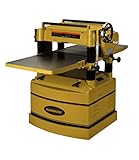


What the Powermatic 20-inch planer is designed to do
Powermatic’s 20-inch class planer, commonly identified as the Model 201 and Model 201HH, is a stationary thickness planer for production-scale stock preparation. It accepts boards up to 20 inches wide and approximately 8 inches thick, depending on the exact machine configuration and specification revision. That capacity is the main reason to buy it: a 20-inch planer can process wide table components, glued-up panels, stair parts, and heavy slabs that exceed the limits of typical 12- or 15-inch machines.
The machine is not a compact “large hobbyist” planer. It needs a permanent location, a suitable dust collector, and a clear infeed and outfeed path. Before buying a used unit, confirm the model plate, voltage, phase, cutterhead, and maximum thickness because Powermatic 20-inch planer specifications can vary between versions and production years.
Capacity and performance at a glance
| Specification or ownership factor | Powermatic 201/201HH class | Why it matters |
|---|---|---|
| Maximum planing width | 20 inches | Handles wide boards and panels without ripping them into narrower strips |
| Maximum stock thickness | Approximately 8 inches | Useful for thick beams, table parts, and substantial glued-up work |
| Motor | Approximately 5 HP, commonly 230 V single-phase | Provides the torque expected of a fixed production planer |
| Feed rates | Typically about 16 and 30 feet per minute | Offers a slower finish-oriented setting and a faster stock-removal setting |
| Maximum cut per pass | About 3/32 inch under rated conditions | Prevents treating the machine like a rough-sawing mill; depth depends on species, width, and grain |
| Cutterhead choices | Conventional knife or helical insert head, depending on model | Changes noise, tear-out behavior, maintenance, and operating cost |
| Approximate machine weight | Around 900 pounds | Improves stability but requires serious moving and floor planning |
These figures should be treated as a buying guide rather than a substitute for the manual or machine plate. A used 20 Powermatic planer may have been rewired, retrofitted, or fitted with a different cutterhead. Confirm electrical and dimensional details before arranging delivery.
Cutting capacity and feed performance
The 20-inch table is valuable only if the rest of the shop can support it. Wide stock places greater demand on the cutterhead and feed rollers than narrow boards do. A full-width, hard maple panel at an aggressive depth of cut will slow the machine more than a narrow pine board, even when both are within the published capacity.
The two-speed feed system is practical rather than decorative. The slower setting is the better default for wide, dense, figured, or tear-out-prone material. The faster setting can improve throughput when dimensioning straight-grained boards and removing modest amounts of material. For a clean finish, it is usually better to take multiple consistent passes than to rely on the maximum cut depth on every board.
Feed rollers and bed condition matter as much as motor horsepower. Resin, dust, and crushed fibers on the rollers can cause slipping or uneven feeding. A polished or contaminated bed increases friction and can make a powerful planer appear underpowered. Clean the bed and rollers before diagnosing a motor or gearbox problem.
Conventional knives versus the helical cutterhead
Standard knife head
The conventional head uses long straight knives. Its advantages are a lower purchase price, rapid stock removal, and a familiar sharpening or replacement process. The disadvantages are greater noise, a full-width knife change when an edge is damaged, and a greater tendency to show tear-out in figured or reversing grain.
Helical insert head
The 201HH-style helical head uses many small, replaceable carbide inserts. Rotating one damaged insert can restore a cutting edge without removing and sharpening a long knife. The insert geometry generally produces a quieter cut and can reduce visible tear-out, although feed direction and grain still matter.
The helical option costs more initially and uses a larger number of consumable edges. It is most attractive for a shop that processes figured hardwood, reclaimed timber, or abrasive species frequently. For a shop mainly dimensioning clear, straight-grained softwood, the conventional head may provide better value.
Footprint, power, and dust collection
Plan for more than the machine’s steel cabinet. A 20-inch planer needs an unobstructed infeed and outfeed zone long enough for the boards being processed. A practical layout often requires roughly 8 to 12 feet of straight clearance, depending on stock length and how much room is needed to safely support the board.
The weight is an advantage during use because it reduces vibration and helps the rollers maintain contact. It is a disadvantage during installation. Moving one generally requires a machinery pallet jack, toe jacks, lifting equipment, or a professional rigger. Check door width, thresholds, floor loading, ceiling height, and the route from the delivery point before purchasing.
A suitable dust collector is essential. A 4-inch hose may restrict airflow on a machine producing this much waste; a 5- or 6-inch duct, short runs, and a collector capable of maintaining useful airflow at the machine are preferable. Poor extraction lets chips accumulate around the cutterhead, restricts visibility, contaminates the feed mechanism, and increases cleanup time. Use the manufacturer’s dust-port size and collector requirements as the final authority.
Most versions require a dedicated 230-volt circuit, and some used machines may be configured for three-phase power. Have a qualified electrician verify the circuit, disconnect, overload protection, and motor configuration rather than assuming a residential outlet is suitable.
Which buyer is a good fit?
| Shop situation | Recommendation | Reason |
|---|---|---|
| Frequent wide hardwood work | Buy the 20-inch machine, preferably with the helical head if budget allows | The extra capacity avoids ripping panels and improves difficult-grain results |
| Occasional boards under 13 inches wide | Choose a smaller planer | The Powermatic’s floor space, power, and moving cost are difficult to justify |
| Small garage with no 230 V supply | Do not buy until electrical and layout work are solved | Capacity cannot compensate for an unsafe or impractical installation |
| Production or shared professional shop | Strong candidate; compare cutterhead and service availability | Heavy construction and wide capacity suit repeated use |
| First stationary planer purchase | Usually start with a smaller machine | Lower installation risk and lower consumable cost make learning less expensive |
Ownership costs beyond the purchase price
New pricing for a heavy 20-inch planer can range from several thousand dollars into the low five figures depending on configuration, cutterhead, and market. Used prices vary widely with condition, electrical setup, included stand or mobile equipment, and whether the machine is a standard 201 or a helical-head 201HH-style version. Transport and electrical work can add a meaningful amount before the first board is machined.
Consider a simple capacity calculation. If a shop processes 600 boards per year and a 20-inch planer saves an average of 8 minutes per board compared with repeated ripping, flattening, and rejoining, the time saved is 4,800 minutes, or 80 hours annually. At a shop labor value of $50 per hour, that represents $4,000 of annual productive capacity. The calculation does not prove that the machine pays for itself—the shop must actually have that workload—but it shows why the planer makes more sense for regular wide-stock work than for occasional convenience.
Budget for knives or carbide inserts, belts, bearings, feed-roller maintenance, lubrication, dust-collection filters, and possible electrical service. On a used machine, inspect the bed for deep scoring, check that the thickness adjustment moves smoothly, listen for gearbox noise, and look for play in the cutterhead or feed rollers. A low purchase price can disappear quickly if the machine needs a gearbox, rollers, and a complete cutterhead service.
Maintenance and common mistakes
- Clean the bed and rollers regularly; wax or use an approved low-friction treatment only as directed by the manual.
- Measure board thickness at several points instead of trusting a single caliper reading when checking snipe or uneven feeding.
- Remove metal, grit, and loose fasteners from reclaimed lumber before it reaches the cutterhead.
- Do not force a bowed board through the machine; surface one face first or use a jointer, sled, or suitable flattening method.
- Keep knives or inserts consistent. A missing, incorrectly oriented, or unevenly torqued insert can damage the head and produce ridges.
- Support long boards at the correct height. Infeed or outfeed sag is a common cause of snipe that is incorrectly blamed on the planer.
- Use hearing protection and appropriate dust control. A heavy planer is not automatically a quiet or clean machine.
Verdict
The Powermatic planer 20 is best understood as infrastructure for a high-volume woodworking shop, not simply a larger benchtop planer. Its 20-inch capacity, substantial motor, two-speed feed, and optional helical cutterhead make it highly capable with wide and difficult stock. The trade-offs are substantial: a large permanent footprint, difficult installation, dedicated electrical service, serious dust extraction, and ongoing maintenance.
Choose it when wide-board work is frequent enough to recover those costs, and inspect used examples with particular attention to the cutterhead, feed system, gearbox, electrical configuration, and moving requirements. If most of your material is narrower than 15 inches, a smaller planer will usually deliver the better overall shop fit and financial result.