
What's inside
As an Amazon Associate I earn from qualifying purchases. This post may contain affiliate links at no extra cost to you.
The SawStop Professional Cabinet Saw (PCS) is the better fit for most home shops, while the Industrial Cabinet Saw (ICS) earns its higher price when you need 3–5 HP power, a heavier fence system, and frequent production-level use.
Both are cabinet saws rather than contractor-style machines: they use enclosed steel bases, cast-iron tables, belt-driven induction motors, and SawStop’s electronic flesh-detection brake. The buying decision is less about basic cut quality than about electrical capacity, floor space, fence hardware, and how often the saw will run.
As an Amazon Associate we earn from qualifying purchases at no extra cost to you.
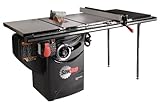


PCS vs. ICS: the short buying decision
- Choose the PCS 1.75 HP for a typical one-car garage, mixed hardwood and plywood work, and a 120V-compatible installation where available.
- Choose the PCS 3.0 HP if your shop has a dedicated 230V circuit and you want more reserve for thick hardwood, dadoes, and continuous ripping without stepping up to the largest cabinet.
- Choose the ICS 3.0 HP when the fence is a primary priority, the saw will be used several days a week, or you want a more industrial-feeling platform without the electrical and price demands of the 5 HP version.
- Choose the ICS 5.0 HP for production work, repeated thick-stock ripping, or a shop already wired for a substantial 230V circuit. It is usually excessive for occasional furniture building.
Head-to-head comparison
The exact package can vary by fence, table extension, motor voltage, and mobile base, so treat the figures below as planning numbers rather than a substitute for the configuration sheet supplied with a particular saw.
| Characteristic | PCS | ICS |
|---|---|---|
| Typical motor choices | 1.75 HP or 3.0 HP | 3.0 HP or 5.0 HP |
| Common operating voltage | 120V for 1.75 HP configurations; 230V commonly used for 3.0 HP | 230V for 3.0 HP and 5.0 HP configurations |
| Blade diameter | 10 inches | 10 inches |
| Maximum standard blade depth at 90 degrees | Approximately 3 1/8 inches | Approximately 3 1/8 inches |
| Maximum bevel range | Approximately 46 degrees left | Approximately 46 degrees left |
| Table height | Approximately 34 inches | Approximately 34 inches |
| Fence family | Professional T-Glide or package-specific equivalent | Industrial T-Glide, generally heavier and more rigid |
| Table and extension configuration | Cast-iron center table with steel extension wings; options vary | Heavier-duty cast-iron and steel package options; options vary |
| Planning footprint with 36-inch fence | Roughly 70–75 inches wide and 35–40 inches deep before infeed/outfeed clearance | Roughly 75–85 inches wide and 35–40 inches deep before infeed/outfeed clearance |
| Safety brake | Electronic brake system with replaceable brake cartridge | Electronic brake system with replaceable brake cartridge |
The PCS and ICS both accept a 10-inch blade and provide the cut capacity expected from a professional cabinet saw. The ICS advantage is not automatically a cleaner cut. It is greater motor reserve, more substantial industrial hardware, and a platform better suited to sustained work.
Horsepower and the 220V question
Horsepower should be matched to the material and duty cycle, not used as a proxy for accuracy. A sharp general-purpose blade can make excellent furniture cuts on a 1.75 HP saw. The practical difference appears when ripping thick maple, oak, or walnut, cutting damp or difficult stock, using a dado set, or making repeated cuts without allowing the motor to recover.
A 220V or 230V circuit does not create more horsepower by itself. It allows the motor to deliver its rated output with appropriate wiring and lower current on the supply conductors. A 3 HP model still needs a properly sized branch circuit, disconnecting means where required, and a receptacle matching the saw plug. The circuit rating depends on the exact motor and nameplate, so use the manufacturer’s electrical specification and have the installation checked by a qualified electrician.
For floor-plan planning, a useful example is a 12-by-20-foot garage. If the saw and fence occupy about 7 feet of width, leaving 36 inches on each side for feeding and handling means the machine needs approximately 13 feet of usable cross-shop width. Add at least 8 feet of clear path in front and behind the blade for an 8-foot panel. In practice, an outfeed table, lumber storage, and parked vehicles usually make the PCS easier to live with than the ICS.
Fence options: where the upgrade is felt every day
The fence is one of the most important differences between a basic saw package and a premium cabinet-saw setup. SawStop’s PCS packages commonly use a Professional T-Glide fence, while the ICS is associated with the heavier Industrial T-Glide system. Both are designed to lock squarely and slide along a front rail, but the industrial assembly generally brings more mass and stiffness.
- Professional T-Glide: a strong choice for a home shop, especially when the saw is used for cabinets, furniture, and sheet goods rather than nonstop production ripping.
- Industrial T-Glide: worthwhile when the fence is frequently repositioned, when long stock contacts it with force, or when you prefer a more substantial rail and locking mechanism.
- Fence length: a longer rail improves ripping capacity but increases wall clearance and the machine’s parked width. Do not select maximum capacity unless your material and shop layout need it.
Check whether the advertised rip capacity is measured to the right of the blade and whether it includes the selected extension table. A 36-inch fence package can require more than 6 feet of wall or aisle width even before stock is added.
Mobile-base footprint and shop fit
A mobile base solves one problem and can create another. It lets you move the saw away from a wall for maintenance or rotate it for a cut, but lifting the cabinet changes the working height and adds a few inches to the plan. A compatible SawStop mobile base or equivalent should be rated for the complete saw, extension wings, fence rails, and accessories—not merely the cabinet’s shipping weight.
Measure three footprints:
- Parked footprint: the cabinet, rails, and extension table at rest.
- Operating footprint: the parked footprint plus at least 36 inches on the operator side and enough clearance on the opposite side to prevent stock from striking a wall.
- Material footprint: the operating area plus the length of the boards or panels you commonly cut. For an 8-foot sheet, plan an unobstructed feed and outfeed line of roughly 16 feet whenever possible.
For a compact home shop, a PCS with a shorter rail and folding or removable outfeed support is often more usable than an ICS with maximum rip capacity. A large saw that must be pushed aside for every cut is less effective than a smaller one with a clear, repeatable workflow.
Decision matrix for common buyers
| Your situation | Best starting point | Why |
|---|---|---|
| Occasional weekend furniture projects; limited budget | PCS 1.75 HP | Lower electrical demand and adequate power for normal 10-inch-blade work |
| Regular hardwood furniture; dedicated 230V circuit | PCS 3.0 HP | More reserve without the largest cabinet and fence package |
| Cabinetmaker using the saw most days | ICS 3.0 HP | Industrial fence and heavier-duty platform justify the added cost and space |
| Production ripping of thick hardwood or wide batches | ICS 5.0 HP | Maximum motor reserve, provided the electrical service supports it |
| Garage shop that must be reconfigured often | PCS with a compatible mobile base | Usually easier to place and maneuver than the larger ICS configuration |
| Mostly plywood and sheet goods | PCS 1.75 or 3.0 HP | Fence accuracy, outfeed support, and dust collection matter more than maximum horsepower |
Safety system and ownership realities
The SawStop safety system detects electrical contact with the blade and triggers a brake cartridge that stops the blade and drops it below the table. It is an important layer of protection, not permission to bypass guards, riving knives, push sticks, or safe feeding practices. Wet lumber, foil-backed material, and some conductive sheet goods can affect detection; consult the manual before cutting unusual materials.
The brake cartridge and damaged blade are consumables after an activation. Keep a spare cartridge if downtime matters, and budget for replacement blades, dado-specific components, belts, and dust-collection filters. The brake does not eliminate kickback, so alignment and stock control remain essential.
Maintenance that protects accuracy
- Vacuum cabinet dust regularly, especially around the motor, elevation mechanism, and brake-sensing area.
- Clean and wax the cast-iron table with a suitable non-silicone product so stock slides without contaminating finishes.
- Inspect belt tension, pulley alignment, and arbor runout if vibration develops.
- Keep the fence rail and locking surfaces free of pitch; a fence that drags or locks unevenly can produce inaccurate rip cuts.
- Verify blade parallelism to the miter slot after moving the saw. A mobile base can introduce small shifts if the cabinet is not sitting level.
Final verdict
For most buyers searching for a SawStop cabinet table saw, the PCS 1.75 HP is the sensible home-shop choice, while the PCS 3.0 HP is the stronger all-around option when a 230V circuit is already available. The SawStop Professional Cabinet Table Saw becomes more compelling than the ICS when space and budget are constrained but accurate cabinet-saw performance is still required.
Choose the ICS when its industrial fence, heavier construction, and 3–5 HP motor will be used often enough to repay the extra cost and floor space. Before ordering either saw, confirm the motor nameplate requirements, fence length, mobile-base compatibility, door and stair access, and a complete 16-foot feed path for the sheet goods or lumber you actually buy.