
What's inside
As an Amazon Associate I earn from qualifying purchases. This post may contain affiliate links at no extra cost to you.
A “ryobi 10 table saw” almost always means one of Ryobi’s corded 15-amp RTS-series jobsite saws — the 10-inch portables and folding-stand kits sold over the last decade — and not the 18V ONE+ cordless saw, which spins an 8-1/4-inch blade and sits in a different class entirely. Choosing between the 10-inch models comes down to four things: rip capacity right of the blade, whether a stand is bundled, table and fence design, and whether the saw can accept a dado stack. Here’s how to tell them apart and match one to your shop.
As an Amazon Associate we earn from qualifying purchases at no extra cost to you.
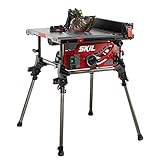

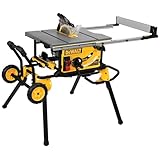

Identifying which Ryobi 10-inch model you’re looking at
The fastest way is the rating plate on the saw body. Model numbers start with RTS (RTS10, RTS12, RTS21G, RTS22, and newer revisions) for the modern jobsite line. The older BT3000/BT3100 benchtop system turns up constantly on the used market — it’s a genuinely capable saw but uses a sliding miter table instead of standard miter slots, which changes accessory compatibility. Quick identification checklist:
- Blade diameter: printed on the guard and label — 10 in. with a 5/8-in. arbor. If it’s battery-powered or labeled 18V ONE+, it’s the 8-1/4-in. cordless saw with much smaller rip capacity.
- Motor: corded 15-amp brushed universal motor on all RTS 10-in. models.
- Stand: “G” and kit variants often bundle a folding or rolling stand; bare-tool versions sit on a bench.
- Fence and table: newer revisions got wider rip capacity and revised fences — worth confirming on the plate’s date code if buying used.
The spec sheet, translated for a small shop
Numbers vary slightly by model and year, but the RTS 10-inch family clusters around these figures:
| Spec | Typical figure | What it means in practice |
|---|---|---|
| Blade / arbor | 10 in., 5/8-in. arbor | Standard, inexpensive blades everywhere |
| Motor | 15-amp brushed universal, ~4,800 RPM | Handles 2x stock and plywood; slow the feed in thick hardwood |
| Rip capacity, right of blade | ~27–30 in. depending on model | 24 in. is the minimum to halve a 4×8 sheet — these clear it with margin |
| Depth of cut | ~3-1/8 to 3-1/2 in. at 90°; ~2-1/2 in. at 45° | A 4×4 (3-1/2 in. actual) is at the limit — plan two passes |
| Bevel range | 0–45° | Standard for the class |
| Table depth (front-to-back) | roughly 20–22 in. | Short infeed — sheet goods need outfeed support |
| Weight | ~45–55 lb bare saw | One-person carry; still wants bolting to a stand or bench |
| Dust port | ~2-1/2 in. nominal | Fits a standard shop-vac hose; blade-guard dust is poorly captured |
| Dado stack support | Not officially supported on most RTS models | See the dado section below before assuming otherwise |
| Typical price | ~$180–$350 new; $75–$200 used | Entry-level bracket — cheapest route to a 10-in. blade |
Match the model to your situation
| Your situation | What matters most | Best move |
|---|---|---|
| Weekend DIY — shelving, trim, repairs | Low cost, easy storage | Current RTS portable, bare tool; add a stand later if needed |
| Garage shop processing plywood weekly | Rip capacity + feed support | Highest-rip-capacity revision you can find, plus roller stands — and still break sheets down roughly with a circular saw first |
| Cabinets and built-ins with dado/rabbet joinery | Dado capability | Ryobi’s RTS line is the wrong tool — choose a saw class rated for a full dado stack |
| Tight space, saw must roll away | Folded footprint | Folding-stand kit; measure folded height against your storage spot |
| Used-market bargain hunting | Parts and accessory fit | Buy only if the fence locks parallel; BT3100 is a decent saw but miter slots and accessories are non-standard |
The 24-inch rule, worked out: halving a 48-in. plywood sheet requires 24 in. of rip capacity. A saw rated at ~27–30 in. gives you 3–6 in. of working margin for the fence scale and blade position — comfortable but not generous. Below 24 in. you’re either flipping the sheet mid-cut or reaching for a circular saw and straightedge. And regardless of the rip number, the ~20-in. table depth means a full sheet wants to tip off the back — an outfeed roller or a helper is not optional for that cut.
Fitting it into a common shop setup
- Power: a 15-amp saw plus a shop vac on the same 15-amp circuit will trip breakers mid-rip. Put the vac on a second circuit or use a 20-amp outlet.
- Extension cords: minimum 14-gauge, preferably 12-gauge at 25 ft — voltage sag is hard on universal motors.
- Miter slots: check your specific model — aftermarket miter gauges and sled runners assume a standard 3/4 x 3/8-in. slot, and some Ryobi variants use a non-standard or T-shaped slot. Measure before ordering a crosscut sled kit.
- Dust: the ~2-1/2-in. port hooks straight to a shop vac; over-table dust from the blade guard needs an aftermarket guard or just acceptance.
- Mounting: the base has pre-drilled holes for bolting to a bench or universal rolling stand — keep total saw-plus-load weight within the stand’s rating.
Dado sets on a Ryobi 10-inch saw
Two clarifications matter here. First, there is no “10 dado blade” to match your 10-inch saw — dado sets for 10-inch table saws come in 6-inch and 8-inch diameters with a 5/8-in. arbor, because dado cuts are shallow (rarely deeper than 1 in.). The smaller diameter is normal, not a compromise. Second, Ryobi is the weak point in this plan: most RTS-model manuals prohibit stacked dado sets, and the arbors are physically short — often too short for more than a thin stack to get full thread engagement on the nut.
If your model’s manual permits a dado, the sensible setup is a 6-inch stacked set kept to 1/2 in. width or less (a 6-in. set loads the universal motor far less than an 8-in.), paired with a proper dado throat plate — never run a stack over the stock insert opening. Avoid wobble-style dado blades entirely on these motors. If the manual says no — and for most RTS owners it does — the realistic alternatives are multiple passes with a standard blade, a router and straightedge for shelving dados, or stepping up to a contractor or hybrid saw rated for a 13/16-in. stack if joinery is central to your work.
What wears first, and setup realities
- The stock 24T blade is the first thing to replace — a 40–50T combination blade is the single biggest cut-quality upgrade, and thin-kerf versions ease the load on the motor.
- Blade-to-slot parallelism is commonly off out of the box; 15 minutes checking the blade against a miter slot pays off in every cut afterward.
- The fence can drift out of parallel over time — verify against the miter slot at each setup, not just when something looks wrong.
- Throat plate: the stock insert flexes; an aftermarket or shop-made zero-clearance plate cuts tearout dramatically.
- Motor brushes on the corded universal motor wear over years of use — inexpensive and user-replaceable.
- Most common mistake: ripping sheet goods without outfeed support, which causes binding far more often than blade quality does.
FAQ
Can a Ryobi 10-inch table saw cut a 4×4 in one pass?
No — a 4×4 is 3-1/2 in. thick and maximum cutting depth sits at roughly 3-1/8 to 3-1/2 in. at 90°. Two passes with a flip, or a different saw, is the safe answer.
Is the Ryobi cordless table saw a 10-inch?
No. The 18V ONE+ brushless saw uses an 8-1/4-in. blade and has considerably less rip capacity — it’s aimed at portability, not sheet goods.
What blades fit?
Any 10-in. blade with a 5/8-in. arbor. Thin-kerf blades are a smart match for the universal motor — less material removed per pass means less bogging in hardwood.