
What's inside
- Quick comparison: the best budget CNC routers
- Best cheap CNC router by situation
- Genmitsu 3018-PROVer: the sensible entry-level pick
- Genmitsu 3020-PRO MAX V2: better rigidity without a full-size footprint
- FoxAlien Masuter Pro and Genmitsu 4040-PRO: choose area over compactness
- Why the Nomad 3 is not “cheap,” but can be economical
- Software costs change the real purchase price
- What these machines really cut
- Ownership realities: what wears first
- Final buying advice
- Related Guides
As an Amazon Associate I earn from qualifying purchases. This post may contain affiliate links at no extra cost to you.
The best cheap CNC router for most beginners is the Genmitsu 3018-PROVer, while the FoxAlien Masuter Pro is the better choice when you need a larger work area and can accept more assembly and setup.
A low-cost CNC router can accurately cut plywood, hardwood, acrylic, plastics, engraving stock, and non-ferrous metals in light passes. It cannot deliver the speed, rigidity, or unattended reliability of a professional machine. The right purchase therefore depends less on the lowest advertised price and more on whether the frame, spindle, work area, software, and upgrade path match your material and workload.
As an Amazon Associate we earn from qualifying purchases at no extra cost to you.


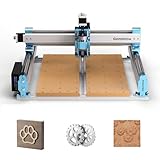
Quick comparison: the best budget CNC routers
| Machine | Approx. market range | Working area | Spindle and drive | Best fit |
|---|---|---|---|---|
| Genmitsu 3018-PROVer | $200–$350 | Approx. 300 × 180 × 45 mm | 60 W-class trim spindle; lead screws | Small signs, engraving, learning CNC |
| Genmitsu 3020-PRO MAX V2 | $500–$800 | Approx. 300 × 200 × 78 mm | 300 W-class spindle; lead screws | More rigid small-shop work |
| FoxAlien Masuter Pro | $600–$1,000 | Approx. 400 × 400 × 60 mm | Compact router/spindle options; lead screws | Larger signs and cabinet-sized panels in sections |
| SainSmart Genmitsu 4040-PRO | $700–$1,100 | Approx. 400 × 400 × 78 mm | 300 W-class spindle; lead screws | Frequent hobby use and larger workpieces |
| Carbide 3D Nomad 3 | $2,500–$3,000 | Approx. 203 × 203 × 76 mm | Compact enclosed router; ball screws | Cleaner, more polished small-part workflow |
Dimensions and included accessories can change by bundle and production revision, so verify the exact package before ordering. The cheaper machines usually include V-bits, clamps, or a basic spoilboard, but often do not include a proper dust shoe, enclosure, upgraded collets, or commercial design software.
Best cheap CNC router by situation
| Your situation | Best starting point | Why |
|---|---|---|
| Under $350, learning from scratch | Genmitsu 3018-PROVer | Low entry cost, common parts, large amount of community guidance |
| Small workshop and regular hardwood work | Genmitsu 3020-PRO MAX V2 | Stronger frame and deeper Z travel than a typical 3018 |
| Need to cut larger signs | FoxAlien Masuter Pro or Genmitsu 4040-PRO | Roughly 400 × 400 mm of travel, reducing the need to tile jobs |
| Want the least exposed mechanical hardware | Carbide 3D Nomad 3 | Enclosed design and more integrated workflow, at a much higher price |
| Expecting aluminum production | Do not choose by price alone | A rigid mill-style machine with coolant and appropriate tooling is more suitable |
Genmitsu 3018-PROVer: the sensible entry-level pick
The 3018-PROVer remains attractive because it is inexpensive, compact, and adequate for learning CAD, CAM, workholding, zeroing, feeds and speeds, and basic machine maintenance. Its approximately 300 × 180 mm cutting area suits coasters, small plaques, control panels, guitar parts, templates, and engraved hardwood pieces.
Its limitations are just as important. The light frame flexes when cutting aggressively, the small spindle removes material slowly, and the included clamp system is basic. Expect accurate engraving and shallow profile cuts rather than fast pocketing through thick hardwood. A practical working envelope is closer to thin stock and modest depth per pass than to furniture-scale joinery.
Buy this machine if you value a low-risk introduction and have limited bench space. Budget another $50–$150 for a spoilboard, better clamps, spare bits, and dust control. A replacement or upgraded spindle may cost more than the machine’s original price, so upgrade selectively rather than chasing maximum power.
Genmitsu 3020-PRO MAX V2: better rigidity without a full-size footprint
The 3020-PRO MAX V2 occupies the useful middle ground in the cheap CNC router market. Its smaller work area than a 4040 is offset by a sturdier construction and greater Z-axis travel. That makes it more suitable for hardwood signs, thicker blanks, inlays, and repeated small parts.
It still uses a light-duty spindle and should not be confused with a metal-cutting mill. Aluminum is possible in shallow, carefully lubricated passes with suitable single-flute cutters, but the process is slow and sensitive to vibration. For wood, the additional rigidity can improve edge quality and reduce chatter, especially after the machine is squared and the spoilboard is surfaced.
FoxAlien Masuter Pro and Genmitsu 4040-PRO: choose area over compactness
When the main problem is fitting the workpiece, a 400 × 400 mm machine is a more meaningful upgrade than a slightly stronger small router. These machines can handle larger signs, instrument components, drawer fronts, and multiple small parts in one setup. They also make it easier to use a wasteboard with several clamping zones.
The trade-off is space. Allow room for the machine, cable loops, dust collection, and access to the emergency stop; a nominal 400 mm travel does not mean a 400 mm-wide usable bench footprint. Larger gantries can also amplify vibration if the machine sits on a thin or flexible table.
The Masuter Pro is appealing when modularity matters, since router and spindle configurations and extension options are available depending on the bundle. The 4040-PRO is a sensible alternative for users who prefer the Genmitsu ecosystem. Compare included motors, controller features, spoilboard, and emergency-stop hardware rather than comparing advertised work area alone.
Why the Nomad 3 is not “cheap,” but can be economical
The Carbide 3D Nomad 3 costs several times more than a 3018-class machine and has a smaller cutting area than many open-frame routers. Its justification is ownership convenience: an enclosed body, ball screws, more controlled cable management, and an integrated workflow can reduce setup time and mess.
For occasional small parts, the higher initial price may be offset by fewer mechanical upgrades. For large signs or low-cost experimentation, however, it is poor value because its work envelope is restrictive. Consider it a compact premium desktop router rather than a budget machine.
Software costs change the real purchase price
Most budget routers accept common G-code workflows, but the controller, sender, and CAM software may not be equally simple. Free options such as Carbide Create’s free tier, Easel’s free capabilities, or other free/open-source CAM tools can cover basic 2D work, though features and machine compatibility vary. Paid CAM packages can add better toolpath control, nesting, 3D machining, and simulation, but may cost from roughly $100 to several hundred dollars per year or as a one-time license.
Calculate the complete first-year cost before deciding:
- Machine: $300
- Bits and collets: $80
- Clamps and spoilboard: $70
- Dust shoe and extraction adapter: $60
- Software: $0–$300
That makes a nominally $300 cnc router cheap closer to $510 before material, and potentially $810 with paid software. If you make 30 projects in the first year, the machine-related cost is approximately $17–$27 per project before wood and finishing supplies.
What these machines really cut
- Best materials: plywood, MDF, hardwood, softwood, acrylic, HDPE, PVC sheet, engraving plastic, and foam.
- Possible with care: brass and aluminum in shallow passes using sharp, appropriate cutters and secure workholding.
- Poor choices: steel, stainless steel, thick solid aluminum, and production work requiring high material-removal rates.
Router power is not the only limitation. A flexible frame turns cutting force into vibration, while a dull bit creates more heat and force. A small machine can produce a clean result when taking 1–2 mm passes in wood, yet chatter badly when asked to remove 6 mm in one pass.
Ownership realities: what wears first
Cutting tools usually wear before the machine. Inspect the cutting edge, listen for a changed spindle sound, and replace bits when edges burn or fuzz despite correct feeds and speeds. Lead screws collect dust, V-wheels can develop play, and unsealed bearings suffer when fine MDF dust enters them.
Before important work, vacuum the machine, wipe exposed screws, check that eccentric nuts are not loose, and verify that the spindle is square to the spoilboard. Surface the spoilboard after assembly or relocation. A simple dial-indicator check can reveal backlash, but even a test square and a known-dimension pocket will expose many alignment errors.
Final buying advice
Choose the Genmitsu 3018-PROVer for the lowest sensible learning cost, the 3020-PRO MAX V2 for compact rigidity, and the FoxAlien Masuter Pro or Genmitsu 4040-PRO when work area matters most. Move to a more expensive enclosed machine only if reduced setup, noise, and dust justify the premium. In every case, reserve money for cutters, workholding, dust extraction, and software: those accessories often determine whether a cheap CNC router produces accurate parts or becomes an unused project on the bench.