
What's inside
- DeWalt scroll saw at a glance
- Choose by throat depth and project size
- Blade changes: a major reason to consider the DeWalt
- Vibration control and cut quality
- Decision matrix: is this DeWalt the right fit?
- Long-term durability and ownership realities
- Setup choices that improve results
- Final buying verdict
- Related Guides
As an Amazon Associate I earn from qualifying purchases. This post may contain affiliate links at no extra cost to you.
The DeWalt scroll saw is best suited to woodworkers who value low vibration, a generous 20-inch throat, and quick blade changes more than compact size, low price, or cordless convenience.
DeWalt scroll saw at a glance
The well-known DeWalt DW788 is a floor-standing-style benchtop scroll saw with a 20-inch throat, variable speed, parallel-link arm movement, and a tilting worktable. Availability can vary because this model is an older product line, so confirm the exact type number, included accessories, warranty status, and parts support before buying a used or remaining-stock machine.
As an Amazon Associate we earn from qualifying purchases at no extra cost to you.
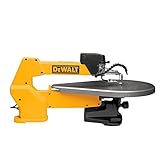

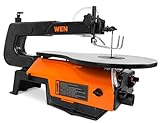
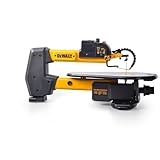
| Feature | DeWalt DW788 specification | What it means in practice |
|---|---|---|
| Throat depth | 20 inches | Allows larger panels, lettering, fretwork, and interior cutouts without repeatedly repositioning the work. |
| Cutting capacity | Approximately 2 inches of wood | Suitable for most scroll-saw work in thin boards, plywood, veneers, and moderate-thickness hardwood. |
| Speed range | 400–1,750 strokes per minute | Lower speeds help with delicate work and plastics; higher speeds suit thinner, easier-cutting wood. |
| Motor | 1.3 amp, corded | Provides continuous operation without battery changes, but requires a permanent bench location and suitable electrical supply. |
| Table | Approximately 16 × 23 1/2 inches; tilts up to 45 degrees | Gives useful support for bevel cuts and larger workpieces. |
| Blade compatibility | Plain-end and pinned blades, depending on the holder and setup | Plain-end blades offer broader selection and are convenient for pierced internal cuts. |
| Weight | Approximately 56 pounds | Heavy enough to resist walking and vibration, but awkward to move frequently. |
Choose by throat depth and project size
Throat depth is the distance from the blade to the rear frame. It does not describe the maximum length of a cut, but it determines how far a panel can extend around the blade before the frame gets in the way.
- Small ornaments and intarsia: A 16-inch throat is often sufficient, so the DeWalt’s 20-inch capacity may be more space and money than necessary.
- Names, signs, fretwork, and portraits: The 20-inch throat is useful when the design is wide or contains many internal openings.
- Large panels: The DeWalt helps, but it is not a replacement for a bandsaw or a large-format panel-cutting setup. You still need to support the workpiece so its weight does not twist the cut.
- Thick stock: The approximately 2-inch cutting capacity is a limit, not a recommendation. Cutting thick hardwood at full depth is slower, demands a suitable blade, and increases the chance of wandering or overheating.
A practical sizing rule is to choose a saw whose throat is at least 2 inches greater than the widest portion of your usual workpiece. For a 17-inch panel, a 20-inch throat leaves about 1 1/2 inches of working clearance on each side of the blade path, assuming the design is centered. That extra room makes rotating the panel easier and reduces accidental contact with the frame.
Blade changes: a major reason to consider the DeWalt
Scroll-saw projects often contain dozens of enclosed cutouts. Each cutout requires drilling a starter hole, removing or releasing the blade, threading the blade through the hole, and tensioning it again. A machine that makes this routine slow can become frustrating even when its cutting performance is good.
The DW788 is valued for its tool-free blade-clamp arrangement and accessible upper and lower blade holders. Plain-end blades are particularly useful because they can pass through small drilled holes and are widely available in different tooth patterns. Before purchase, inspect the clamps on a used saw for stripped threads, damaged levers, or jaws that do not hold a blade squarely.
Blade selection still matters more than the brand name on the saw. Use a fine-tooth blade for thin plywood and detailed fretwork, a coarser blade for faster material removal, and a blade designed for plastics when cutting acrylic or similar materials. A blade that is too coarse can chip fragile stock; one that is too fine can cut slowly and heat the work.
Vibration control and cut quality
The DeWalt’s parallel-link arm design is intended to keep the blade moving through a shorter, more controlled path than a conventional long-arm mechanism. In use, that design characteristic should translate into less arm movement and reduced vibration at the table, particularly when the saw is mounted on a rigid surface.
Do not treat the machine’s weight as a substitute for installation. Put it on a solid bench, keep the bench level, and use the mounting holes if the saw shifts during direction changes. A flexible folding table can transmit more vibration than the saw itself produces. The rubber feet should be intact, and the workpiece should remain flat against the table rather than being forced downward aggressively.
Low vibration helps with accuracy, but it does not prevent blade deflection. Feeding too quickly, twisting the workpiece, using a dull blade, or cutting hardwood beyond the blade’s practical capacity can still produce angled edges and oversize kerfs.
Decision matrix: is this DeWalt the right fit?
| Your situation | Fit of the DeWalt scroll saw | Reason |
|---|---|---|
| Beginner making occasional small ornaments | Potentially oversized | A smaller, less expensive scroll saw may provide enough throat depth and simpler ownership. |
| Experienced maker producing fretwork weekly | Strong fit | Quick blade changes, variable speed, low-vibration design, and a large table reduce repeated setup work. |
| Limited workshop space | Weak fit | The saw is heavy and needs a stable bench plus clearance for rotating large workpieces. |
| Frequent production of large decorative panels | Good, within limits | The 20-inch throat is helpful, but very large or thick stock may call for a bandsaw or specialty scroll saw. |
| Occasional portable work | Poor fit | It is corded and weighs about 56 pounds; it is better treated as a stationary machine. |
| Buyer prioritizing current parts availability | Check carefully | Because the DW788 is an older model, confirm blade-holder, arm, switch, and table-support availability before committing. |
Long-term durability and ownership realities
A heavy, corded scroll saw can serve for years when it is kept clean and used within its limits, but several components deserve attention. Blades are consumables and should be replaced as soon as they begin requiring excessive feed pressure. A dull blade increases heat, makes the motor work harder, and encourages the operator to twist the stock.
Dust is another long-term issue. Fine wood dust can settle around the arm pivots, blade holders, speed-control area, and motor ventilation openings. After cutting, brush or vacuum accessible surfaces rather than blowing dust deeper into the mechanism with high-pressure air. Keep the table free of resin and corrosion, and apply only the lubrication recommended in the manual; excess oil can attract abrasive dust.
On a used machine, check the following before buying:
- Run the speed control through its full range and listen for surging, scraping, or intermittent operation.
- Confirm that both blade clamps hold a straight blade securely without excessive force.
- Inspect the arm pivots and linkage for unusual play or knocking.
- Verify that the table locks firmly at zero and at its bevel settings.
- Look for cracks around the cast frame, damaged electrical insulation, and missing mounting hardware.
- Check whether the included dust blower, hold-down components, and blade adapters are present and functional.
Setup choices that improve results
Start with a sharp blade appropriate to the material and set the table square to the blade. Tension the blade until it gives a clear, firm response when lightly plucked, but do not over-tighten it. Excessive tension can damage holders or increase stress on the mechanism.
Mark the cut line clearly, drill internal starter holes only slightly larger than the blade, and let the saw do the cutting. Use a moderate feed rate: if the motor pitch drops sharply or the blade begins bowing, slow down. For thick stock, make test cuts in offcuts first because the nominal 2-inch capacity does not guarantee an accurate result in every hardwood species.
Final buying verdict
Choose the DeWalt scroll saw when your priorities are a large 20-inch throat, frequent internal cutouts, controlled vibration, continuous corded operation, and a substantial machine that can remain on a dedicated bench. It is less attractive for beginners with small projects, workshops without permanent space, or buyers who need guaranteed modern parts support. For a used or older-stock DW788, condition and replacement-part availability are as important as the advertised specifications.