
What's inside
As an Amazon Associate I earn from qualifying purchases. This post may contain affiliate links at no extra cost to you.
For most scroll-saw work, choose a pinned blade if your saw accepts only pin-end blades; choose a pinless blade for finer blades, tighter interior cuts, and detailed work. Match tooth count to wood thickness: a blade should leave roughly 3–5 teeth in the material, so thicker stock generally needs a coarser blade and thin stock a finer one. Skip-tooth blades are a versatile starting point; spiral blades are for cutting in any direction without turning the workpiece, not for the cleanest edge.
As an Amazon Associate we earn from qualifying purchases at no extra cost to you.
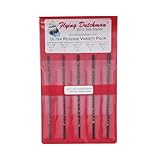
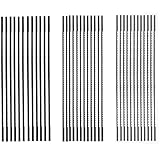

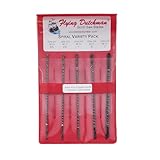
Choose by the job, not by the multipack
Blade numbers and tooth counts vary among manufacturers, so treat the ranges below as starting points rather than universal standards. Check the blade maker’s chart and your saw’s manual before buying: blade numbering, clamp compatibility, and recommended tension can differ.
| Workpiece and task | Useful starting point | Why it fits | Trade-off |
|---|---|---|---|
| 1/8–1/4 in. (3–6 mm) plywood; small curves | Pinless skip-tooth, around #2/0–#2 | Fine teeth can follow tight turns; the gullets clear sawdust. | Fine blades cut slowly in thicker stock and can break if forced. |
| 1/4–1/2 in. (6–13 mm) hardwood; general curves | Pinless skip-tooth, around #2–#5 | A practical balance of control, feed rate, and chip clearance. | Choose the finer end for tight details and the coarser end for faster, straighter cuts. |
| 1/2–1 in. (13–25 mm) stock; broader curves | Coarser skip-tooth or standard-tooth blade, around #5–#9 | Larger teeth clear chips and are less prone to clogging in deep cuts. | They leave a wider kerf and need more room to turn. |
| Interior cutouts; blade must pass through a drilled hole | Pinless blade, sized to the material and hole | The plain ends can fit through a small starter hole and clamp directly. | Threading and clamping take more time than using a pinned blade. |
| Large panels; cuts that change direction frequently | Spiral blade, often a fine or medium size | Teeth face around the blade, so the work can move in any direction. | Leaves a wider, rougher kerf and can be harder to steer precisely. |
Pin-end vs. pinless: which attachment suits your saw?
Pin-end blades
Pin-end blades have a cross pin at each end and install quickly on compatible saws. They are convenient for straightforward exterior cuts, repeated pattern changes, and users who prefer simple blade changes. Their thicker ends require larger access holes, however, and they are generally less suited to the finest blades and intricate interior fretwork. A pin-end blade is not automatically interchangeable with a pinless blade: some saws accept only one type, while some models use adapters or compatible clamps. Verify the machine’s manual before ordering.
Pinless blades
Pinless blades have plain ends held by clamps. They are widely used for fine scroll work because small blades can pass through drilled holes for interior cutouts. The drawback is setup: the ends must be seated securely and the blade tensioned correctly. A blade that slips, sits at an angle, or is over-tightened can break or cut poorly. For frequent interior cuts, that extra setup is usually worth it; for simple shapes, the convenience of a compatible pin-end system may matter more.
Skip-tooth, standard-tooth, and spiral blades
- Skip-tooth: Alternating teeth leave more space for sawdust. This makes skip-tooth blades a forgiving general-purpose choice, especially for beginners and thicker pieces where chip clearing matters.
- Standard-tooth: Teeth are more closely spaced, supporting a smoother cut in thinner material. They can clog more readily in deep cuts, so ease off the feed if sawdust stops clearing.
- Spiral: Teeth face in multiple directions, letting the blade cut while the piece moves sideways, forward, or backward. Use one for wide panels or patterns with frequent direction changes. Because the kerf is wider and the blade can wander, it is usually a poor first choice when a crisp, narrow edge or very tight accuracy matters.
How to match TPI to thickness
TPI means teeth per inch. The useful rule is to keep about three to five teeth engaged with the wood at once. Too few teeth can snag and chip the edge; too many can pack with sawdust, heat the cut, or make feeding painfully slow. With variable-tooth blades, use the manufacturer’s stated range or recommended application rather than trying to count a single consistent TPI.
As a rough example, a blade with 20 TPI has teeth spaced about 1/20 inch apart. In 1/4-inch stock, that is roughly five tooth spaces through the material; in 1-inch stock, it is roughly twenty. The first may suit a fine cut, while the second is likely to cut slowly and clog. That is why thicker work usually calls for a coarser blade even if the finer blade looks more precise.
Make the choice by situation
- New to scroll sawing, mostly 1/4-inch plywood: Start with a small assortment of pinless skip-tooth blades if your saw accepts them. Buy a few nearby sizes rather than a large mixed pack, and note which size tracks cleanly in your material.
- Mostly thick hardwood or repeated production cuts: Keep coarser skip-tooth blades on hand for chip clearance and a smoother, finer option for details. Let the blade’s cut rate—not extra pushing—set your feed speed.
- Frequent interior fretwork: Choose pinless blades that fit the saw’s clamps and can pass through the pattern’s drilled access holes. Check blade width against the tightest turn before starting.
- Large pieces with cuts in every direction: Try a spiral blade on a practice piece first. Its all-direction cutting can save repeated repositioning, but expect to spend time controlling wander and sanding the edge.
- Saw accepts only pinned blades: Buy compatible pin-end blades and plan patterns around the larger threading hole. Do not force a pinless blade into clamps not designed to hold it.
Set up for a cleaner cut and longer blade life
- Check the blade and clamps. Match blade type and length to the manual; inspect the teeth and ends for damage. A bent or worn blade is more likely to wander or break.
- Install it in the correct direction. Most scroll-saw blades cut on the downstroke, but tooth direction varies by blade. Follow the maker’s instructions and confirm the teeth face the correct way for your saw.
- Tension it securely. Use the saw’s recommended tensioning method. A loose blade twists and cuts off-square; excessive tension increases stress on the blade and clamps.
- Test on offcut of the same material. Check cut quality and turning behavior before committing to the pattern. If the blade struggles or the kerf burns, try a different size or reduce feed pressure.
- Feed without forcing. Let the teeth remove material. For tight curves, steer gradually; trying to pivot sharply can bend the blade sideways and snap it.
- Clear dust and replace worn blades. Brush sawdust from the table, clamps, and air openings with the machine unplugged. Replace a blade when it cuts slowly, needs more pressure, or leaves a rougher edge than it did when fresh.
Blades are consumables, and breakage is part of scroll sawing. Fine blades tend to be most vulnerable to sideways force and overfeeding; coarse blades can still dull or clog when used in material that is too thick for their tooth spacing. Store blades dry and organized by size and type so a fresh, suitable blade is easy to find.
What to check before buying
Confirm attachment type, blade length, and the saw’s supported blade range first. Then choose sizes around the thickness and tightest curve you actually cut. A small, purposeful selection—a fine blade for thin detail, a medium general-purpose blade, and a coarser blade for thicker stock—usually teaches more than a random multipack. Once a size gives a clean cut in your usual wood, restock that size rather than guessing again.