
What's inside
- The Quick Answer: Which Blade for Which Job
- What Tooth Count, Kerf, and Hook Angle Actually Tell You
- The 10 Best Table Saw Blades, Ranked by Job
- Spec Comparison Table
- Decision Matrix: Match Your Saw and Work to a Blade
- Two-Blade vs. One-Blade Setups: The Math
- Ownership Realities: What Wears First and What Goes Wrong
- FAQ
- Related Guides
As an Amazon Associate I earn from qualifying purchases. This post may contain affiliate links at no extra cost to you.
The Quick Answer: Which Blade for Which Job
If you want one recommendation before reading further: for most woodworkers running a 10 inch table saw blade, the Freud Fusion P410 (40-tooth combination) is the best single-blade choice, while a dedicated 24-tooth ripper like the Freud Diablo D1024X beats any combo blade on thick hardwood, and an 80-tooth blade like the Freud LU91R010 is what keeps plywood veneer from chipping. The rest of this list explains why — sorted by what each blade actually does well, not by marketing claims.
What Tooth Count, Kerf, and Hook Angle Actually Tell You
Before the rankings, three specs decide almost everything about how 10 in saw blades for table saws behave:
As an Amazon Associate we earn from qualifying purchases at no extra cost to you.


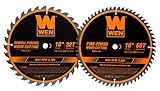

- Tooth count: Fewer teeth (24–30) clear chips fast for ripping; more teeth (60–90) shear fibers cleanly for crosscuts and plywood; 40–50 teeth split the difference.
- Kerf: Full kerf (~1/8″, or 0.126″) is stable and straighter in hard material but needs a 3+ HP saw to run well. Thin kerf (~3/32″, 0.090″–0.098″) is the right call for 1.5–2 HP contractor and jobsite saws.
- Hook angle: Aggressive positive hooks (20°+) feed fast but can grab; low or negative hooks (0° to -5°) cut slower, safer, and cleaner in brittle or thin material.
- Grind: ATB (alternating top bevel) for crosscuts, FTG (flat top grind) for ripping, Hi-ATB or TCG for plywood/melamine, and combination (4+1) patterns for general work.
The 10 Best Table Saw Blades, Ranked by Job
1. Freud Fusion P410 — Best Single Blade for Most Shops
40 teeth, Hi-ATB/FTG hybrid grind, thin kerf (0.091″), ~15° hook. This is the blade to buy if you switch between ripping and crosscutting without wanting to swap blades. It rips 8/4 oak without burning and leaves a glue-ready edge on crosscuts.
2. Forrest Woodworker II — Best Full-Kerf Premium Pick
40 teeth, ATB, full kerf, 15°–20° hook depending on version. Hand-tensioned in the USA, and famous among cabinet shops for staying flat under load. Costs roughly double a big-box blade, but owners report years between sharpenings — and it can be resharpened many times, unlike cheap disposable blades.
3. Freud Diablo D1050X — Best Budget Combination
50 teeth, ATB combination grind, thin kerf (0.098″), ~15° hook. Typically runs in the $40–$55 range and delivers about 85% of the Fusion’s performance. The 50-tooth count biases it toward crosscuts, so ripping stock over 1.5″ thick gets slow.
4. Freud Diablo D1024X — Best Dedicated Rip Blade
24 teeth, FTG, thin kerf (0.098″), 20° hook. If you regularly break down 8/4 or 10/4 hardwood, this is the blade. Flat-top teeth leave a slightly rougher surface, which doesn’t matter — the jointer or planer cleans it up. On underpowered saws, the difference versus a combination blade is dramatic.
5. Freud LU91R010 — Best for Plywood and Melamine
80 teeth, Hi-ATB, thin kerf, -3° hook. The negative hook angle is the key spec: it reduces the top-surface pressure that blows out veneer. Pair it with a zero-clearance insert and you get factory-edge cuts on Baltic birch.
6. Ridge Carbide TS2000 — Best for Precision Joinery
40 teeth, ATB combination, thin kerf, claimed flatness tolerances tighter than most competitors. A favorite for box joints and dados where a wobbly plate ruins fit. Similar tier and price to the Woodworker II (~$100–$130).
7. DeWalt DW7140PT — Best Jobsite Combo Blade
40 teeth, ATB, thin kerf, ~20° hook. Designed for portable saws drawing limited amps. Won’t match the Fusion’s finish, but it’s durable, widely available, and handles site abuse — construction lumber, occasional nail strikes aside — better than premium thin-plate blades.
8. Irwin Marples 50T — Best Value Thin Kerf
50 teeth, ATB, thin kerf (0.098″). Often found under $40. A sensible step up from the blade that shipped with your saw; crosscuts are clean, ripping capacity is modest. Good spare blade.
9. Tenryu Gold Medal GM25540 — Best Finish Blade
40 teeth, ATB, thin kerf. Tenryu grinds its plates differently — the result is a crosscut surface that genuinely needs less sanding. At ~$90–$110 it’s a splurge, but furniture makers notice the difference on show faces.
10. Oshlun SBW-100072 — Best Budget Dado-Adjacent/Crosscut Option
72 teeth, ATB, thin kerf. For picture frames, trim, and fine crosscutting on a budget (~$35–$45). The high tooth count means slow feed rates — let the blade do the work or it will burn.
Spec Comparison Table
| Blade | Teeth | Grind | Kerf | Hook | Best For | Street Price Range |
|---|---|---|---|---|---|---|
| Freud Fusion P410 | 40 | Hybrid | 0.091″ | 15° | All-around | $85–$110 |
| Forrest Woodworker II | 40 | ATB | 0.125″ | 15–20° | Premium general | $110–$140 |
| Freud Diablo D1050X | 50 | ATB combo | 0.098″ | 15° | Budget combo | $40–$55 |
| Freud Diablo D1024X | 24 | FTG | 0.098″ | 20° | Ripping | $35–$50 |
| Freud LU91R010 | 80 | Hi-ATB | 0.090″ | -3° | Plywood/melamine | $70–$90 |
| Ridge Carbide TS2000 | 40 | ATB combo | 0.100″ | 15° | Joinery | $100–$130 |
| DeWalt DW7140PT | 40 | ATB | 0.098″ | 20° | Jobsite | $45–$60 |
| Irwin Marples 50T | 50 | ATB | 0.098″ | 15° | Value crosscut | $30–$40 |
| Tenryu Gold Medal | 40 | ATB | 0.094″ | 15° | Fine finish | $90–$110 |
| Oshlun SBW-100072 | 72 | ATB | 0.098″ | 10° | Budget fine cut | $35–$45 |
Decision Matrix: Match Your Saw and Work to a Blade
| Your Situation | Pick | Why |
|---|---|---|
| 1.5–2 HP saw, one blade only | Freud Fusion P410 | Thin kerf reduces motor load; hybrid grind handles both cuts |
| 3+ HP cabinet saw, one blade | Forrest Woodworker II | Full kerf stability shines on big motors |
| Mostly ripping thick hardwood | Diablo D1024X | 24T FTG clears chips; prevents burn and motor strain |
| Sheet goods / built-ins / melamine | Freud LU91R010 | Negative hook + 80T = minimal veneer chipout |
| Budget under $50, mixed work | Diablo D1050X | Best performance-per-dollar combo on the market |
| Portable/jobsite saw | DeWalt DW7140PT | Thin kerf and durable brazing for site conditions |
| Furniture finish surfaces | Tenryu Gold Medal | Sand-ready crosscuts straight off the blade |
Two-Blade vs. One-Blade Setups: The Math
A common question: is a dedicated rip plus crosscut pair worth it? A D1024X + an 80T Oshlun runs about $80 total — less than one Woodworker II. In a hobby shop cutting 20 board feet a month, expect roughly 2 years before sharpening either. At ~$25–$35 per professional sharpening, the pair costs about $30/year to maintain versus $60+/year if you’re pushing one premium blade through work it wasn’t designed for. Combination blades earn their keep through convenience, not longevity — every rip cut wears teeth meant for crosscuts.
Ownership Realities: What Wears First and What Goes Wrong
- Resin buildup, not dullness, causes most burning. Clean blades with a dedicated blade cleaner or oven cleaner every 20–30 hours of cutting pitchy wood. A “dull” blade is often just a dirty one.
- Carbide chips before it dulls. One nail strike can knock the corner off a tooth. On budget blades with small carbide tips, chipped teeth aren’t worth repairing; premium blades (Woodworker II, TS2000) use larger carbide that survives regrinding.
- Common mistake: running thin-kerf blades without a stabilizer on saws with loose arbor bearings, then blaming the blade for wobble. Conversely, don’t put thin-kerf blades on saws with riving knives sized for full kerf — the stock can pinch the knife.
- Burning on one side only usually indicates fence misalignment, not a blade problem. Check alignment before buying a new blade.
FAQ
Are all 10 inch table saw blades interchangeable?
Yes for diameter — any 10 table saw blade fits a 10″ saw — but check arbor size (5/8″ is standard; some European saws use 30mm or dado arbors) and match kerf to your riving knife thickness.
Is a 40-tooth or 60-tooth blade better for general use?
40T rips faster with cleaner edges on thick stock; 60T leaves finer crosscuts but bogs down ripping hardwood over 1″. For a true one-blade setup on a hobby saw, 40–50T hybrid grinds are the better compromise.
When should I resharpen instead of replace?
Blades over ~$80 are worth sharpening ($25–$35 each, 5–10 times). Sub-$50 blades are usually cheaper to replace once dull.