
What's inside
As an Amazon Associate I earn from qualifying purchases. This post may contain affiliate links at no extra cost to you.
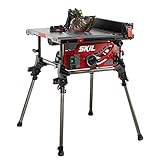
The best budget friendly table saw for a small workshop is the SKIL TS6307-00 for most occasional users, while the DeWalt DWE7485 is the better choice when fence accuracy and compact storage matter more than cutting full 4×8 sheets.
A small-shop table saw should be judged by more than motor power. The useful questions are: How wide can it rip, how reliably does the fence lock parallel to the blade, what safety equipment is included, how easily can it be moved, and how much clear floor space is available for feeding and receiving material?
As an Amazon Associate we earn from qualifying purchases at no extra cost to you.


Quick comparison: affordable table saws
| Model | Blade and motor | Rip capacity | Approx. weight | Stand and portability | Typical market position |
|---|---|---|---|---|---|
| SKIL TS6307-00 | 10 in., 15 amp | 25.5 in. right of blade | About 51 lb | Compact folding stand; easy to move | Lower-cost general-purpose option |
| DeWalt DWE7485 | 8-1/4 in., 15 amp | 24.5 in. right of blade | About 46 lb | Very compact; stand commonly purchased separately | Mid-range compact jobsite saw |
| Bosch 4100XC-10 | 10 in., 15 amp | 25 in. right of blade | About 60 lb | Gravity-Rise wheeled stand | Convenience-focused portable option |
| SKILSAW SPT99-11 | 10 in., 15 amp worm-drive motor | 30.5 in. right of blade | About 94 lb with stand | Wheeled stand; portable but heavy | Higher-cost choice for frequent cutting |
Specifications can vary slightly by package, stand, and production year, so verify the exact configuration before buying. The table is intended to show the practical differences between compact budget saws, not to replace the manufacturer’s manual.
Best choices by workshop situation
| Your situation | Best fit | Why | Main compromise |
|---|---|---|---|
| Lowest sensible cost for weekend projects | SKIL TS6307-00 | 10-inch blade, 25.5-inch rip capacity, folding stand, and useful rack-and-pinion fence adjustment | Fence and stand feel less refined than premium jobsite systems |
| Smallest storage footprint | DeWalt DWE7485 | Light, compact, and its telescoping fence rails retract close to the saw | 8-1/4-inch blade limits maximum depth of cut |
| Frequent setup and teardown | Bosch 4100XC-10 | Its wheeled Gravity-Rise stand makes deployment and storage faster | Heavier and usually more expensive than compact saws |
| Repeated wide sheet and framing cuts | SKILSAW SPT99-11 | 30.5-inch rip capacity and strong cutting performance under load | Large, heavy, and less suitable for a crowded hobby shop |
Head-to-head: what matters most
Rip capacity
About 24 to 25.5 inches is enough to rip a 4×8 sheet in half lengthwise, provided the sheet is supported properly. That capacity is also sufficient for most cabinet sides, shelving, and furniture panels. The SKILSAW SPT99-11 gains a meaningful advantage with 30.5 inches, but the extra range comes with a larger footprint and more difficult storage.
Remember that the number printed on the specification sheet is not the same as usable capacity in a crowded room. If the fence rail extends beyond your bench or a wall blocks the sheet, the advertised capacity cannot be used safely.
Fence accuracy
A dependable fence should lock without visibly shifting and should remain parallel to the miter slot and blade. The DeWalt DWE7485 is attractive for a small workshop because its rack-and-pinion telescoping rails make small adjustments quick and repeatable. The SKIL TS6307-00 also uses rack-and-pinion adjustment, which is valuable at this price level.
On any saw, check alignment after assembly. Measure from the fence to the nearest miter slot at both the front and rear. A small difference can cause binding, burning, or inaccurate parts. Do not “fix” a fence by forcing it against the blade; correct the fence or saw alignment according to the manual.
Safety features
These saws generally include a riving knife, transparent blade guard, anti-kickback pawls, and a large power switch. The riving knife is particularly important because it helps keep the kerf from closing onto the rear of the blade. Leave the guard and riving knife installed for ordinary through-cuts.
For a small shop, a stable stand is also a safety feature. A lightweight saw that walks during a cut is not a bargain. Lock the stand, place it on a level surface, and keep the power cord away from the feed path. Use a push stick or push block when your hands would approach the blade, and never reach over a spinning blade to retrieve offcuts.
Portability
The DWE7485 is easiest to carry and store, but it may need a separate stand or a sturdy custom base. The SKIL TS6307-00 offers a useful middle ground: a 10-inch blade and folding support without the weight of a large contractor-style machine. The Bosch 4100XC-10 is the most convenient to roll and set up, though its additional weight takes up more storage space.
The SPT99-11 is portable in the sense that it has wheels, not in the sense that one person will enjoy carrying it up stairs. Choose it when it will stay in one work area or when wide ripping is more important than compact storage.
How much room does a small workshop need?
Plan for the saw footprint plus the workpiece, not just the machine. A practical starting calculation is:
Required length = saw length + longest material length + at least 2 feet of receiving clearance.
For example, if a compact saw and stand occupy about 3 feet from front to back and you are cutting an 8-foot board, allow approximately 3 + 8 + 2 = 13 feet of unobstructed length. That does not mean the entire room must be 13 feet long: an outfeed table can fold, and long stock can be supported with a roller stand. It does mean that a wall, tool cabinet, or doorway should not stop the board while it is passing through the blade.
For crosswise sheet handling, allow roughly 8 feet of side-to-side clearance for a full sheet, plus enough room for your body to stand comfortably beside the saw. In a tighter room, break down plywood with a track saw or circular saw first, then use the table saw for narrower, manageable pieces.
Budget and ownership realities
Affordable jobsite saws commonly fall into a broad market range from roughly $300 to $700, depending on the model, stand, promotions, and included accessories. The purchase price is only part of the budget. Allow for a quality combination blade, hearing and eye protection, a push block, and additional outfeed support. A better blade often improves cut quality more than a modest increase in motor specifications.
The parts most likely to need attention are the blade, throat plate, fence adjustment points, stand hardware, and dust-collection passages. Resin and sawdust can accumulate on the tabletop and fence faces, making stock drag or the fence sit slightly out of position. Unplug the saw before cleaning, brush or vacuum debris from the mechanism, and avoid spraying lubricant where it can attract more dust.
Common ownership mistakes include storing the saw with the fence clamped tightly against the rail, forcing warped lumber through the blade, using a dull blade for hardwood, and assuming a dust port eliminates airborne dust. A shop vacuum helps, but it does not replace ventilation, suitable respiratory protection, and regular cleaning.
Which one should you buy?
Choose the SKIL TS6307-00 if you want the broadest capability for the money: a 10-inch blade, useful rip capacity, folding stand, and compact storage. It is the strongest default recommendation for a beginner or occasional furniture maker.
Choose the DeWalt DWE7485 if every inch of storage matters or you value fast, repeatable fence adjustments. Its smaller blade is rarely a problem for sheet goods and ordinary dimensional lumber, but it offers less depth than a 10-inch saw.
Choose the Bosch 4100XC-10 when rolling the saw into position is part of nearly every project. The stand can justify its higher cost if setup time and mobility matter more than minimum weight.
Choose the SKILSAW SPT99-11 only when you will regularly exploit its wider rip capacity or cut demanding stock. In a genuinely small workshop, its extra weight and floor space may outweigh its performance advantage.
For most buyers, the right budget friendly table saw is not the one with the largest blade or highest advertised rip number. It is the model that can be aligned accurately, stored securely, and used with enough clearance that the operator never has to improvise around the room.