
What's inside
- SKILSAW Worm Drive Table Saw Review: Torque, Rip Capacity & Portability
- What the SPT99-11 offers
- Torque on thick hardwoods: what the worm drive changes
- Fence accuracy and rip capacity
- How the rolling stand handles real transport
- Which buyer should choose it?
- Ownership details that affect long-term value
- Verdict
- Related Guides
As an Amazon Associate I earn from qualifying purchases. This post may contain affiliate links at no extra cost to you.
SKILSAW Worm Drive Table Saw Review: Torque, Rip Capacity & Portability
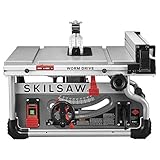
The SKILSAW SPT99-11 is one of the better choices for a contractor who needs worm-drive torque, a 30-1/2-inch rip capacity, and a rolling stand, but its roughly 94-pound ready-to-move weight makes it portable rather than genuinely lightweight.
This skilsaw worm drive table saw is built around a 15-amp motor and SKILSAW’s worm-drive gearing, a design intended to deliver strong low-speed cutting power through demanding material. It is not the smallest jobsite saw, and it is not the best fit for a shop where the saw must be lifted frequently. Its appeal is more specific: substantial rip capacity, a stable stand, and enough reserve for thick framing lumber and hardwood work when paired with a sharp, appropriate blade.
As an Amazon Associate we earn from qualifying purchases at no extra cost to you.

What the SPT99-11 offers
| Specification | SKILSAW SPT99-11 | Why it matters |
|---|---|---|
| Blade diameter | 10 inches | Uses widely available 10-inch table-saw blades |
| Motor | 15 amps, corded | Suitable for continuous jobsite and shop use without battery-runtime limits |
| Maximum rip to the right | 30-1/2 inches | Handles standard 4-by-8 sheet breakdowns more comfortably than compact saws |
| Maximum cut depth at 90 degrees | 3-5/8 inches | Enough for a 4-by-4 in one pass under normal conditions |
| Maximum cut depth at 45 degrees | 2-1/4 inches | Useful for beveling substantial stock without immediately switching tools |
| Approximate saw-and-stand weight | 94 pounds | Stable in use, but demanding on stairs and when loading alone |
| Stand | Integrated rolling stand | Folds for transport and provides working height without a separate base |
Torque on thick hardwoods: what the worm drive changes
A table saw worm drive arrangement does not make the saw immune to bogging. The blade, feed rate, material moisture, fence alignment, and electrical supply still determine the cut. Its practical advantage is the gearing: the motor drives the blade through a reduction system that emphasizes torque rather than simply chasing a high no-load blade speed.
That matters when ripping thick hardwood, dense construction lumber, or material that puts sustained resistance on the blade. A 15-amp saw can make these cuts effectively, but the operator should still use a sharp rip blade with an appropriate tooth count, avoid forcing the stock, and use a properly rated extension cord if one is necessary. A dull combination blade can make even a powerful worm-drive saw appear weak.
For a 3-1/2-inch hardwood rip, expect a controlled feed rather than a fast push. Let the blade maintain momentum, keep the work supported on both sides of the cut, and stop if the motor pitch drops sharply. The gearing improves working reserve; it does not replace correct blade selection or adequate circuit capacity.
Fence accuracy and rip capacity
The large rip range is one of the strongest reasons to choose this SKIL worm drive table saw over a compact jobsite model. A 30-1/2-inch right-side rip allows the saw to break down wide panels with less reliance on a temporary guide rail. That saves setup time, but it also increases the importance of checking the fence at both ends of its travel.
Before precision work, verify three things:
- The fence locks firmly without shifting as pressure is applied.
- The fence remains parallel to the miter slot and blade through its full travel.
- The measurement scale agrees with an actual test cut rather than being trusted blindly.
For cabinet parts, measure a test strip at the near and far ends of the fence. If the dimensions differ, correct the fence alignment before cutting expensive sheet goods. A small angular error becomes more visible over a wide panel: a fence that is only 1/32 inch out across a short reference distance can produce a noticeably tapered cut over several feet.
The fence is appropriate for general framing, trim, and sheet breakdown, but a dedicated cabinet saw with a heavier cast-iron table and more refined fence system remains the better choice for frequent furniture production.
How the rolling stand handles real transport
Stairs
The stand’s wheels make movement across a level garage or driveway much easier than carrying a bare saw. Stairs are different. At approximately 94 pounds, the assembled unit is awkward to control, particularly when the stand is folded. For occasional stairs, remove loose accessories and have a second person stabilize the load. If stairs are part of every job, a lighter compact saw may save more effort than the worm-drive power justifies.
Truck beds
The rolling stand is useful at a truck or trailer because it can be wheeled close to the loading point, but it does not eliminate lifting. Use the vehicle’s ramp or a second person rather than trying to muscle the saw over a tailgate. Secure the stand and saw separately with straps so the wheels cannot roll and the fence cannot be struck by other tools.
Small-shop storage
Folded, the stand occupies less floor area than a permanent cabinet saw, but the saw still needs a clear storage zone for its broad table, fence, cord, and accessories. In a small shop, plan for a wall-side parking position and leave enough clearance to unfold the stand without moving every surrounding tool. A ceiling-mounted or wall-mounted support system can help, but do not hang the saw by the fence or by plastic adjustment parts.
Which buyer should choose it?
| Situation | Best decision | Reason |
|---|---|---|
| Frequent framing and remodeling | Choose the SPT99-11 | Torque, wide rip capacity, and rolling support suit repeated jobsite use |
| Mostly stairs and solo loading | Consider a lighter compact saw | Portability is limited by the assembled weight |
| Occasional DIY projects | Buy only if the capacity will be used | A smaller saw may cost less and store more easily |
| Furniture and cabinet production | Compare with a cabinet saw | A heavier fixed saw generally offers better fence refinement and table support |
| Small shop with no permanent saw location | Choose it if folding storage is essential | It combines substantial capacity with mobile storage, though not minimal weight |
Ownership details that affect long-term value
The first maintenance priorities are blade cleanliness, fence alignment, and dust removal around the height and bevel mechanisms. Resin buildup on a blade increases friction and can make the motor work harder. Clean the blade according to its manufacturer’s instructions, vacuum accumulated dust from the saw, and inspect the power cord and stand hardware regularly.
Likely wear points are the blade, throat plate, fence-contact surfaces, wheel hardware, and adjustment components exposed to jobsite dust. Keep the original blade for rough work and use a separate fine-tooth blade for plywood or hardwood. Do not use the fence as a clamp, and do not push narrow stock between the blade and fence without a suitable push stick or jig.
A useful ownership calculation is capacity per pound: the saw provides about 30.5 inches of rip capacity for approximately 94 pounds, or roughly 0.32 inches of rip capacity per pound. That is not a laboratory performance metric, but it illustrates the trade-off: the SPT99-11 carries more capability than many compact saws, while asking the owner to transport substantially more mass.
Verdict
The SKILSAW worm drive table saw is a strong match for contractors and serious remodelers who value sustained cutting power, wide panel capacity, and a stand that rolls across flat ground. Its fence and scale still deserve verification before precision work, and its weight makes stairs and truck loading a two-person task more often than not.
Searches for “worm drive SKILSAW table saw,” “skill worm drive table saw,” or “worm drive table saw” usually point to the same buying question: do you need maximum jobsite capacity, or minimum carrying weight? Choose the SPT99-11 when torque and 30-1/2-inch ripping matter more than easy lifting. Choose a lighter saw when frequent solo transport and compact storage are the overriding priorities.