
What's inside
- Quick picks by workshop situation
- Head-to-head: the three practical ways to combine a saw and router
- Router plate compatibility: the measurement that prevents an expensive mistake
- How one fence saves space without sacrificing rip capacity
- What to inspect before choosing an extension
- Ownership realities: what wears first
- Is a table saw router combo better than two separate tools?
- Related Guides
As an Amazon Associate I earn from qualifying purchases. This post may contain affiliate links at no extra cost to you.
The best table saw router combo for a small workshop is usually a 10-inch jobsite or contractor saw with a router extension wing, provided the wing preserves the saw’s original fence travel and accepts a rigid, replaceable router plate.
For the most integrated setup, choose a SawStop Professional Cabinet Saw with its matching router-table extension. For lower cost, a DeWalt DWE7491-series or Bosch 4100-series saw can share a custom or aftermarket extension, but you must verify rail clearance, wing thickness, and fence travel before buying a router plate. The key is not simply fitting a router into spare tabletop space: it is keeping the router bit aligned, the fence supported, and the rip capacity usable.
As an Amazon Associate we earn from qualifying purchases at no extra cost to you.


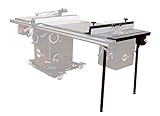

Quick picks by workshop situation
| Workshop situation | Best approach | Why it makes sense | Main compromise |
|---|---|---|---|
| Frequent furniture or cabinet work | SawStop Professional Cabinet Saw with matching router-table extension | Rigid cast-iron platform, shared fence potential, excellent dust-control options | High initial cost and substantial footprint |
| Small shop that needs mobility | DeWalt DWE7491-series with a compatible aftermarket router extension | Compact rolling format and generous rack-and-pinion fence adjustment | Extension rigidity and plate fit depend on the accessory |
| Occasional routing and limited budget | Bosch 4100-series saw plus a separate benchtop router table | Avoids uncertain wing compatibility and keeps the saw portable | Uses more storage space and requires a second fence setup |
| Maximum precision in a permanent shop | Cabinet saw with a full-size router table wing and dedicated lift plate | Best support for large panels, heavy bits, and repeated work | Least portable option |
Head-to-head: the three practical ways to combine a saw and router
SawStop cabinet-saw router extension
A matching SawStop router-table extension is the closest thing to a purpose-built table saw and router combo. The extension is designed around the saw’s cast-iron table and rail system rather than being a loose board attached to the side. Depending on the saw configuration, the extension can be ordered with a router plate or router-table components intended for the Professional Cabinet Saw, Industrial Cabinet Saw, or compatible SawStop platforms.
This arrangement is strongest when the saw is permanently installed. The heavy base and cast-iron surfaces resist vibration, while a shared saw fence can often be positioned across both the blade and router areas. That saves the floor space normally occupied by a separate router table and avoids having two fences compete for storage.
Check the exact saw model before ordering. SawStop’s contractor and jobsite saws do not automatically accept the same extensions as its cabinet saws. A router plate made for one SawStop table should not be assumed to fit another simply because both are branded SawStop.
DeWalt DWE7491-series saw with an aftermarket wing
The DWE7491-series is attractive for a mobile shop because its 10-inch saw uses a telescoping rack-and-pinion fence and offers up to 32-1/2 inches of rip capacity to the right of the blade in common configurations. That capacity is valuable, but an oversized router wing can interfere with the telescoping rail or reduce the distance available for wide panels.
Look for a table saw router extension specifically listed for the DWE7491 family, not merely a universal wing with similar bolt spacing. The extension must leave room for the front and rear fence rails, provide a flat surface at the same height as the saw, and support the router plate without flexing. Many users improve a lightweight extension by adding a plywood or laminate substructure beneath it, but the reinforcement must not obstruct the fence carriage.
A DeWalt-based table saw router combo makes sense for a woodworker who breaks down sheet goods at a jobsite and routes smaller parts in the shop. It is less suitable for a heavy 3-1/2-inch panel-raising bit or continuous production routing unless the extension is substantially reinforced and dust collection is effective.
Bosch 4100-series saw with a separate or custom router surface
The Bosch 4100-series is a portable 10-inch saw with a gravity-rise stand, but it is not automatically a router-table system. Some universal extensions can be adapted to portable saws, yet a router plate that fits a Bosch RA1181 router table does not mean that the plate fits the Bosch saw’s side wing. These are different interfaces.
For this reason, the safest Bosch router and table saw combo is often a Bosch saw paired with a separate benchtop router table. If you choose a combined extension, measure the opening and mounting locations first, then confirm that the router plate is independently supported by the extension rather than hanging from a thin saw wing.
Router plate compatibility: the measurement that prevents an expensive mistake
Router plates are not universal. Before buying a table saw extension router plate, record four measurements:
- The length and width of the plate opening.
- The corner radius or corner shape of the opening.
- The plate thickness and how much adjustment is available for leveling.
- The distance from the opening to the saw’s front and rear edges, fence rails, and blade.
A common full-size router-table plate is approximately 9-1/4 by 11-3/4 inches, while compact plates may be closer to 8 by 11 inches. Those dimensions are not interchangeable. Even a one-eighth-inch mismatch can leave insufficient bearing surface for leveling screws or create a dangerous lip that catches a workpiece.
Also confirm the router’s mounting pattern. A plate may accept a particular router base, a universal insert ring system, or a router lift, but not all three. A fixed router base is adequate for occasional edge profiles; a lift is more convenient when changing bit height from above the table. Heavy routers and large bits need a plate that is stiff enough to avoid sagging.
How one fence saves space without sacrificing rip capacity
The most useful design is a continuous fence that can serve the saw blade and the router table, with a removable auxiliary router fence when needed. In the saw position, the fence must remain square and lock securely. At the router, the auxiliary fence should be adjustable independently so the outfeed side can close around the bit.
Do not permanently center the router plate wherever it is easiest to install. First measure the saw’s maximum rip position. For example, if a saw provides 32-1/2 inches of rip capacity with its original rail position, an extension that moves the fence rail inward by 3 inches may reduce practical capacity to about 29-1/2 inches. That reduction can determine whether a 30-inch cabinet side can be ripped in one pass.
A useful layout calculation is:
Usable rip capacity = original fence capacity − rail displacement − safety clearance.
If the original capacity is 32-1/2 inches, the new extension displaces 1-1/2 inches, and you reserve 1/2 inch so the fence carriage does not contact the router housing, the working capacity is approximately 30-1/2 inches. Measure with the fence installed, not from the tabletop alone.
What to inspect before choosing an extension
- Surface rigidity: A thin steel or plastic wing may be acceptable for light edge routing but can vibrate with large bits. Cast iron, thick aluminum, or a well-supported laminated panel is preferable.
- Height adjustment: The router plate should be flush with the saw table. Leveling screws and a firm underside support are more important than a decorative insert system.
- Fence travel: Check the closest and farthest positions, including the rail carriage and locking handle.
- Dust collection: A fence with a rear port and an enclosed router cabinet captures much more dust than an open wing. Use a separate blade guard and dust path where possible.
- Electrical access: A switched outlet or accessible router switch is safer than reaching beneath the table during a cut.
- Plate inserts: Use the smallest insert opening that clears the bit. Large unsupported openings increase the chance of a workpiece dipping at the cut.
Ownership realities: what wears first
In a combined table saw router setup, the router plate’s leveling screws, fence faces, insert rings, and dust hose connections usually need attention before the saw itself. MDF or plywood fence faces become damaged around the bit opening, especially when a bearing-guided bit is used without a properly supported auxiliary fence. Replaceable laminate or phenolic faces reduce that maintenance.
Dust also accumulates in the saw’s fence rail and router lift mechanism. Vacuum the lift threads and clean them according to the lift manufacturer’s instructions; do not pack them with sticky lubricant that attracts abrasive dust. Inspect the router collet for resin and debris, and periodically verify that the plate is still flush after moving the extension or transporting the saw.
The most common mistake is routing with the saw fence locked across an unsafe portion of the bit. Use a dedicated router fence or an auxiliary face with proper bit clearance. The second is assuming that a router extension can support the same work as a full cabinet router table. Large panels need infeed and outfeed support even when the combination saves floor space.
Is a table saw router combo better than two separate tools?
Choose the combined arrangement when floor space, shared dust collection, and one adjustable fence matter more than maximum flexibility. It is especially effective for edge profiles, rabbets, dados, and small-to-medium workpieces.
Choose separate machines when you regularly use wide router-table panels, large panel-raising bits, multiple fence settings, or simultaneous saw and routing operations. A separate router table also lets you leave one tool set up while the other is in use, which can outweigh the saved floor space in a production-oriented shop.
For most small workshops, the buying order is clear: select the saw first, verify its fence and rail geometry, then choose an extension made for that exact saw family. Treat the router plate as a measured component rather than a universal accessory. That approach gives you the space savings of a table saw and router combo while preserving the rip capacity that made the saw useful in the first place.