
What's inside
As an Amazon Associate I earn from qualifying purchases. This post may contain affiliate links at no extra cost to you.
Yes—the SawStop router table is worth its premium price if you want a heavy, integrated workstation with a very good fence and SawStop-compatible mounting; it is harder to justify if you already own a quality router lift and need only an inexpensive standalone table.
The important buying question is not simply whether the table is well made. It is whether you want the SawStop ecosystem: a cast-iron top, a fence designed around repeatable micro-adjustments, a compatible lift and insert system, and the option of installing the table beside a SawStop table saw. That convenience costs more than a basic MDF or laminate router table.
As an Amazon Associate we earn from qualifying purchases at no extra cost to you.
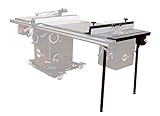


What the SawStop router table includes
The SawStop router table is built around a cast-iron top measuring approximately 27 by 16 inches. The top is rigid, flat, and resistant to the sagging that can appear in large laminated tops after years of use. Its size is suitable for cabinet doors, rails and stiles, trim, pattern routing, and general furniture work, although very large panels still benefit from additional outfeed support.
The system is sold in configurations that may include the tabletop, fence, insert plate, mounting hardware, and router lift. Check the exact package carefully: a “table” listing does not always mean the same bundle as a complete router-table station. A router motor is also not automatically included.
| Item | SawStop router-table specification or fit | Why it matters |
|---|---|---|
| Tabletop | About 27 x 16 inches; cast iron | Rigid support and good stability for large workpieces |
| Insert opening | Uses a replaceable router-table insert system; verify the opening and plate version before buying | Determines router-lift and insert compatibility |
| Fence adjustment | Independent faces with a fine-adjust mechanism | Allows small setting changes without repeatedly loosening and shifting the entire fence |
| Typical standalone footprint | Approximately 27 x 24 inches before accounting for infeed and outfeed space | Requires more shop floor than the tabletop dimensions suggest |
| Usable cutting area | Best suited to router bits with 1/4- or 1/2-inch shanks, within the router’s rated capacity | Bit diameter and router horsepower limit the work more than the table does |
Dimensions can vary by package and generation, so use the current SawStop manual as the final authority before cutting a cabinet or ordering a replacement plate.
Fence micro-adjust accuracy: the feature that earns the premium
The fence is the strongest reason to choose this table over a low-cost alternative. Its fine-adjust system lets you make controlled, small movements after the fence has been roughly positioned. That is useful when a cut is only slightly too deep, when matching two sides of a joint, or when sneaking up on a bearing-guided profile.
In practical terms, the mechanism is more valuable for repeatability than for a particular advertised resolution. A micro-adjuster can move the fence in tiny increments, but the final accuracy still depends on clean rails, locked fence faces, a properly seated insert, and a workpiece that is held consistently against the fence.
For a flush-trimming operation, for example, make the initial adjustment with the fence visibly close to the required position, lock the main fence, and then use the fine adjuster for the last small change. Do not use the micro-adjuster as a substitute for locking the fence. If the main clamping hardware is loose, even a precise adjustment screw cannot prevent movement under feed pressure.
The independent fence faces are also useful for shimming one side, closing the gap around a large bit, or setting up a jointing-style cut. Keep the faces coplanar for ordinary routing; deliberately offset them only when the operation calls for it.
Lift and insert-plate compatibility
The SawStop router table is most cohesive when paired with the matching SawStop lift and insert system. The lift provides above-table height adjustment and makes bit changes easier than reaching beneath the table. That is a meaningful advantage for anyone who changes profiles often or works with several bit heights in one project.
Compatibility is the area where buyers should slow down. Router lifts are not universal merely because they fit a standard-looking opening. Check all four measurements before purchasing:
- the outside dimensions and thickness of the lift plate;
- the size and shape of the table opening;
- the router motor body diameter and mounting range;
- the insert-ring system and the maximum bit diameter allowed through the plate.
A SawStop router table insert is not automatically interchangeable with every aftermarket lift plate. Some third-party lifts may fit after careful measurement, while others can be too large, too thin, or positioned incorrectly for the leveling screws. The safest pairing is the SawStop lift and the insert rings specified for that lift. If you already own a premium lift from another manufacturer, compare its exact plate dimensions with the current SawStop opening rather than assuming compatibility.
Insert rings should sit flush with the surrounding cast iron. A ring that is proud of the table can catch a workpiece; one that sits low can affect small stock and make cleaning difficult. Replace damaged or distorted rings instead of trying to compensate with fence adjustments.
Does it bolt into a SawStop saw?
In the appropriate configuration, the SawStop router table can serve as a router-table extension beside a compatible SawStop table saw, rather than requiring a completely separate workstation. The mounting arrangement uses the saw’s extension-wing area and the supplied hardware or the hardware specified for that saw configuration.
However, this is not a universal “bolt onto any SawStop saw” accessory. Compatibility depends on the saw family, table depth, extension-wing arrangement, rails, and whether the saw has a factory or aftermarket extension setup. A contractor-style saw, compact saw, cabinet saw, and industrial cabinet saw may require different brackets or may not support the same installation.
Before ordering a router table for a SawStop, confirm the exact saw model and the required wing or rail configuration in the current installation guide. Also check the final surface height. The router top must be aligned with the saw table and supported firmly; a small height error can catch long boards as they pass between machines.
If the saw cannot accept the required mounting hardware, the table can be used as a standalone router table with a suitable base. In that arrangement, the cost of the base, leveling feet, dust collection, and possibly extension wings should be included in the budget. The router table itself is not a complete mobile cabinet.
Standalone base or saw extension: which setup makes sense?
| Your situation | Better choice | Reason |
|---|---|---|
| Already own a compatible SawStop cabinet saw and have limited floor space | Saw extension installation | Uses existing structure and keeps the router within the main machine footprint |
| Use a contractor saw, portable saw, or a different brand | Standalone base after checking mounting options | Do not assume the SawStop wing hardware will fit another saw |
| Route several times per week | Complete lift-and-fence setup | Above-table adjustment and repeatable fence movement save setup time |
| Route only occasional small parts | Less expensive table or benchtop solution | The cast-iron top and premium mounting system may not pay back |
| Need to route very large panels | Standalone station with broad auxiliary support | The 27 x 16-inch top benefits from added infeed and outfeed support |
Ownership realities and likely wear points
Cast iron is durable, but it still needs protection. Wax the tabletop periodically, keep glue and damp dust off the surface, and avoid storing wet lumber on it. Surface rust is more likely to appear when a shop has high humidity or when the top is cleaned with a water-based product and left unprotected.
The parts most likely to need attention are the insert rings, fence locking hardware, leveling screws, and dust-collection path—not the cast-iron top. Fine dust can make height mechanisms stiff, so vacuum around the lift and avoid forcing a dirty adjustment. Check that the fence remains square after moving it, and inspect the plate for cracks or looseness before routing.
A common mistake is buying the table first and treating router compatibility as an afterthought. Add the router motor, lift if needed, insert rings, dust hose, base or mounting hardware, and suitable bit collets to the real cost. Premium router-table packages commonly place the total investment in the several-hundred-dollar range, with a complete lift-based setup potentially approaching or exceeding $1,000 depending on the router and accessories.
Final verdict
The SawStop router table is a strong buy for a woodworker who values a rigid cast-iron surface, a genuinely useful fence micro-adjustment, and integration with a compatible SawStop saw. It is particularly appealing when a saw extension installation saves floor space and keeps both machines at a consistent working height.
Choose a standalone base when your saw is incompatible, when you need independent mobility, or when the router table must support unusually large work. Choose a cheaper table when routing is occasional and you already have a reliable lift and fence. The premium is easiest to justify through frequent use and integration—not through the tabletop alone.