
What's inside
As an Amazon Associate I earn from qualifying purchases. This post may contain affiliate links at no extra cost to you.
The best CNC router table for most serious woodworkers is a rigid 2 × 4-foot machine with a supported gantry, accessible spoilboard, and at least 3 feet of working clearance on every side; choose a smaller tabletop CNC router only when space is the deciding constraint.
A CNC router table is less about maximum cutting area than about how reliably it holds position, manages dust, and lets you load, clamp, surface, and remove work. The right choice depends on the size of your projects, how often you cut, your tolerance for assembly, and the room available around the machine.
As an Amazon Associate we earn from qualifying purchases at no extra cost to you.


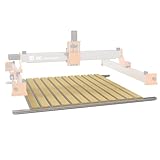
Quick comparison of CNC router table sizes
| Machine class | Typical cutting area | Typical footprint | Best for | Main compromise |
|---|---|---|---|---|
| Compact tabletop CNC router | 12 × 18 to 24 × 24 in. | 24 × 36 to 36 × 48 in. | Signs, small parts, inlays, learning | Limited sheet-goods capacity |
| Desktop 2 × 2 CNC table | 20 × 20 to 24 × 24 in. | 36 × 48 to 48 × 60 in. | Furniture components and smaller batches | Most cabinet panels require repositioning |
| 2 × 4 CNC router table | 24 × 48 in. | 48 × 72 to 60 × 84 in. | Cabinet parts, signs, templates, furniture | Needs a dedicated stand and dust system |
| 4 × 4 CNC router table | 48 × 48 in. | 72 × 72 to 84 × 84 in. | Large signs, doors, nested components | Higher cost and greater space demand |
| 4 × 8 production table | 48 × 96 in. | Approximately 6 × 12 ft. or more | Full-sheet processing and production work | Usually excessive for a home workshop |
These dimensions include practical machine proportions rather than only the advertised cutting envelope. A table advertised as 24 × 48 inches may need substantially more room for its rails, control box, dust hose, and operator access.
Best choices by workshop situation
| Your situation | Most sensible choice | Why |
|---|---|---|
| First CNC, occasional signs and small parts | Compact tabletop CNC router | Lower cost, easier storage, and less demanding dust collection |
| Regular furniture work in a one-car garage | Rigid 2 × 4-foot machine | Useful capacity without the footprint of a full production table |
| Frequent cabinet and sheet-goods work | 2 × 4 or 4 × 4 machine with a vacuum table option | Fewer repositioning operations and faster loading |
| Large signs and doors | 4 × 4 machine | Allows larger workpieces to remain registered throughout the cut |
| Production or full-sheet processing | 4 × 8 industrial CNC router | Designed for throughput, automatic tooling, and dedicated extraction |
What separates a good CNC router table from a frustrating one
Bed size and usable work area
Compare the actual cutting envelope, not the outside dimensions. A 2 × 4-foot bed is useful for many cabinet components, but a 48-inch-wide sheet may not fit if the clamps, waste edges, or hold-down rails consume part of the surface. If you routinely cut 24-inch-wide panels, a 2 × 4 machine gives useful margin. If you cut full 4 × 8 sheets, repeatedly indexing a smaller table adds alignment risk and labor.
For small projects, a table top CNC router can be the better tool. It fits on a sturdy bench and is easier to bring indoors for electronics work or storage. However, “tabletop” describes the mounting arrangement, not necessarily precision. A lightweight table CNC router can cut accurately in plywood while struggling with aggressive passes in hardwood if the frame flexes.
Frame rigidity and motion system
Frame rigidity affects dimensional accuracy, corner quality, noise, and tool life. Look for aluminum extrusion or welded steel construction with substantial gantry supports, dual-sided drive on wide machines, and linear rails or well-supported V-wheel systems. A wide gantry driven from only one side can rack during direction changes, particularly when cutting dense hardwood or making deep pockets.
Lead screws can provide good positioning at modest speeds, while rack-and-pinion systems are common on larger machines because they handle long travel efficiently. Neither system automatically makes a machine rigid. The important questions are whether the rails are supported, whether the gantry remains square, and whether the manufacturer provides a practical method for tramming the spindle or router.
For occasional work, a trim-router-powered machine may be adequate. A water- or air-cooled spindle is usually quieter and better suited to long cutting cycles, but it adds expense, electrical requirements, and setup complexity. A spindle also needs an appropriate variable-frequency drive and enclosure or shielding in some workshops.
Spoilboard access and workholding
The spoilboard is a consumable surface, not a permanent reference. It eventually becomes uneven from surfacing, pockets, and accidental cuts. Choose a design that lets you remove or resurface it without dismantling the machine.
Useful features include threaded inserts, a grid of drilled holes, T-tracks, or a replaceable MDF spoilboard over a rigid base. A vacuum table can speed production, but it is not essential for most hobby work and may hold porous MDF poorly without masking or a sealed auxiliary surface. Mechanical clamps remain valuable for irregular boards and thick stock.
Leave enough edge area for screws and clamps. A design that offers every square inch as cutting space but no convenient hold-down locations can be less useful than a slightly smaller machine with a well-planned workholding grid.
Dust collection
Dust collection is a primary design feature. A 2- to 2.5-inch hose is common for compact machines; larger router tables may use a 4-inch hose and a shoe designed for higher airflow. A typical shop vacuum can handle a small CNC router, but a cyclone separator protects its filter and maintains suction. Larger machines cutting MDF or plywood benefit from a dedicated dust collector with roughly 800 to 1,200 CFM at the collector, depending on hose length and shoe design.
Check whether the dust shoe clears clamps, follows the spindle through its full height range, and can be removed quickly for tool changes. A poorly sealed shoe can spread fine dust even when the vacuum is powerful. Never assume that a large extractor compensates for a badly designed brush skirt.
Assembly and calibration
Assembly quality directly affects repeatability. On a bolt-together machine, plan to check rail parallelism, gantry squareness, belt or rack tension, spoilboard flatness, and spindle tram. A typical first setup may take 4 to 12 hours depending on size and whether the stand and dust system are included.
After assembly, cut a measured square and a circle. If a nominal 100 mm square measures 99.7 mm on one axis and 100.2 mm on the other, correct steps-per-unit or belt calibration only after confirming that the frame is square and the tool is not deflecting. Calibration cannot fix a loose gantry or a twisted spoilboard.
How much room does a CNC router table really need?
Use this simple sizing calculation before buying. Start with the machine footprint, then add at least 24 inches on the operator side and 18 inches on the other accessible sides. Add another 24 to 36 inches where long stock must be loaded.
For example, a 60 × 84-inch 2 × 4 machine placed with 30 inches of front clearance and 18 inches at the rear needs approximately 60 × 132 inches of floor area before allowing for a dust collector. That is 55 square feet. If sheet stock enters from the 84-inch end, allow additional loading space rather than placing the table against a wall.
A folding or wall-mounted arrangement can reduce storage space, but it does not eliminate operating clearance. The machine still needs a level, rigid surface during cutting, and its stand must resist movement. Casters should lock firmly or retract so the frame cannot shift while the gantry accelerates.
Ownership costs and durability
Typical market pricing in 2026 ranges from about $800 to $2,000 for a compact tabletop CNC router, $2,000 to $5,000 for a capable 2 × 4 hobby machine, and $4,000 to $10,000 or more for a larger 4 × 4 machine before premium tooling, extraction, and automation. Industrial 4 × 8 systems are a separate category and can cost substantially more.
Budget for router or spindle tooling, collets, a surfacing bit, dust hoses, clamps, replacement spoilboard material, and software. The cutting bit is often the first consumable to show wear, especially in abrasive MDF. Brushes on the dust shoe, V-wheels or bearings, belts, and router collets also need periodic inspection.
- Vacuum the rails and lead screws instead of brushing dust deeper into them.
- Keep MDF dust away from exposed electronics and cooling fans.
- Check fasteners after the first several cutting sessions.
- Resurface the spoilboard when workpieces stop sitting flat.
- Replace dull bits rather than compensating with excessive feed or plunge settings.
- Use a consistent work zero and probing routine if repeatability matters.
Final buying recommendation
Choose a compact table top CNC router when your work is mostly signs, inlays, models, and small components. Choose a rigid 2 × 4 CNC router table for the best balance of capacity, cost, and workshop practicality. Move to a 4 × 4 table when large signs, doors, or uninterrupted sheet layouts justify the extra floor area. A 4 × 8 machine makes sense only when throughput and full-sheet handling are central to the business.
Before comparing motors or software features, measure the room, the stock you actually use, and the clearance needed to work safely. Bed size determines what fits; frame rigidity determines how accurately it cuts; spoilboard access determines how easily it stays accurate; dust collection and assembly determine whether you will enjoy using it repeatedly.