
What's inside
As an Amazon Associate I earn from qualifying purchases. This post may contain affiliate links at no extra cost to you.
Best CNC Router Bits for Wood: Clean Cuts and Long Life
The best CNC router bits for wood depend on the material and cut: choose a sharp, solid-carbide upcut or compression spiral for plywood, a downcut spiral for clean top edges and MDF, and a two-flute carbide spiral for most hardwood and softwood work. Match the cutting diameter and profile to the detail and rigidity of your machine, then set feeds and speeds to make chips rather than heat.
Choose by material and cut quality
For routine woodworking, a 1/4-inch shank, two-flute solid-carbide spiral is a versatile starting point. A larger shank can improve stiffness if your collet and machine support it; it does not fit every trim router. Shank diameter is not cutting diameter: check both before ordering.
As an Amazon Associate we earn from qualifying purchases at no extra cost to you.



- Plywood: A compression spiral is usually the best choice for profiles that pass through the full thickness. Its upcut section clears chips while its downcut section presses the top veneer down, helping limit tear-out on both faces. For shallow pockets or cuts from one face, use a downcut bit to protect the visible top surface, but make sure chips can escape.
- Hardwood: A two-flute upcut spiral clears chips effectively in slots and deeper cuts. A downcut spiral can leave a cleaner top edge on shallow contours. Make multiple passes rather than forcing a large-depth cut, especially on small machines.
- Softwood: A sharp two-flute spiral or straight bit works well for general routing. Softwood can fuzz or tear around knots; a downcut spiral helps on the top edge, while a finishing pass at a light depth can improve the surface.
- MDF: A downcut or compression bit can reduce top-face breakout, but MDF produces fine, abrasive dust. Use effective dust extraction and avoid deep cuts that pack dust into the kerf. Carbide lasts longer than high-speed steel in this wear-prone material.
Compare the main bit choices
The figures below are common woodworking sizes, not universal limits. Confirm the bit’s rated speed, cutting length, shank, and your machine’s collet capacity before use. Feeds and speeds depend on the router, material, tool geometry, and cut depth, so treat the profiles as selection guidance rather than fixed settings.
| Bit type | Common cutting diameter | Flutes | Best use | Main trade-off |
|---|---|---|---|---|
| Upcut spiral | 1/8–1/2 in (3.2–12.7 mm) | 1–2 | Slots, pockets, deep cuts; chip clearing | Can lift fibers and chip the top face |
| Downcut spiral | 1/8–1/2 in (3.2–12.7 mm) | 1–2 | Clean top edges, shallow profiles, veneers | Pushes chips down; deep cuts need careful evacuation |
| Compression spiral | 1/4–1/2 in (6.4–12.7 mm) | 2 | Through-cuts in plywood and laminated panels | Needs enough depth for both cutting zones to engage properly |
| Straight bit | 1/8–1/2 in (3.2–12.7 mm) | 2 | Simple grooves and general-purpose cuts | Usually clears chips less effectively than a spiral |
| V-bit | Commonly 60° or 90° included angle | 1–2 cutting edges | Engraving, lettering, and chamfers | Line width changes with depth; small tips are fragile |
Carbide grade, flute count, and diameter: what matters
For regular CNC work, solid carbide is the practical default: it holds a sharp edge longer than high-speed steel when cutting wood composites and hardwood. “Carbide” alone does not guarantee quality. Carbide composition, edge grinding, brazing, balance, and coating all affect performance. A well-ground uncoated carbide bit can be a better buy than a poorly made coated one. Coatings may help in some applications, but they do not compensate for a dull edge or incorrect cutting conditions.
Two flutes are a reliable all-round choice because they balance chip space with a smooth cut. One-flute bits offer more room for chips and can suit smaller machines or materials that load up, but they may leave a rougher finish. More flutes can improve finish at an appropriate feed rate, yet reduce chip space; in wood, that can mean heat and burning if the machine cannot maintain a suitable feed.
Choose the smallest diameter that safely handles the detail, not automatically the smallest bit available. A 1/8-inch bit reaches fine corners but is more vulnerable to deflection and breakage. A 1/4-inch bit is stiffer for general cutting, while a 1/2-inch bit can be useful for broader profiles and heavier work on a machine built to accept it. Cutting length must exceed the material thickness plus the intended cut depth, with enough flute length for chip clearance.
Which profile fits the job?
- Grooves and pockets: Start with an upcut spiral for chip removal. For a clean visible top edge, consider a downcut spiral and use a shallow pocket strategy that prevents chip buildup.
- Plywood panels: Pick a compression bit for full-depth cuts when the cutting depth engages its upcut and downcut sections. If the panel is thin or cuts are shallow, check the manufacturer’s specified minimum cutting depth; a compression bit used too shallowly may not protect both faces.
- Profiles and edge work: Use a roundover, chamfer, or ogee bit sized to the desired feature and the machine’s available clearance. Large profile bits require more power and careful control than small engraving tools.
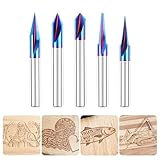
- Carving and lettering: The best V bit for carving on a CNC router depends on line width and detail. A 60° V-bit creates narrower lines at a given depth than a 90° bit, making it useful for finer lettering; a 90° bit creates broader strokes and is often more forgiving for larger designs. Use a small-tip V-bit only when the design needs it, since its point is easier to damage.
A practical buying plan
If you are building a small starter set, buy fewer dependable bits rather than a large assortment of unknown geometry. A useful sequence is:
- General work: One 1/4-inch-shank, two-flute solid-carbide upcut spiral in a diameter suited to your machine, often 1/4 inch for everyday cutting.
- Clean panel faces: Add a compression spiral matched to the thicknesses of plywood you cut most often.
- Detail work: Add a 60° or 90° V-bit, chosen from the lettering and engraving widths in your designs.
- Edge finishing: Add one common roundover or chamfer profile only when your projects call for it.
Before ordering, check the shank against the collet, cutting diameter against the tightest feature, cutting length against stock thickness, and maximum speed against the router’s range. For a hobby machine used occasionally, a small set of quality carbide bits is usually more useful than buying specialty profiles in bulk. Frequent production work makes consistent geometry, replacement availability, and clear manufacturer specifications more valuable.
Keep bits cutting cleanly
Premature wear often starts with heat, not a dramatic break. A rubbing bit, a feed that is too slow for the spindle speed, a cut that is too deep, or packed chips can discolor wood and dull the edge. Listen for changes in cutting sound, inspect edges for fuzzing or burning, and reduce depth per pass if the tool or machine is struggling.
After use, remove resin and dust with a cleaner suitable for cutting tools, then dry the bit and store it so carbide edges cannot knock together. Avoid scraping the cutting edge with steel tools. Replace or professionally resharpen a bit when it burns despite corrected settings, leaves persistent tear-out, or shows a chipped edge. Resharpening makes most sense for higher-quality bits with enough cutting length left; tiny engraving tools may be cheaper to replace.
In short: choose the profile for the cut, the flute direction for the surface you need clean, and solid carbide for durability. For most woodworkers, a two-flute upcut spiral is the starting point, a compression bit is the plywood specialist, and a V-bit is the detail tool—not a substitute for either.