
What's inside
As an Amazon Associate I earn from qualifying purchases. This post may contain affiliate links at no extra cost to you.
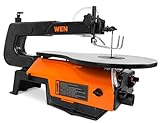
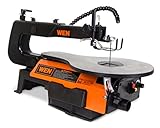
The best budget scroll saw for most beginners is the WEN 3921: its 16-inch throat, 400–1,600 strokes-per-minute speed range, tool-free blade clamps, and roughly 2-inch hardwood capacity give it more useful control than most entry-level saws without moving into professional pricing.
As an Amazon Associate we earn from qualifying purchases at no extra cost to you.


Best budget scroll saws compared
Affordable scroll saws usually trade refinement—not basic cutting ability—for a lower price. The important differences are how slowly they can run, how quickly blades can be changed, how much the table vibrates, and whether the machine can cut thick hardwood without forcing the blade.
| Model | Throat depth | Speed range | Stated wood capacity | Blade changes | Approximate market range | Best suited to |
|---|---|---|---|---|---|---|
| WEN 3921 | 16 in | 400–1,600 SPM | About 2 in at 90° | Tool-free clamps; accepts pinned and plain-end blades | $130–$190 | Best overall budget choice |
| SKIL 3335-07 | 16 in | Three-speed control | About 2 in at 90° | Plain-end blade system; less convenient than quick-release designs | $120–$180 | Occasional craft work |
| Shop Fox W1713 | 16 in | 550–1,650 SPM | About 2 in at 90° | Quick-release upper clamp; lower clamp may take more adjustment | $220–$320 | Frequent hobby use and heavier work |
| Delta 40-694 | 20 in | 400–1,750 SPM | About 2 1/8 in at 90° | Quick-set blade tension and tool-free blade access | $450–$600 | Large patterns and long-term ownership |
Capacities are manufacturer-style maximums, not guarantees of a clean cut in every species. Dense maple, oak, and beech place much greater demand on a small saw than soft pine or poplar. Prices are broad 2026 market ranges and vary by region and promotions.
Our budget picks by situation
Best overall: WEN 3921
The WEN 3921 is the most balanced choice when the budget is tight but you still want useful speed control. Its 400 SPM low setting is slow enough for small interior corners and heat-sensitive materials, while 1,600 SPM is suitable for ordinary wood cutting. The 16-inch throat handles signs, ornaments, fretwork, and most small furniture components.
Its most practical advantage is blade compatibility. The saw accepts both pinned and plain-end blades, and the quick-change design reduces the frustration of replacing a blade in the middle of a detailed pattern. That matters because intricate scrollwork may require several blade changes in one project.
Expect acceptable results in hardwood around 3/4 to 1 inch thick when using a sharp, appropriately sized blade and a steady feed rate. The machine can cut thicker stock, but “can cut” and “cuts cleanly” are different standards. At roughly 1 1/2 to 2 inches in hard maple or oak, vibration, blade deflection, and slower cutting become more noticeable.
Best for occasional use: SKIL 3335-07
The SKIL 3335-07 is a sensible option for someone who expects to cut holiday decorations, simple lettering, thin plywood, and occasional small hardwood pieces. It has a 16-inch throat and a work-light feature, but its three-speed control is less precise than a continuously variable dial.
That limitation is most visible when moving between materials. A continuously variable saw lets you reduce speed for thin veneer or tight turns and increase it for straight cuts in thicker stock. With three settings, you have fewer intermediate choices, so feed pressure and blade selection become more important.
Choose this model when purchase price and basic capability matter more than rapid setup. It is not the strongest choice for frequent production work or large quantities of interior cuts.
Best step-up choice: Shop Fox W1713
The Shop Fox W1713 costs more than the entry-level machines, but its heavier construction is valuable when vibration is your main complaint. It provides a 16-inch throat, variable speed from approximately 550 to 1,650 SPM, a cast-iron table, and stronger support for regular hobby use.
The higher minimum speed is a disadvantage for very delicate veneer and fragile plastics, but it remains suitable for most wood projects. Its extra mass helps keep the saw settled on a sturdy bench. You will still need to bolt it down if the table flexes or the workpiece chatters.
This is the better choice for someone who uses a scroll saw every week and would rather pay more initially than upgrade after a year of vibration and inconvenient blade changes.
Best for large patterns: Delta 40-694
The Delta 40-694 is not a low-cost saw in absolute terms, but it is the most capable pick here for large work. Its 20-inch throat gives substantially more room for furniture panels, large signs, and patterns that cannot be rotated comfortably on a 16-inch machine.
Its approximately 2 1/8-inch capacity is useful for thicker stock, although large hardwood cuts still demand a sharp blade, careful tensioning, and patience. This is a purchase for someone who already knows they need the extra reach. For small ornaments, the additional size and price provide little benefit.
What the specifications mean in actual cutting
Throat depth
Throat depth is the distance from the blade to the rear frame. A 16-inch saw can theoretically cut a 32-inch-wide pattern by rotating the workpiece, but that does not mean every 32-inch panel will be convenient. The frame, clamp position, and pattern shape limit practical capacity. For most beginner projects, 16 inches is enough; choose 20 inches when large panels are a regular part of your work.
Variable speed
Slow speeds make it easier to control tight curves, reduce burning, and protect thin stock. Faster speeds remove material more quickly in straight cuts but can increase heat and make a fine blade harder to control. A useful starting range is 600–900 SPM for delicate interior cuts and 1,000–1,400 SPM for ordinary softwood or hardwood. Adjust by sound and cut quality rather than treating the dial as a fixed recipe.
Vibration
Vibration usually comes from a light stand, an uneven bench, loose fasteners, incorrect blade tension, or a blade that is bent or installed off-center. A heavier saw helps, but no machine can compensate for a flexible work surface. Place the saw on a rigid bench, tighten the mounting hardware, and check that the blade moves vertically without visibly wandering.
Hardwood thickness
For clean results, a realistic budget-saw limit is often lower than the advertised maximum:
- 1/4–1/2 inch hardwood: generally comfortable for detailed work with a fine blade.
- 3/4–1 inch hardwood: practical for most models when the blade is sharp and the feed is controlled.
- 1 1/4–1 1/2 inches: possible, but expect slower progress and more blade wandering in dense species.
- 2 inches: reserve for straight or gently curved cuts, softer hardwood, or a heavier saw with excellent setup.
Do not push the stock harder to make up for a dull blade. Excessive feed pressure bends the blade, widens the kerf, and can pull the cut away from the pattern line.
A practical buying decision matrix
| Your situation | Recommended direction | Why |
|---|---|---|
| Under $180 and learning fretwork | WEN 3921 | Useful variable speed and simple blade changes |
| Occasional decorations and thin plywood | SKIL 3335-07 | Basic capacity without paying for heavy-duty construction |
| Weekly use and irritation with vibration | Shop Fox W1713 | Heavier build and steadier support |
| Large panels or furniture-scale patterns | Delta 40-694 | 20-inch throat and stronger long-workpiece capability |
| Very limited workspace | WEN 3921 or SKIL 3335-07 | Smaller footprint than heavier 20-inch machines |
Blade changes, consumables, and ownership costs
Blades are the main consumable. Keep several tooth sizes available rather than using one blade for everything. Fine-tooth blades suit thin stock and tight curves; larger-tooth blades clear sawdust faster in thick material. Plain-end blades are common for detailed work, while pinned blades can be easier for beginners but offer fewer choices in some specialty assortments.
A simple cost-per-use calculation helps compare machines. Suppose a $160 saw lasts five years and is used twice per month: 2 uses × 12 months × 5 years equals 120 sessions, or about $1.33 per session before blades. If a heavier $280 saw is used weekly for the same period, 4 × 12 × 5 equals 240 sessions, reducing the machine cost to about $1.17 per session. The more often you cut, the more valuable reduced vibration and faster blade changes become.
Clean the table and lower cabinet after each project, especially when cutting resinous wood or MDF. Fine dust can collect around the mechanism and obstruct airflow. Check blade tension before every session, inspect the table insert for damage, and replace blades at the first signs of wandering, burning, or excessive pressure.
Bottom line
Choose the WEN 3921 if you want the best balance of price, throat depth, variable speed, and convenient blade changes. Choose the SKIL 3335-07 for light, occasional work; step up to the Shop Fox W1713 for regular use and lower vibration; and buy the Delta 40-694 only when its 20-inch throat and heavier-duty design solve a real need. Whichever model you select, a rigid bench, correctly tensioned blade, and sharp blade matched to the wood will have more effect on cut quality than the headline maximum thickness.