
What's inside
- Cordless Band Saw Comparison: Cut Capacity, Weight, and Runtime
- Deep Cut vs. Compact: Which Cordless Band Saw Do You Actually Need?
- Weight and Balance for Overhead and One-Handed Cuts
- Runtime Worked Calculation: How Many Cuts Will You Actually Get?
- Decision Matrix: Pick by Your Situation
- Blades, Speed, and Clean Cuts: What Actually Affects Performance
- Durability and Ownership Realities
- FAQ
- Related Guides
As an Amazon Associate I earn from qualifying purchases. This post may contain affiliate links at no extra cost to you.
The best cordless band saw for most users is the Milwaukee M18 FUEL Deep Cut (2729-20) for its 5-inch x 5-inch cut capacity and best-in-class balance, while the Milwaukee M18 FUEL Compact (2829-20) is the best cordless band saw for overhead and one-handed work at just 7.75 lbs bare, and the DeWalt 20V MAX DCS377 is the top choice if you want the lightest deep-cut option for all-day plumbing and electrical runs.
As an Amazon Associate we earn from qualifying purchases at no extra cost to you.
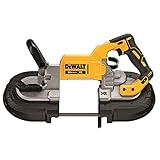


Cordless Band Saw Comparison: Cut Capacity, Weight, and Runtime
Choosing a cordless band saw comes down to three trade-offs: how large of material you need to cut in one pass, how heavy a tool you can safely control overhead, and how many cuts you get per battery. Compact models cut faster in tight spaces but top out around 3-5/16″ capacity, while deep-cut models handle 5″ square stock and larger pipe but weigh 3 to 6 lbs more.
| Model (Bare Tool) | Cut Capacity (W x H) | Bare Tool Weight | Blade Length / Speed | Typical Cuts Per Charge* | Best For |
|---|---|---|---|---|---|
| Milwaukee M18 FUEL Deep Cut 2729-20 | 5″ x 5″ | 14.0 lbs | 44-7/8″ / 0-540 FPM variable | 150-180 cuts in 3/4″ EMT on 5.0Ah | Large strut, 4″ pipe, structural steel |
| DeWalt 20V MAX Deep Cut DCS377B | 5″ x 5″ | 11.2 lbs | 44-7/8″ / 0-540 FPM variable | 140-170 cuts in 3/4″ EMT on 5.0Ah | Deep cut capacity with lower weight |
| Makita 18V LXT Sub-Compact XBP02Z | 3-1/4″ x 3-1/4″ | 7.3 lbs | 36-1/4″ / 0-630 FPM variable | 110-130 cuts in 3/4″ EMT on 5.0Ah | One-handed overhead, tight bays |
| Milwaukee M18 FUEL Compact 2829-20 | 3-1/4″ x 3-1/4″ | 7.75 lbs | 35-3/8″ / 0-730 FPM variable | 120-140 cuts in 3/4″ EMT on 5.0Ah | Overhead conduit, all-day carry |
| DeWalt 20V MAX Compact DCS374B | 2-1/2″ x 2-1/2″ | 7.2 lbs | 32-7/8″ / 0-490 FPM variable | 100-120 cuts in 3/4″ EMT on 5.0Ah | Lightest compact for service work |
| Bosch 18V Compact GCB18V-2N | 2-1/2″ x 2-1/2″ | 7.4 lbs | 32-7/8″ / 0-530 FPM variable | 95-115 cuts in 3/4″ EMT on 4.0Ah | Budget-friendly compact |
*Runtime estimates based on manufacturer data and trade testing using a sharp 18 TPI blade. Actual runtime drops 20-30% on stainless, threaded rod, or with a dull blade. Using a 2.0Ah battery cuts these numbers by roughly half; a 6.0Ah or 8.0Ah High Output battery adds 20-35%.
Deep Cut vs. Compact: Which Cordless Band Saw Do You Actually Need?
A cordless band saw is not a woodworking resaw tool. It is a metal-cutting portaband designed for conduit, strut, threaded rod, angle iron, copper, and stainless steel. The category splits into two distinct tools:
Deep Cut (5″ x 5″ Class)
Uses a 44-7/8″ blade. Cuts 4″ schedule 40 pipe, 4-5/8″ strut on the diagonal, and double-stacked 2″ conduit in one pass. The throat is deeper and the frame is stiffer, which reduces blade deflection on heavy wall material. The penalty is weight and bulk. At 11 to 14 lbs bare plus a 1.5 lb battery, extended overhead work fatigues your wrist and shoulder quickly. These saws are best on the ground, on a stand, or at chest height.
Compact / Sub-Compact (2-1/2″ to 3-1/4″ Class)
Uses a 32-7/8″ to 36-1/4″ blade. Cuts up to 3-1/4″ round, which covers 2-1/2″ EMT, 2″ rigid, 1-5/8″ strut, and most residential and light commercial material. Bare weight under 8 lbs makes true one-handed operation possible, especially overhead in joist bays. You give up the ability to cut 4″ pipe or wide flat stock in one pass and you lose some cut straightness on 1/4″ wall steel because the shorter frame flexes more.
If you only buy one, get the size that covers 90% of your daily material. Electricians and HVAC service techs who rarely exceed 2″ conduit are faster with a compact. Plumbers, fitters, and industrial electricians cutting 3″ and larger should go deep cut.
Weight and Balance for Overhead and One-Handed Cuts
Spec sheet weight does not tell the whole story. Balance, handle position, and trigger control matter more when you are cutting with one hand above shoulder height.
- Milwaukee 2829 Compact: Lowest center of gravity in the compact class. The inline handle puts your wrist directly over the blade centerline, so the saw does not tip forward on vertical cuts. The variable-speed trigger with lock is easier to feather with one hand than a dial.
- Makita XBP02Z: Lightest deep-balance feel at 7.3 lbs bare. Slightly narrower grip circumference suits smaller hands and glove use. The built-in LED and blade guard window helps when cutting overhead in dark ceilings.
- DeWalt DCS377 Deep Cut: Noticeably lighter than the Milwaukee deep cut (by nearly 3 lbs) and has a top carry handle that doubles as a second grip for vertical cuts. Less vibration in the front handle than older DCS374/375 designs.
- DeWalt DCS374 / Bosch GCB18V-2N: Both true one-handers under 7.5 lbs. The DeWalt has a slightly shorter nose, which helps in stud bays. The Bosch has a more aggressive rubber overmold that reduces slip when hands are oily.
For any overhead work, add a battery no larger than 4.0Ah or 5.0Ah. A 6.0Ah or 12.0Ah Flexvolt battery adds 0.5 to 1.0 lb at the worst possible leverage point and quickly causes forearm fatigue. Save large batteries for ground-level work where runtime matters more than balance.
Runtime Worked Calculation: How Many Cuts Will You Actually Get?
Do not judge a cordless band saw by minutes of trigger time. Battery life is measured in cuts, and blade condition matters more than amp-hours.
Here is a practical way to estimate runtime for your material:
Example: Electrician running 3/4″ EMT with Milwaukee 2829 Compact + M18 5.0Ah battery.
- Lab number: ~130 cuts per charge on clean 3/4″ EMT with new 18 TPI blade.
- Derate for real-world conditions: If 30% of cuts are on threaded 3/8″ rod or stainless strut, reduce total by 25% = 130 x 0.75 = ~97 cuts.
- Derate for worn blade: A blade after ~80 cuts cuts 15% slower and draws 10-15% more current = ~85 usable cuts before charge or blade change.
- Cost per battery cycle: A 5.0Ah pack costs in the general market range of $90 to $130 and is rated for ~400-500 full cycles. That is roughly $0.20 to $0.30 per charge, or less than $0.01 per cut in energy. Blade cost dominates: a $12 to $18 bi-metal blade lasting 100-150 cuts is $0.10 to $0.15 per cut.
Takeaway: Carry two 5.0Ah batteries and two sharp blades rather than one massive 8.0Ah battery. A fresh 18/24 TPI blade will save more battery than any High Output pack.
Decision Matrix: Pick by Your Situation
| Your Situation | Pick This Type | Specific Recommendation | Why |
|---|---|---|---|
| Service electrician / HVAC, ladder and ceiling work daily, material under 2-1/2″ | Compact | Makita XBP02Z or Milwaukee 2829 | Sub-8 lb weight allows safe one-handed control; fits between studs |
| Commercial / industrial, cutting 3″ to 4″ pipe, strut, and angle iron | Deep Cut | DeWalt DCS377 or Milwaukee 2729 | Only 5″ capacity tools cut 4″ pipe in one pass without rotating |
| One saw for mixed shop and field use, limited budget | Compact | Bosch GCB18V-2N or DeWalt DCS374 | Lower bare-tool price ($180-$250 range) and cheaper short blades |
| Already invested in Milwaukee M18 or DeWalt 20V batteries | Stay on platform | Match your batteries | Battery cost exceeds tool cost over time; no performance gain worth switching platforms |
| Need straightest cuts on 1/4″ wall steel | Deep Cut with stand | Milwaukee 2729 + table accessory | Stiffer frame and longer blade reduces drift; stand converts to stationary |
Blades, Speed, and Clean Cuts: What Actually Affects Performance
The tool matters less than the blade and technique. For a cordless band saw, use this rule:
- 14 TPI: For thick wall (1/8″ and up) and solids over 1″ diameter. Fewer teeth clear chips better but leave a rougher edge on thin conduit.
- 18 TPI: The all-around choice for EMT, strut, threaded rod, and copper. If you buy one blade, buy this pitch.
- 24 TPI: For thin wall under 1/16″, stainless steel, and sheet metal. Needs lighter feed pressure to avoid stripping teeth.
- Speed: Run slower (30-50% trigger) on stainless and hardened rod to keep teeth from overheating. Run full speed on mild steel, aluminum, and copper. Let the blade do the work; pushing hard stalls the motor and kills battery.
- Break-in: New bi-metal blades last 30% longer if you make your first 2-3 cuts at reduced feed pressure. This hones the tooth edge instead of chipping it.
Durability and Ownership Realities
Cordless band saws are durable, but four things wear first:
- Blades: Consumable. Expect 75 to 150 cuts per blade in mixed metal. Cutting threaded rod and rebar halves life. A blade that starts to squeal, drift, or leave heavy burrs is dull. Forcing a dull blade overheats the motor and drains batteries.
- Blade guides and tires: The rubber tires on the drive wheels collect metal chips. Clean them weekly with a dry brush and compressed air. A groove worn into the guide bearings causes the blade to wander and break prematurely.
- Chip buildup: Steel chips pack behind the blade guard and around the gearcase. Blow out after each day of heavy use. Never use water or lubricant flood on a portaband; a dry stick wax on the blade reduces friction without making a mess.
- Battery contacts: Metal dust is conductive. Keep batteries out of the dust tray and wipe contacts with a dry cloth. Storing the saw with a blade under tension for months can flat-spot the tires; release tension if you will not use it for weeks.
Common mistakes: cutting with the wrong TPI, twisting the saw mid-cut to speed up, cutting hardened steel like spring steel or tool steel, and using wood-cutting blades. All three strip teeth instantly. If you need to cut wood or PVC with a band saw, use a coarse wood blade and accept that it will dull quickly on nails.
FAQ
Can a cordless band saw cut wood?
Yes, but it is inefficient. Portabands use fine-tooth metal blades (14-24 TPI) that cut wood slowly and burn. A compact 18V jigsaw or reciprocating saw is faster for wood. If you must use a band saw for wood, switch to a 6-10 TPI hook-tooth blade and cut at full speed.
Do I need a brushless cordless band saw?
All current deep-cut and compact models from Milwaukee, DeWalt, Makita, and Bosch are brushless. Brushless adds 15-25% runtime and better speed control under load, which matters more on battery tools than on corded ones.
What battery size is best for a cordless band saw?
A 4.0Ah or 5.0Ah is the sweet spot for weight and runtime. It balances overhead control and still delivers over 100 cuts in 3/4″ EMT. Reserve 6.0Ah+ packs for deep-cut work at ground level where weight is less critical.