
What's inside
As an Amazon Associate I earn from qualifying purchases. This post may contain affiliate links at no extra cost to you.
Best Band Saw Mills for Turning Logs into Lumber
The best band saw mill for most small-scale owners is a portable horizontal mill sized for the largest log you expect to cut—not just the logs you usually find. A compact manual mill suits occasional work and limited budgets; a larger-capacity mill with powered log handling is a better fit for frequent milling, heavy timber, or long days. Before choosing, compare log diameter, maximum board width, bed length, portability, setup demands, and blade upkeep.
Compare the main mill types
Capacities vary by model and configuration, so treat the figures below as practical buying ranges rather than specifications for a particular product. Check the manufacturer’s published capacity before ordering.
As an Amazon Associate we earn from qualifying purchases at no extra cost to you.
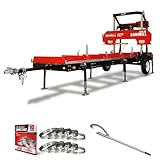


| Mill type | Typical log diameter | Typical maximum board width | Typical track length | Best suited to | Main trade-off |
|---|---|---|---|---|---|
| Compact manual portable mill | 16–24 in. | 12–20 in. | 8–12 ft. | Occasional milling, smaller logs, tight budgets | More hand work and limited capacity |
| Full-size manual portable mill | 26–36 in. | 20–30 in. | 10–16 ft. | Regular owner-operator use and varied timber | Large logs need careful loading and handling |
| Hydraulic or powered-handling portable mill | 30–40+ in. | 24–36+ in. | 12–20+ ft. | Frequent production, heavy logs, reduced manual handling | Higher purchase, transport, and maintenance demands |
| Stationary sawmill | Model-dependent; often 30 in. and up | Model-dependent; often 24 in. and up | Expandable or fixed bed | A dedicated milling site and repeat production | Needs space, a prepared foundation, and suitable log handling |
These are broad equipment categories, not guarantees of cut size. A mill’s advertised log diameter may differ from its maximum cutting width: bunks, clamps, and the saw head all affect the usable opening. Also check whether quoted bed length includes the space needed to position the saw head at the end of a log.
Choose by the timber and the work
- Mostly small logs and occasional projects: A compact manual mill is easier to transport and less costly to store. Confirm that its board-width limit leaves room to square a log and recover useful lumber.
- Mixed species and regular milling: A full-size manual mill offers more room to handle larger logs without the expense and complexity of hydraulic equipment. It makes sense when you can safely load logs and do not need to maximize daily output.
- Large hardwoods or frequent production: Consider powered log loading, turning, and clamping. These features can reduce strenuous handling and speed repeated cuts, but they add components that need maintenance and may require a larger trailer or dedicated work area.
- Little room at home, but access to timber: A portable mill can travel to the logs, potentially avoiding the need to move heavy logs. Check total transport weight, towing requirements, track assembly, and how level the milling site must be.
- A permanent, high-volume operation: A stationary mill may be more practical if the site has room for log storage, lumber stacking, and safe material flow. Include the cost and effort of preparing the site in your decision.
What to look for beyond the capacity number
Cut width, length, and usable lumber
Start with the largest finished boards you actually need. A wider advertised cut is useful for slabs and wide furniture stock, but it can require larger logs, more careful handling, and additional drying space. For long timbers, compare bed length and ask whether extension sections are available. Extensions add capacity, but every joint must be aligned and secured to keep the saw head traveling smoothly.
Portability and setup
“Portable” does not mean effortless to move or set up. Compare the mill’s total weight, trailer design, loading method, and the number of track sections. A short track is easier to place but may limit the length of lumber; a longer track takes more space and time to level. On uneven ground, the bed must be supported and aligned before cutting. A twisted or sagging track can cause inconsistent board thickness even when the blade is sharp.
Power and feed method
Gas-powered mills can work away from an electrical supply, while electric models may be quieter at the cutting station and require suitable power access. Match the engine or motor to the manufacturer’s recommendations and the timber you expect to cut. Feed can be manual, assisted, or powered. Powered feed is most valuable when production is frequent; for a few logs a season, a simpler setup may be easier to own.
Work out whether powered handling pays
Estimate your annual milling volume before paying extra for hydraulics. For example, if powered handling saves an assumed 12 minutes per log and you mill 50 logs a year, the time saved is 600 minutes, or 10 hours annually. At 100 logs, that becomes 20 hours. This is a planning estimate, not a promised performance figure: log shape, species, loading equipment, and operator experience change the result. Compare the value of that time with the added purchase cost, maintenance, and transport demands.
Ownership: blades, alignment, and wear
Blades are routine consumables. Their useful life depends on species, dirt, knots, feed rate, blade tension, and sharpening quality. A blade that dulls quickly may be cutting through bark and grit, running with poor tension, or being pushed too fast. Keep a cleaning tool nearby and remove loose dirt from logs before cutting; grit is especially hard on teeth.
- Check blade tension and guides: Follow the manual and inspect before milling. Incorrect tension or guide alignment can lead to wandering cuts and premature blade wear.
- Keep the bed clean: Sawdust and chips under bunks or around the head can interfere with log seating and accurate movement.
- Inspect drive components: Belts, bearings, wheels, and hydraulic hoses are wear items. Look for cracking, unusual play, leaks, or vibration on the schedule specified by the manufacturer.
- Store and transport carefully: Protect blades from corrosion and avoid jolting the mill out of alignment. Recheck the track and saw head after moving or extending the bed.
- Budget for sharpening: Compare local sharpening access, blade availability, and the cost of keeping spare blades on hand. A low initial price can be less attractive if consumables are difficult to source.
One common mistake is buying for a rare maximum-size log and overlooking the typical workload. Another is focusing only on engine power while ignoring how logs will be loaded, turned, and secured. Safe handling equipment, stable supports, and a clear work area matter as much as the saw itself.
Which band saw mill is the best fit?
For occasional milling, choose the simplest portable mill that comfortably fits your common log diameter and desired board width. For a varied supply of timber, a full-size manual portable model is often the most balanced choice. For regular production or heavy logs, prioritize log-handling features and support availability over headline capacity alone. If milling is a permanent business activity, compare stationary mills and include site preparation, lumber storage, and material handling in the total cost.
Searches for “best saw mills band saws” often mix up the saw type with the whole milling system. The right purchase is not just a powerful band saw: it is a compatible head, bed, loading method, blades, and maintenance plan matched to your logs and annual volume.