
What's inside
- Horizontal vs. Vertical vs. Portable: Which Design Fits Your Work
- Capacity and Specs Compared: What the Numbers Mean
- Speed Control and Blade Options Are More Important Than Horsepower
- Decision Matrix: Pick by Your Situation
- Worked Calculation: Blade Cost Per Cut
- Durability and Ownership Realities
- How to Set Up for a Square Cut
- Frequently Asked Questions
- Related Guides
As an Amazon Associate I earn from qualifying purchases. This post may contain affiliate links at no extra cost to you.
The best band saw for cutting metal for most small shops is a 7×12 horizontal swivel-head saw with variable blade speed between 85 and 270 FPM and a 3/4-inch bi-metal blade, because it handles common stock sizes like 4-inch round and 6-inch angle without the capacity limits of a portable model or the footprint of an industrial vertical saw.
As an Amazon Associate we earn from qualifying purchases at no extra cost to you.



Horizontal vs. Vertical vs. Portable: Which Design Fits Your Work
Choosing a metal cutting band saw starts with design, not brand. Each type cuts differently and suits different stock handling needs.
Horizontal Band Saws
Horizontal saws hold the workpiece stationary in a vise while the bow pivots down. Gravity and hydraulic feed control the cut, which makes them ideal for cutting solid bar, tubing, and structural shapes to length. They excel at repetitive 90-degree and miter cuts and can often run semi-unattended. For most buyers cutting steel, aluminum, and stainless stock under 7 inches, a horizontal model is the most versatile.
Vertical Band Saws
Vertical saws work like a wood band saw turned for metal, with the blade running vertically through a table. You feed the material by hand to make contours, curves, notches, and internal cuts. They are essential for fabrication, plate work, and pattern cutting, but they are slower for straight cutoff work and require more operator skill to keep cuts square. Look for models with a built-in blade welder if you need to cut interior profiles.
Portable Deep-Cut Band Saws
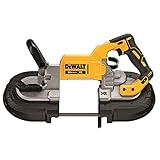
Portable or handheld band saws are carried to the work. They are indispensable for field work, plumbing, electrical, and cutting installed pipe, angle, or threaded rod. Their capacity is limited to roughly 5 inches, and they cannot match the squareness or consistency of a vise-held horizontal saw for shop production. Many shops own both: a portable for onsite and a stationary horizontal for bulk cutting.
Capacity and Specs Compared: What the Numbers Mean
Capacity is listed as two numbers, like 7×12. The first is throat/height, the maximum diameter of round stock at 90 degrees. The second is width at 90 degrees. Miter capacity drops significantly at 45 degrees, which is where undersized saws frustrate buyers.
| Model (Type) | Capacity at 90 deg (Round / Rect.) | Capacity at 45 deg (Round) | Blade Size | Speed Range | Motor / Weight |
|---|---|---|---|---|---|
| Milwaukee 6232-21 (Portable Deep-Cut) | 5 in. round | N/A (handheld angle) | 44-7/8 in. x 1/2 in. x 0.020 in. | Single speed ~380 FPM | 11.0A AC/DC / 14.5 lbs |
| WEN 3970 (Benchtop Horizontal 4×6) | 4-1/2 in. round / 4 x 6 in. rect. | ~3 in. round | 64-1/2 in. x 1/2 in. x 0.025 in. | 3-speed: 80, 120, 200 FPM | 3.5A (1/3 HP) / 72 lbs |
| Grizzly G0622 (Horizontal/Vertical 6×10) | 6 in. round / 6 x 10 in. rect. | 4-1/2 in. round | 98 in. x 3/4 in. x 0.035 in. | Variable: 85 – 275 FPM | 1 HP / 440 lbs |
| JET HVBS-712D (Horizontal Swivel 7×12) | 7 in. round / 7 x 12 in. rect. | 5 in. round | 93 in. x 3/4 in. x 0.032 in. | Variable: 82 – 265 FPM | 1 HP / 573 lbs |
| Ellis 1600 (Horizontal Mitre) | 10 in. round / 10 x 16 in. rect. | 6-1/2 in. round | 124 in. x 1 in. x 0.035 in. | Variable: 45 – 330 FPM | 1 HP / 555 lbs |
Takeaway: A 4×6 benchtop saw handles 2-inch square tube and 3-inch solid round easily but struggles with 4-inch angle or 5-inch channel at an angle. If you regularly cut 4-inch angle iron, trailer frame, or 6-inch flat bar on the diagonal, you need a 7-inch class machine to avoid turning the stock or making two cuts.
Speed Control and Blade Options Are More Important Than Horsepower
Metal cutting requires much slower blade speeds than wood. Running too fast overheats teeth and strips them. Variable speed lets you match surface feet per minute to the material.
- Steel (mild/low carbon): 150-220 FPM with bi-metal blade
- Tool steel / Stainless: 80-120 FPM with slower feed
- Aluminum / Brass / Copper: 250-300+ FPM, can use coarser teeth
- Thin-wall tubing (under 1/8 in. wall): 120-180 FPM with fine tooth pitch to keep 3 teeth in the cut
Single-speed portable saws are typically set around 380 FPM for general steel. That is fine for thin conduit and Strut but too fast for stainless or thick solid stock, which will dull blades quickly. A 3-speed or variable frequency drive model pays for itself in blade life if you cut mixed metals.
Blade TPI Rules for Metal
For a metal cutting band saw, use bi-metal M42 blades for steel and carbide-tipped blades only for high-production or abrasive materials. Tooth pitch is chosen by material thickness, not just material type.
| Material Thickness / Form | Recommended TPI | Why |
|---|---|---|
| Solid round over 3 in. | 5/8 or 4/6 variable | Large gullet clears chips, fewer teeth reduce heat |
| 1/4 in. to 1 in. wall / plate | 8/12 or 10/14 variable | Balance of cut speed and finish, 6-12 teeth in cut |
| Thin tubing, angle under 1/8 in. | 14/18 or 18 TPI | At least 3 teeth must contact the wall to avoid tooth strippage |
| Structural shapes (mixed thickness) | 8/12 variable pitch | Variable pitch dampens vibration on intermittent cuts |
Variable-pitch blades (like 5/8, 8/12) are quieter and last longer on a shop saw that sees mixed stock. Use a dedicated coarse blade for solids and a fine blade for thin-wall to double blade life, rather than running one compromise blade for everything.
Decision Matrix: Pick by Your Situation
| Your Situation | Best Fit | Reason |
|---|---|---|
| Garage shop, limited space, cutting under 4 in. steel a few times per month, budget under $600 | 4×6 benchtop horizontal/vertical (e.g., WEN 3970 type) | Lightweight, runs on 120V, converts to vertical for notches |
| Small fabrication shop, cutting 4-7 in. tube, plate, and mitering angle weekly on 120V | 7×12 swivel-head horizontal (e.g., JET HVBS-712D or Grizzly 7×12 class) | True miter capacity, variable speed extends blade life, handles stock you cannot turn |
| Field service, contractor, or maintenance – cutting installed pipe and metal on site | Portable deep-cut band saw (e.g., Milwaukee 6232-21 or DeWalt DWM120 type) | One-handed operation, cuts in place, no vise needed |
| High-volume shop cutting stainless, tool steel, or 8 in.+ solids daily | Industrial horizontal with 1 in. blade and hydraulic downfeed (e.g., Ellis 1600 class) | Wider blade resists deflection, low-end speed down to 45 FPM prevents work hardening |
| Plate fabrication, curves, and custom brackets | Vertical metal-cutting band saw (e.g., Jet J-8203K or Kalamazoo type) | Table feed for contour work, ability to cut inside radii |
Worked Calculation: Blade Cost Per Cut
Blade cost matters more than saw price over time. Here is how to estimate it:
A quality 93-inch x 3/4-inch M42 bi-metal blade for a 7×12 saw typically falls in the $35 to $55 range. On mild steel with correct speed and feed, expect 120 to 200 cuts through 4-inch x 1/4-inch wall square tube before teeth dull. On thin-wall tubing with correct 14/18 TPI, life is similar; on stainless at low speed, life may be 60-90 cuts.
Example: $45 blade / 150 average cuts = $0.30 per cut. If you cut 30 pieces a week, that is $9.00 per week in consumables. A $45 carbide-tipped blade might last 400+ cuts in aluminum but will chip on steel if feed is too aggressive, raising cost per cut to $0.50 or more if misused. Using coolant and proper break-in (run first 15 minutes at 50% feed rate) typically adds 25-40% more cuts per blade.
Durability and Ownership Realities
Metal band saws are low-maintenance, but a few items determine long-term accuracy.
- What wears first: Blade guide bearings and carbide pads wear before anything else. A loose guide allows blade twist and crooked cuts. Check for play every 40 hours and replace bearings when you hear squealing or see uneven tooth wear on one side.
- Vise and ways: Chips embedded in the vise bed lift stock and cause angled cuts. Brush the vise after every cut and wipe ways weekly. On 4×6 saws, the cast vise base can flex if you overtighten; snug is enough to hold without moving the jaw.
- Coolant: Flood coolant doubles blade life on steel over 1/2-inch thick and prevents chip welding. If your saw has no coolant system (many benchtop models), use a stick wax or spray mist for thick cuts and avoid cutting stainless dry.
- Blade tension and break-in: Over-tensioning cracks blades at the gullet; under-tensioning causes wandering. Follow the saw’s tension gauge and release tension overnight on stationary saws to preserve blade and wheel tires. Always break in a new blade at reduced feed.
- Common mistakes: Cutting thin-wall tube with a coarse 6 TPI blade strips teeth instantly. Dropping the bow too fast on a horizontal saw hardens the material and dulls the blade in one cut. Feeding too slowly on aluminum clogs gullets. Let the hydraulic cylinder control descent rather than forcing it.
Weight is durability. A 70-lb benchtop saw will vibrate more on heavy stock than a 500-lb 7×12 saw with a cast iron bow. If your cuts must be square within 1/32 inch over 6 inches for welding, the heavier frame holds tolerance longer.
How to Set Up for a Square Cut
Most out-of-square cuts come from setup, not the saw itself.
- Verify blade is square to the vise with a machinist square after installing a new blade, not just to the table.
- Adjust guide arms as close to the stock as possible, ideally within 1/4 inch on each side, to reduce blade deflection.
- Set downfeed so chips are small, curled, and not blue. Blue chips mean speed is too high or feed is too light and you are work-hardening.
- Support long stock with a roller stand at vise height to prevent the piece from dropping and binding the blade at the end of the cut.
Frequently Asked Questions
Can I cut metal on a wood band saw?
No. Wood saws run at 2,500 to 3,000 FPM, more than 10 times too fast for steel. The blade will overheat, lose teeth, and create a hazard. Metal-cutting saws use geared reduction to run under 300 FPM and have stronger guides for metal cutting forces.
Do I need coolant on a metal cutting band saw?
For aluminum and thin mild steel under 1/4 inch, you can cut dry with wax. For solids, thick wall, or stainless, flood coolant or at minimum a mist system significantly improves blade life and finish. Dry cutting stainless will work-harden the cut and destroy bi-metal teeth.
What size saw do I need for 45-degree miters?
Check the 45-degree capacity, not the 90-degree rating. A saw rated 7×12 at 90 degrees often drops to 5 inches round at 45 degrees. If you regularly cut 4-inch tube at 45 degrees, choose a saw rated at least 5-1/2 inches at 45 degrees to leave clearance.